
US Midterms Unlikely to be a Game Changer for Thailand, says KKP Economist


KKP’s chief economist expects a divided Congress to raise US shutdown risks but not derail Thai markets, as 2.5% growth masks a lopsided recovery
- KKP's chief economist believes the US midterm elections will not be a "game changer" for Thailand, as markets have already anticipated a divided US Congress.
- A divided Congress is expected to increase the risk of US government shutdowns, but the short-term effect on Thai markets is predicted to be limited.
- The ongoing trade war is unlikely to end as a result of the election, because tariffs are imposed through executive power rather than new legislation.
- The primary impact on Thailand would be indirect, through shifts in global investor sentiment that could cause capital to flow out of all emerging markets.
- The economist suggests that domestic factors, such as Thailand's lopsided "K-shaped" economic recovery, are a more significant concern than the US election results.
KKP’s chief economist expects a divided Congress to raise US shutdown risks but not derail Thai markets, as 2.5% growth masks a lopsided recovery.
The US midterm elections are unlikely to be a “game changer” for Thailand, though a weaker Republican grip on Congress could unsettle global sentiment and make life harder for emerging markets, according to Pipat Luengnaruemitchai, chief economist at KKP Research.
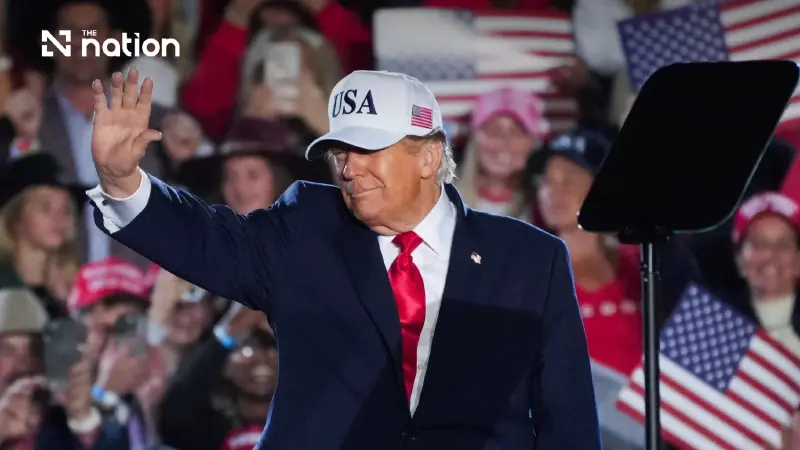
Speaking ahead of the vote on Monday (November 2), Pipat said markets had largely priced in the likelihood that President Donald Trump’s Republican Party would lose control of the House of Representatives. The real surprise, he said, would be a Republican sweep.
Limited legislative power
Pipat noted that US laws must pass both chambers of Congress before being signed by the president. Without a congressional majority, Trump would lose much of his ability to legislate for the final two years of his term.
His main legislative achievement, the sweeping tax-cut package, would not have been possible without Republican control of both chambers. He identified several consequences.
First, the risk of US government shutdowns and debt-ceiling standoffs would return, as budgets become harder to pass, as they were under Barack Obama and Joe Biden.
Second, large-scale military action would become harder. The president can order limited operations, but a formal declaration of war requires congressional approval, which makes fears of a ground invasion or full-scale war improbable.
Third, Trump would be forced to rely more heavily on executive power. That does not mean the trade war would end, Pipat said.
Tariffs so far have been imposed through agencies such as the US Trade Representative and provisions such as Section 301, rather than new legislation.
Washington is expected to keep using its tariff threats to press countries to sign reciprocal trade agreements, though it remains unclear how many will be concluded.
He added that the prospect of impeachment could also emerge if Republicans lose both chambers. Previously, Trump had operated with few constraints, but that could change.
Even so, Pipat suggested investors were not overly worried. Most presidents, he noted, push through their agenda in the first two years, and a president without a legislative majority tends to attempt little that is dramatic.
Areas to watch include trade agreements and the regulation of artificial intelligence, which could be pursued through executive action. Anything requiring legislation will be harder.
Europe’s political strains
Turning to Europe, Pipat said developments there did not directly affect Thailand. Investors’ concerns had shifted from smaller economies such as Greece and Portugal, which have improved their finances, to large ones such as France and Italy, where the problem is more political than economic.
Voters want better public services, while bond investors demand spending cuts, and governments facing elections within months are reluctant to cut. Credit rating agencies have not downgraded France, he noted, because default is not seen as a risk. The more likely consequence is rising bond yields, which could dent confidence and growth.

For Thai capital markets, the main channel is sentiment. Equity markets, he said, want strong growth and low interest rates, but the world is facing the opposite combination of rising yields and a slowing economy.
That could prompt investors to de-risk, pulling money out of emerging markets as well. The Nasdaq’s fall of more than 2 per cent last Friday illustrated the nervousness. Such outflows would affect all countries, he said, not Thailand alone.
A K-shaped economy
On Thailand’s economy, Pipat said KKP forecasts growth of about 2.5 per cent this year, but the pattern is distinctly K-shaped. Exports and AI-related capital spending are booming, with exports growing 18 per cent and investment jumping, according to the latest Bank of Thailand data.
However, these sectors rely heavily on imported inputs. Imports are growing faster than exports, and Thailand is beginning to run a trade deficit. Meanwhile, major industries including automobiles, petrochemicals, electrical appliances, construction, property and tourism remain under pressure.
“The upper leg of the K is growing, while the lower leg is struggling,” Pipat said, adding that headline figures therefore overstate the experience of most people.
His greatest concern is that domestic consumption is slowing.
Investment outlook
Pipat said KKP’s target for the benchmark SET Index stands at 1,680 and is under review as the firm prepares its 2027 forecast. He stressed that listed companies’ earnings were the key variable. Apart from the petrochemicals sector, profit upgrades have been limited.
With concerns growing about the durability of AI-related spending, he suggested investors favour safer sectors, such as banks, which have strong capital positions, as well as healthcare and food and beverages, which he described as the bread and butter of the Thai economy.
KKP’s model portfolio, however, has held no Thai equities for about three years, favouring global equities, with the US the largest holding. Pipat cited the limited choice in the Thai market and the lack of a strong growth driver.
On asset allocation, he said investors should “stay invested” but avoid overweight positions for now, preferring a neutral stance. Yields on some overseas fixed-income assets, such as US bonds at around 5 per cent, have become more attractive, and higher returns are available elsewhere for those willing to bear currency risk.
Gold, he said, should not be held for speculation but as a hedge against long-term inflation, with an allocation of around 2 to 5 per cent. He cautioned that gold tends to struggle while interest rates are rising and would recover once rates peak and begin to fall, since it pays no interest.
Asked about the impact of any further US shutdown, Pipat said the market had seen it repeatedly and the short-term effect would be limited.
