
Toyota expands in Vietnam while Thailand remains key production base
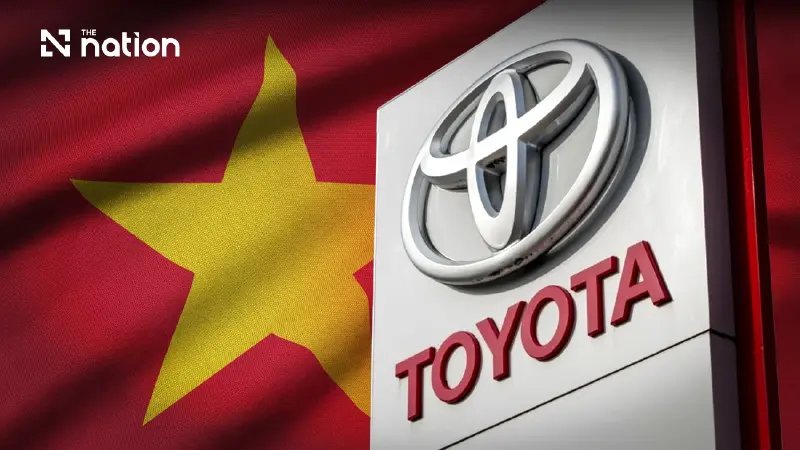


Toyota’s US$283m Vietnam expansion adds electrified vehicle capacity but does not indicate relocation from the much larger Thai production base
- Toyota is investing over US$283 million to expand and modernize its operations in Vietnam, adding an annual production capacity of 52,000 vehicles, including electrified models.
- This move is a diversification of its manufacturing network, not a relocation, as no Thai factories are being closed or moved to Vietnam.
- Thailand remains Toyota's key regional production and export base, with a combined annual capacity of 770,000 vehicles, which is nearly 15 times larger than Vietnam's expanded capacity.
- Toyota is also reinforcing its commitment to Thailand with a separate, much larger planned investment to upgrade its Thai production lines for hybrid vehicles.
Toyota Motor Vietnam’s investment of more than US$283 million, or about THB9.3 billion, has prompted claims that the Japanese automaker is moving production from Thailand to Vietnam, but the disclosed project and production figures do not support that interpretation.
The Vietnamese project expands and modernises Toyota’s existing operations in Phu Tho Province. It does not involve the announced closure of any Thai factory or the transfer of an existing Thai production line to Vietnam.
Instead, the investment indicates that Toyota is broadening its manufacturing network in Southeast Asia while retaining Thailand as a substantially larger production and export base.
Vietnam project adds electrified vehicle capacity
Toyota Motor Vietnam received an adjusted investment policy decision from the People’s Committee of Phu Tho Province and its 12th amended investment registration certificate from the provincial Department of Finance.
The revised project covers vehicle and automotive-parts assembly and production, warranty and repair services, and the import of completely built-up vehicles. Its expanded scope includes electrified vehicles and associated components.
The project covers 28.6 hectares and has registered annual production and assembly capacity of about 52,000 vehicles. This figure applies to the overall project, including electrified models, rather than representing annual production of 52,000 electric vehicles alone.

Toyota plans to begin constructing a paint shop and stamping plant in May 2027. The facilities will use modern technology and increased automation to strengthen production capabilities, maintain quality and improve energy efficiency.
Both facilities are expected to begin operating in 2029, laying the groundwork for new completely knocked-down, or CKD, models produced locally in Vietnam.
Thai production remains considerably larger
Toyota Motor Thailand operates three factories at Samrong, Gateway and Ban Pho, with combined annual production capacity of 770,000 vehicles. Samrong can produce 240,000 vehicles annually, Gateway 300,000 and Ban Pho 230,000.
In 2025, Toyota produced 564,933 vehicles in Thailand, an increase of 5% from the previous year. It exported 358,135 completed vehicles, up 6%, demonstrating Thailand’s continuing importance as an export-oriented production base.
Toyota Vietnam, by comparison, produced 25,200 vehicles in 2025. Its official annual results also showed that the company sold 74,206 Toyota and Lexus vehicles during the year.
The figures show a clear difference in scale. Vietnam’s project capacity of about 52,000 vehicles is less than one-fifteenth of Toyota’s installed annual capacity in Thailand, while its 2025 production was less than one-twentieth of the Thai total.
Toyota has also been reported as planning to invest more than THB55 billion over five years to upgrade production lines in Thailand for hybrid vehicles, nearly six times the value of the latest Vietnamese project. The plan has been cited as evidence of Toyota’s continued commitment to Thai manufacturing.
Investment competition moves to next-generation vehicles
The more significant question is therefore not whether Toyota is immediately abandoning Thailand, but how the company will distribute new investment and future vehicle models across ASEAN.
Thailand retains substantial advantages from its established automotive supply chain, skilled workforce, export infrastructure and expertise in pickup production, including the Toyota Hilux.
Vietnam, meanwhile, offers a large and expanding domestic market that gives automakers an incentive to increase local production, particularly for hybrid and other electrified vehicles.
Toyota’s latest investment suggests that Vietnam is gaining a larger role within the company’s regional manufacturing network. That does not diminish Thailand’s existing scale, but it increases competition for future production lines and next-generation models.
Thailand’s longer-term challenge will be to remain competitive in technology, production costs, government incentives, supply-chain capabilities and export access as the automotive industry moves towards hybrid and electric vehicles.
The current picture is therefore one of production diversification rather than relocation. Thailand remains Toyota’s much larger manufacturing and export base, while Vietnam is emerging as a stronger competitor for future automotive investment.
