
Toyota’s Vietnam expansion exposes Thailand’s EV-era investment challenge
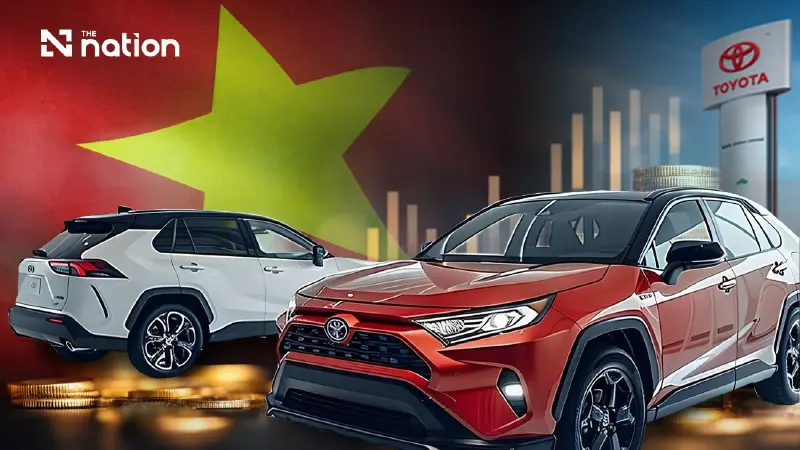


Toyota’s Vietnam investment is not a production shift from Thailand but highlights the race for new automotive investment in the EV transition.
Toyota’s planned investment expansion in Vietnam has reignited concerns over Thailand’s future as a regional automotive production hub, but industry sources say the move reflects a broader shift in ASEAN manufacturing strategy rather than a withdrawal from Thailand.
Toyota has announced additional investment of more than US$283 million (around 9.3 billion baht) in Vietnam, prompting renewed attention on whether Thailand risks losing its position as a key production base.
However, private-sector industry sources said the investment should not be interpreted as Toyota moving production from Thailand to Vietnam. Instead, it reflects the company’s strategy of expanding its regional manufacturing network in response to market size, production costs and changing automotive trends.
The sources said Thailand’s real challenge is not retaining existing factories, but attracting the next wave of investment as the global automotive industry transitions from internal combustion engines (ICE) to hybrid and electric vehicles (EVs).
Thailand remains Toyota’s main production base
Toyota’s new project in Phu Tho province, Vietnam, aims to increase production capacity for vehicles and components while supporting future electric vehicle production.
The project will add production capacity of around 52,000 vehicles per year. Toyota also plans to invest more than US$360 million to upgrade its Vietnamese facilities and prepare for hybrid vehicle production.
Thailand, however, remains a significantly larger production base.
Toyota currently operates three factories in Thailand, located in Samut Prakan, Gateway City and Ban Pho, with combined production capacity of around 770,000 vehicles per year.
In 2025, Toyota produced 564,933 vehicles in Thailand and exported 358,135 vehicles, reinforcing the country’s role as a major regional manufacturing and export centre.
By comparison, Toyota Vietnam produced around 25,200 vehicles in 2025. Even after the planned expansion, Vietnam’s production capacity would remain around one-tenth of Toyota’s production scale in Thailand.
The sources said the figures show that Toyota is expanding its ASEAN production network rather than replacing Thailand with Vietnam.
Toyota also plans to invest around 55 billion baht in Thailand to expand hybrid vehicle production, a project worth almost six times more than its new Vietnam investment.
Competition shifts towards new investment
The sources said Thailand should focus less on whether existing factories will move and more on how to attract future automotive investment.
Thailand has built strong advantages through decades of automotive development, including a large supplier network, skilled workers, export infrastructure and expertise in pickup truck manufacturing, particularly Toyota Hilux production.
However, Thailand’s automotive base has already reached a mature stage. Expanding additional production capacity for overseas markets may become less attractive if manufacturing and logistics costs are higher than producing closer to customers.
Vietnam’s advantage comes partly from its domestic market of more than 100 million people, while Indonesia has a population of around 288 million in 2026, creating larger markets to support direct production.
The sources said manufacturers may increasingly choose countries where factories can serve domestic demand directly, with around 30-50% of production potentially sold locally and the remainder exported to nearby markets.
If overall production costs are similar to Thailand or lower, companies may have less incentive to expand capacity in Thailand.
Vietnam and Indonesia strengthen automotive ecosystems
The growing appeal of Vietnam and Indonesia is not only driven by market size but also by improvements in infrastructure, regulations and supply chains.
Both countries have developed their automotive capabilities significantly compared with the past, allowing them to attract more investment.
Vietnam has strengthened its supply chain in electronics and advanced technology, including chip manufacturing, battery production and technology investment from major companies.
As these supply networks expand, production efficiency can improve and costs can become more competitive.
The sources also said skilled labour is becoming less of a limitation, as multinational companies can recruit experienced engineers and Thai specialists to help establish operations in Vietnam and Indonesia.
The movement of skilled workers has been supported by geographical proximity, cultural similarities and attractive compensation packages.
The sources said some smaller factories with limited output and insufficient economies of scale could close as part of normal business adjustments.
However, this does not mean automakers will abandon Thailand, which still has a large industrial base and a mature supporting ecosystem.
EV transition is Thailand’s next industrial test
The long-term challenge for Japanese automakers is adapting to the shift from ICE vehicles to hybrid and EV technology.
Industry sources said Japanese manufacturers have moved more slowly into EVs compared with Chinese EV companies, which have expanded rapidly and created strong price competition.
The sources compared the situation with Kodak, saying companies with successful legacy businesses may face difficulties if they fail to adapt their structures and supply chains for new technologies.
For Thailand, the priority should be developing domestic capabilities rather than relying only on foreign investment.
The country needs to strengthen technology development, research capacity, skilled workers and supply chains to create greater value in future industries.
Government incentives, including measures from the Board of Investment (BOI), may help retain Japanese investment, but the sources said competition cannot be solved through tax benefits or subsidies alone.
Investment decisions increasingly depend on market size, costs, supply chain readiness and future business opportunities.
Toyota’s Vietnam expansion therefore does not necessarily signal Thailand losing its automotive position.
Instead, it highlights a new phase of ASEAN competition, where countries are competing not only to maintain existing factories but to secure the next generation of automotive investment in the EV era.
Source: Thansettakij
