
Japanese carmakers could gain from Thai three-tier EV tax plan
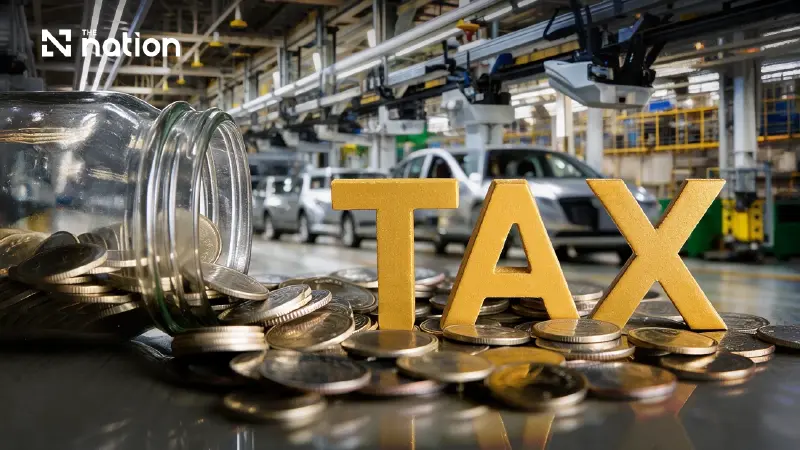


Japanese carmakers’ established Thai factories, supplier networks and hybrid expertise could become an advantage under a proposed three-tier electric vehicle (EV) tax overhaul.
- Japanese carmakers could benefit from their established Thai production networks and hybrid expertise under the proposed vehicle tax overhaul.
- The Finance Ministry plans to submit the three-tier excise proposal to Cabinet in September 2026; final rates remain subject to approval.
- Manufacturers’ eligibility would depend on domestic investment and local content, meaning Chinese companies producing in Thailand could also benefit.
Japanese carmakers could gain a competitive advantage from Thailand’s proposed three-tier vehicle tax overhaul, with their established factories, supplier networks and hybrid expertise positioning them to benefit from greater emphasis on domestic production. The overhaul, which the Finance Ministry plans to submit to Cabinet in September 2026, would confer advantages only if manufacturers meet the final local-content requirements and conditions for preferential tax treatment.
The proposed three-tier excise structure would link tax treatment to manufacturing investment and the use of locally produced parts, reserving the highest rate for businesses importing vehicles solely for sale without plans to establish a Thai production base. For Japanese manufacturers, the opportunity lies in making their existing industrial presence count more heavily in the competitive equation.
Japanese factories and hybrid expertise offer a potential advantage
Japanese manufacturers already have factories, supplier networks and experienced workforces in Thailand. Their strengths in hybrid technology could become particularly valuable because the proposed lowest tier would cover hybrid electric vehicles (HEVs) and plug-in hybrid electric vehicles (PHEVs), allowing established production capabilities to support the transition towards newer technologies.
Thansettakij cites continuing investment by Mitsubishi, Isuzu, Honda and Mazda totalling more than 50 billion baht as evidence that Japanese manufacturers still regard Thailand as an important production base. The proposed tax structure could reward that commitment, although an existing factory would not automatically qualify a company for the lowest rate.
The potential shift is significant when compared with the earlier incentive structure. Eligible Chinese electric vehicle (EV) imports have benefited from zero import duty under the ASEAN–China Free Trade Area (ACFTA), alongside low excise rates under the EV 3.0 and EV 3.5 programmes. Established manufacturers, particularly Japanese brands, have faced substantially higher carbon dioxide emissions-based excise rates on internal combustion engine (ICE) vehicles and hybrids, according to Thansettakij.

Many battery electric vehicles (BEVs) sold in Thailand have arrived as completely built-up (CBU) imports, particularly from China, while domestic vehicle production has declined. That mismatch has raised concerns for Thai component manufacturers, small and medium-sized enterprises (SMEs) and employment throughout the automotive supply chain.
A tax system that places greater weight on domestic value creation could therefore improve the relative position of manufacturers already embedded in Thailand’s industrial economy. The advantage would arise from what they produce and source locally, rather than from their nationality.
Three tax tiers would make investment the dividing line
The proposed structure would separate operators according to the scale of their investment and contribution to Thailand’s production base. The distinction is between businesses developing domestic manufacturing capacity, those moving towards it and those treating Thailand primarily as an import market.
- Tier 1 would carry the lowest rate for manufacturers producing in Thailand with sufficiently high local content or investing in key components such as batteries, motors and drive systems. Thansettakij cites an indicative range of 1–6%, not an approved rate. Coverage would extend to BEVs, hybrids, plug-in hybrids and fuel-cell electric vehicles.
- Tier 2 would apply to companies with Thai factories or investment plans that still need to import selected models to test the market. Operators would have to commit to establishing production lines and manufacturing locally to offset imports under specified quotas. Thansettakij cites an expected rate above 10%, but that figure has not been confirmed as government policy.
- Tier 3 would impose the highest rate on companies importing fully built vehicles for commercial sale without plans to invest in Thai manufacturing or supply-chain development.
The government intends to introduce Tier 3 first to slow imports that do not generate domestic investment. However, the exact rates and transition arrangements had not been settled in the policy announcement, leaving the final competitive impact dependent on the Cabinet proposal.
Stricter local-content rules would test Japanese manufacturers too
A planned overhaul of local-content calculations could prevent established manufacturers from relying on their factory presence alone. Thansettakij reports that operating expenses, labour costs and profits would be excluded, with greater emphasis instead placed on components supporting engines, motors and drive systems, together with research and development undertaken in Thailand.
For Japanese and Chinese manufacturers alike, an assembly operation dependent mainly on imported components might therefore be insufficient. Access to the lowest tax tier would be more closely tied to Thai-made parts, Thai materials and the development of domestic technological capabilities.
Thai suppliers and SMEs could gain if manufacturers respond by placing more orders for important components locally. Foreign suppliers seeking to retain their customers would also have stronger incentives to establish production facilities in Thailand. Those benefits, however, would depend on genuine changes in procurement and investment, rather than compliance on paper.
The design of the local-content test is consequently as important as the headline tax rate. A value-based percentage alone could still allow assembly operations to qualify without deeper manufacturing activity unless the authorities can verify component origins and actual domestic production.
Pressure for a tougher system is coming from 10 automotive and parts-industry associations, including the Electric Vehicle Association of Thailand (EVAT) and the Thai Auto-Parts Manufacturers Association (TAPMA). Their proposals include excise tax of at least 32% on imported CBU EVs, a CBU import ceiling equivalent to 10% of actual vehicle production in Thailand, and a local-content requirement of 80%. These remain industry demands rather than adopted rules.
The Federation of Thai Industries has proposed a CBU tax range of 32–50%. The Thai Chamber of Commerce supports taxation based on domestic economic benefits and wants clear local-content thresholds and import limits, together with protection for the existing manufacturing base and supply-chain SMEs. The common objective is to link access to Thailand’s vehicle market more closely to investment and production within the country.
Chinese manufacturers face different choices from import-only brands
Chinese carmakers with factories in Thailand could still qualify for Tier 1 or Tier 2. Their challenge would be to adjust purchasing and production arrangements to meet stricter local-content requirements, particularly for key components, rather than rely on semi-knocked-down assembly as a route to incentives.
Import-only operators would face a more difficult choice. Thansettakij cites estimates that higher taxes under Tier 3 could lift retail prices by around 25–30% for affected vehicles, although that is a scenario rather than an established outcome. Such businesses could face pressure to invest in Thai factories and supply chains or accept higher costs and the risk of losing market share.
The same investment test would affect Korean, US and European brands. Companies importing CBUs from countries without preferential free-trade treatment could face both import duties and the highest excise tier, widening their cost disadvantage against vehicles produced in Thailand.
Hyundai illustrates the importance of policy clarity for manufacturers weighing their production options. The final tax structure could influence its investment planning and establishment of an EV production base in Thailand. US and European brands could likewise improve their position by establishing or expanding Thai manufacturing and increasing local sourcing, rather than relying solely on imported vehicles.
Tesla provides a contrasting example. Thansettakij reports that the company has shelved manufacturing plans in Thailand and Southeast Asia in favour of Supercharger networks, showrooms and service centres, amid intense price competition from Chinese brands and slower investment in global production capacity.
The Tesla example illustrates the limits of relying on market growth alone to attract factories. Strong demand for EVs does not automatically produce manufacturing investment when costs, competitive pressures and investment incentives do not make local production sufficiently attractive.
Thailand must balance supplier gains against higher buyer costs
Consumers could bear part of the adjustment through higher prices, particularly for imported vehicles from brands without Thai production bases. Manufacturers changing their procurement arrangements could also face additional costs during the transition.
The potential return for Thailand would come through employment, supplier investment, skills development and technology transfer. A stronger domestic industrial presence could also reduce long-term risks involving service-centre coverage and spare-parts availability, although those gains would depend on investment actually materialising.
The policy would also need to meet Thailand’s international trade obligations. Distinguishing between manufacturers by investment rather than brand nationality would not, by itself, settle questions about discrimination between imported and domestic products. The government would need to design the measures carefully under World Trade Organization (WTO) rules and the General Agreement on Tariffs and Trade 1994 (GATT 1994) to limit the risk of trade disputes.
For Thailand, success would therefore mean more than higher vehicle sales or production totals. The relevant measures would include which components are manufactured domestically, how much Thai material is used, what technology is developed and how extensively investment supports the local supply chain.
Japanese carmakers could begin with an advantage because of the industrial networks they already have. Whether they retain it would depend on meeting the final requirements, while competitors that deepen their Thai production and sourcing could qualify alongside them. The decisive distinction would be between selling vehicles in Thailand and building more of the industry there.
Source: Thansettakij
