
Russia and Thailand Panel Calls for Joint Payment Sandbox to Bridge Trade Gap
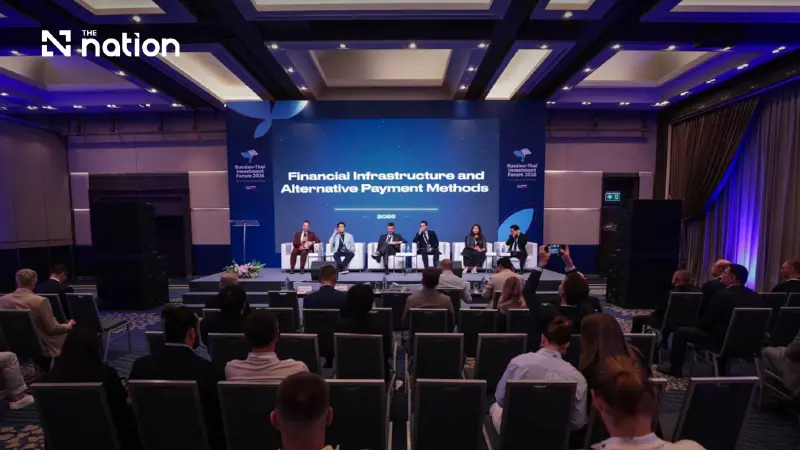


Bangkok forum hears bankers, officials and investors back a bilateral “safe harbour” sandbox, middle-layer links and stablecoin rails to ease payments
- A panel at the Russian-Thai Investment Forum called for a jointly supervised "safe harbour" regulatory sandbox to test new cross-border payment solutions and facilitate trade.
- The proposal addresses the inadequacy of current payment channels, which are struggling to handle the fast-growing bilateral trade and have high transaction costs of 5-8%.
- Instead of a complete overhaul, speakers suggested creating a "middle layer" to link existing national payment systems, such as Thailand's PromptPay and Russian networks.
- The use of digital assets, including stablecoins, was also proposed as a complementary method to ease payments, particularly through a "tourist sandbox" for visitors.
The Bangkok forum hears bankers, officials and investors back a bilateral “safe harbour” sandbox, middle-layer links and stablecoin rails to ease payments.
Russian and Thai bankers, regulators and investors agreed on Saturday that existing payment channels are no longer adequate for fast-growing bilateral trade.
Speaking at the Russian-Thai Investment Forum 2026, panellists called for a jointly supervised regulatory sandbox, links between national payment networks rather than a rebuild of them, and closer co-investment.
The recommendations came at a panel on Financial Infrastructure and Alternative Payment Methods, part of the business programme of the two-day forum, which runs on 30 and 31 October.

A “safe harbour” sandbox
The central proposal came from Dr Darmp Sukontasap of the International Institute for Trade and Development (ITD) at Thailand’s Ministry of Commerce.
He urged both sides to create a “safe harbour” sandbox in which paired Russian and Thai operators would test cross-border transactions, strictly within the compliance rules of both governments.
Dr Darmp said bilateral trade had reached almost $2 billion so far this year. Thailand’s trade deficit with Russia has hit about $400 million, double last year’s figure. The 130th anniversary of Thai-Russian friendship falls next year.
“The roads are there, the goods have been loaded on the trucks, but the bridge is not,” he said, adding that the three or four channels now in use were clearly not enough.
Digital finance, he said, is arriving faster than many expect.

Connect, do not overhaul
Several speakers said the practical answer was a neutral layer linking existing systems. Chotiphun Tiawivat, director of ASTRA Enterprise, argued that rebuilding a country’s payment infrastructure was impractical and politically fraught.
He proposed a standard “middle layer” between Thailand’s PromptPay and Russian networks.
Aung Ko Ko Oo, executive director of the Myanmar Digital Economy Association, drew on ASEAN’s experience. Differing anti-money-laundering and know-your-customer rules make full harmonisation difficult, he said, so the focus should be on interoperability and cyber-security.
Dr Kobsak Pootrakool of Bangkok Bank said Thai QR payments are already linked with Indonesia, Vietnam, Malaysia, Singapore, Laos, Hong Kong and China. He said Bangkok Bank is considering similar links with Russian systems.
Russia is Thailand’s fourth-largest tourist market, with about one million visitors expected this year. The bank has also trialled blockchain-backed letters of credit and digital trade documents with Indonesia, which he said reduced paperwork.

Digital assets as a complement
Speakers presented digital assets as a complement to bank transfers, not a replacement. Petr Zaselsky, chairman of the management board of Roseximbank, said cryptocurrencies, once seen as a curiosity, are now part of cross-border settlement, and Russian legislation has moved beyond the experimental stage.
He suggested that a trusted “friendly” stablecoin, possibly tied to BRICS partners, may eventually be needed as a neutral settlement unit.

Cost was a recurring theme. Thai fintech speakers said a good payment must deliver speed, trust and simplicity without sacrificing any of them. They put the global average cost of a transfer at about 6 per cent, while Russia–Thailand payments have cost 5 to 8 per cent.
Blockchain-based rails, they argued, could cut that sharply. Zaselsky said Roseximbank’s business-to-business platform fixes the exchange rate at the Central Bank of Russia’s official rate when a deal is agreed, so it offers no separate hedging tools.
Khenkin, the moderator, said the digital platform, which emerged from the central bank’s experimental legal regime, settles on the same day without third-party intermediaries.

Niorn Kiatdamrong of Bitkub Blockchain Technology described a proposed “tourist sandbox” for visitors who cannot easily open a Thai bank account.
A visitor sends stablecoins to a licensed Thai broker, who converts them into baht and credits an e-wallet. The visitor can then pay at PromptPay QR merchants nationwide.
Niorn said compliance and blockchain can coexist. Tether and Circle, she noted, had helped to freeze funds stolen in a recent hack, showing that centralised oversight can work alongside distributed technology.

Large corporates stay with banks
Dmitry Shestoperov of VTB Bank acknowledged that sanctions have made payment routes harder and partners more cautious. Large corporate clients, he said, still prefer traditional settlement for its predictability, documentation and paper trail.
Alternative instruments are useful but do not yet work at scale, he said, and VTB’s priority is to extend its existing international network.
Investment: closing the information gap
Evgeny Borisov, founding partner of Kama Flow, said Russian technology companies are valued at five to seven times below comparable international benchmarks.
He cited profitable, fast-growing firms priced at about four times EBITDA (earnings before interest, taxes, depreciation and amortisation). He blamed this on Russian founders’ reluctance to seek foreign capital and on Asian investors’ limited knowledge of Russian opportunities.
Entrepreneurs, he said, now spend more energy building financial workarounds than running their businesses. He proposed investor clubs linking private investors in Thailand, Asia and Russia to exchange deals and co-invest, with holding structures in third jurisdictions where capital cannot move directly.
He also said genuine localisation in Thailand, not merely a shell company, gives access to local banking and low borrowing costs. The moderator put Thailand’s benchmark rate at about 1 per cent, against a far higher Russian key rate. Borisov cautioned that Thai banks are conservative and the process can take years.
He cited medical diagnostics as a model, with Russian technology sold in Thailand and Thai endoscopic equipment reaching the Russian market. Most Russian investment in Thailand, he said, still goes into travel and property.

Property finance
Responding to an audience question on financing for foreign property buyers, Dr Kobsak said Thai rules require foreigners to bring in all purchase funds from abroad, a rule introduced over fears of a property bubble.
He said he was discussing changes with contacts at the central bank, including allowing foreigners who work in Thailand to borrow locally.
Next steps
Speakers said the 130th anniversary of Thai-Russian friendship offers political momentum for turning these ideas into practice.
The discussion pointed first to a supervised bilateral sandbox that would pair operators from both countries, alongside a standard layer linking PromptPay with Russian payment systems.
Panellists also backed stablecoin-to-QR channels for tourists and wider use of digital trade documents and blockchain-backed letters of credit.
Beyond payments, they argued that investor clubs and genuine localisation in Thailand could turn trade ties into lasting investment.
