
Krungthai, PTT and DCCE Back I-SPARK to Draw Private Capital to Low-Carbon Industry
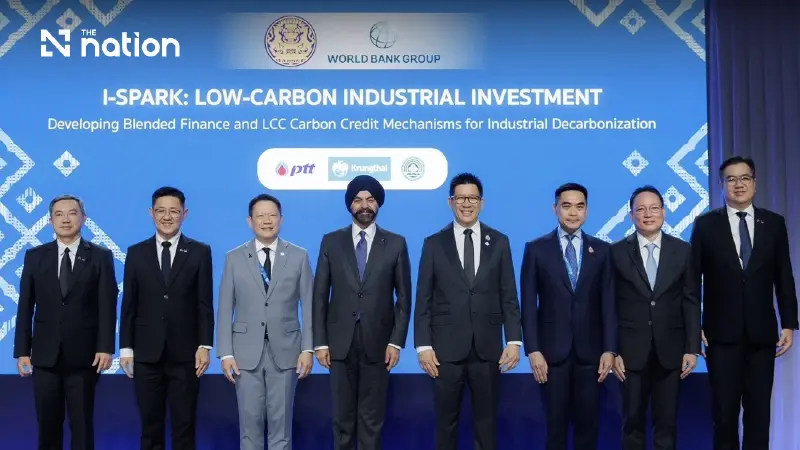


The three-way partnership aims to prepare Map Ta Phut–Rayong projects for private investment, with a possible link to World Bank-backed carbon finance
- Krungthai Bank, PTT, and the Department of Climate Change and Environment (DCCE) have formed a three-way partnership to back I-SPARK, an initiative aimed at decarbonizing industry in the Map Ta Phut–Rayong area.
- The primary goal of the collaboration is to prepare low-carbon projects for private-sector investment by making them more "bankable," potentially through blended finance and World Bank-backed carbon finance mechanisms.
- The I-SPARK initiative is expected to unlock over US$5 billion in potential private investment by 2035, create more than 13,000 jobs, and reduce greenhouse gas emissions by about 9 million tonnes annually.
- The platform will accelerate investment in specific low-carbon solutions such as carbon capture and storage (CCS), clean energy, and bio-circular value chains to enhance Thailand's competitiveness.
The three-way partnership aims to prepare Map Ta Phut–Rayong projects for private investment, with a possible link to World Bank-backed carbon finance.
Krungthai Bank, PTT Public Company Limited (PTT) and the Department of Climate Change and Environment (DCCE) have announced a collaboration to advance I-SPARK, a PTT-led initiative to decarbonise industrial investment. It aims to prepare low-carbon projects in the Map Ta Phut–Rayong area for private-sector investment, strengthen energy security and improve Thailand's competitiveness.
The announcement was made at a collaborative event between the Thai government, the World Bank Group and the Thai private sector, held during the 2026 IMF–World Bank Group Annual Meetings.
The theme was "Low Carbon Cities and Energy Security – Building System at Scale: Mobilising Private Capital, Creating Jobs". The partnership brings together industrial, financial and policy expertise.
I-SPARK is an area-based industrial decarbonisation platform within the Map Ta Phut–Rayong industrial ecosystem. It focuses on three strategic clusters: low-carbon energy and solutions, shared or common infrastructure, and specialty, bio and circularity.
The platform aims to accelerate investment in initiatives such as liquefied natural gas (LNG), carbon capture and storage (CCS), clean energy and bio-circular value chains.
By 2035, I-SPARK is expected to unlock more than US$5 billion in potential investment and create over 13,000 jobs. It is also expected to cut greenhouse gas emissions by about 9 million tonnes of carbon dioxide equivalent a year. The partners say it could serve as a scalable model for low-carbon industrial development across the country.
Next phase: carbon finance and blended funding
In the next phase, the three parties will explore integrating I-SPARK into the World Bank Group-supported Low Carbon Cities and Carbon Market Development Project (LCC). That would let eligible industrial projects use the LCC's carbon finance mechanisms.
They will also explore blended finance, which combines public or concessional funding with commercial capital, to make projects more bankable and mobilise private investment.
"I-SPARK reflects PTT Group's ambition to transform the Map Ta Phut–Rayong area into a competitive, low-carbon industrial ecosystem," said Buranin Rattanasombat, PTT's Chief New Business and Sustainability Officer. "By integrating our energy and industrial capabilities with clean energy solutions, emerging technologies and shared infrastructure, we aim to unlock new investment opportunities and accelerate industrial decarbonisation."
He added that the partnership with Krungthai and the DCCE "brings together industrial expertise, financial innovation and policy support to mobilise private capital, strengthen energy security, and enhance Thailand's long-term industrial competitiveness and sustainable growth".
Phirun Saiyasitpanich, Director-General of the DCCE, said Thailand's climate targets require coordinated action across government, industry and the financial sector.
"Collaboration under I-SPARK offers an important opportunity to align industrial investment with Thailand's evolving climate-policy framework," he said.
It would also explore pathways to the LCC so that eligible projects can access carbon finance, support credible emissions reductions and strengthen competitiveness while fostering sustainable growth.
Payong Srivanich, Chief Executive Officer of Krungthai Bank, said the bank is committed to being "a key enabler in mobilising capital towards low-carbon investment opportunities".
By combining its financial expertise with its partners' strengths, he said, the bank aims to help projects improve bankability. That would let businesses adapt, improve efficiency and build long-term resilience.
"Through I-SPARK, the bank is taking another important step in connecting public and private capital through carefully designed investment structures, while developing scalable approaches that can be expanded to other industrial sectors," he said.
Krungthai, he added, wants the transition to create business opportunities and jobs and strengthen competitiveness.
"By turning environmental goals into drivers of economic activity, we can support a new chapter of sustainable growth for the country."
Payong said the collaboration "reflects the translation of priorities highlighted during the IMF–World Bank Group Annual Meetings into practical action".
By linking industrial development with clean energy and resource efficiency, he said, the aim is to lay the foundation for Thailand to become a competitive low-carbon manufacturing hub that can attract future investment.
I-SPARK is the first of three Krungthai announcements made around the meetings. The LCC, the World Bank-backed project that I-SPARK may tap, is the subject of the second. It centres on a carbon credit market that would put a price on emissions cuts and connect projects with buyers.
