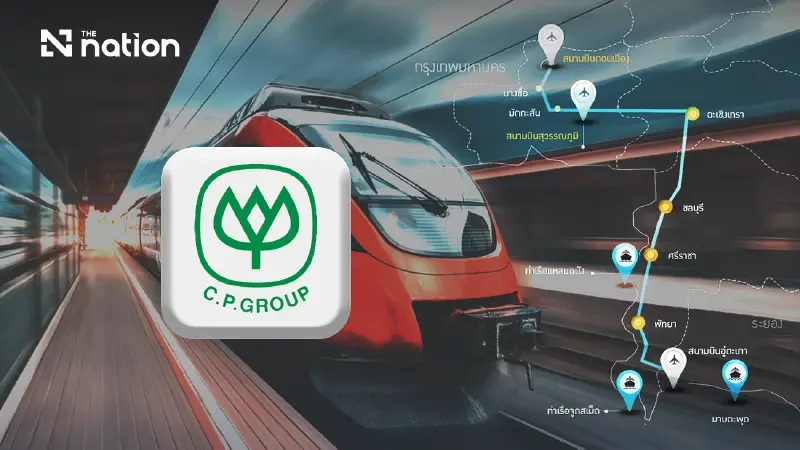
The high-speed rail project linking three airports — Don Mueang, Suvarnabhumi and U-Tapao — began its bidding process in 2018. The CP Group won the bid after seeking 117.226 billion baht in state co-investment, and the State Railway of Thailand (SRT) signed the contract with Asia Era One Co Ltd, in which CP Group is the major shareholder, on October 24, 2019
The Eastern Economic Corridor Office (EECO) will meet on July 15 to decide whether to amend the high-speed train contract with the CP Group or to terminate it.
The contract outlines five specific conditions that can be used as grounds for termination: the concession period expiring, failure to hand over land, a force majeure event, default by either party, or a change in government policy.
The project, linking three airports, has been stalled due to the pandemic and unresolved negotiations over contract amendments since it was signed in 2019.
If the contract is terminated, a new bidding process would be required, though the EECO has also proposed developing the existing double-track railway as an alternative.
The high-speed rail project linking three airports — Don Mueang, Suvarnabhumi and U-Tapao — began its bidding process in 2018. The CP Group won the bid after seeking 117.226 billion baht in state co-investment, and the State Railway of Thailand (SRT) signed the contract with Asia Era One Co Ltd, in which CP Group is the major shareholder, on October 24, 2019.
The Covid-19 pandemic later affected the project, prompting CP Group to seek relief measures. The Cabinet approved contract amendments to address the impact on October 19, 2021, before CP Group took over the management of the Airport Rail Link. However, negotiations on the contract amendments have dragged on and remain unresolved.
The Eastern Economic Corridor Office (EECO) has scheduled a meeting of the joint investment contract management committee on July 15, 2026, to consider possible solutions to be proposed to the Eastern Economic Corridor Policy Committee (EEC Policy Committee), chaired by Prime Minister Anutin Charnvirakul.
A source at the Transport Ministry said the discussion followed confirmation by a three-party working group, comprising the EECO, the SRT and Asia Era One Co Ltd, that two options would be proposed to the EEC Policy Committee in August 2026.
The first option is to amend the contract in line with the previous resolution of the EEC Policy Committee. If the committee approves this approach, the project will move forward under the conditions already discussed and in line with the draft contract amendment reviewed by the Office of the Attorney-General. The proposal would then be submitted to the Cabinet for approval of the revised principles and for authorisation to sign the joint investment contract amendment.
The second option is to end the contract. This would occur if the EEC Policy Committee considers that the contract cannot be amended in line with its previous resolution. In that case, the process would move to consideration of the grounds for contract termination, with the SRT and the private contracting party required to revisit the legal issues.
High-speed train vital to U-Tapao
The source said the high-speed rail project is important to the Eastern Economic Corridor, especially the U-Tapao airport and Eastern Aviation City project, which is intended to become an air travel hub. A transport system is therefore needed to link passenger travel and freight movement.
The U-Tapao airport development plan also includes a high-speed rail station connected to the passenger terminal to facilitate travel. The project is therefore considered necessary for development.
If the EEC Policy Committee decides to terminate the joint investment contract with CP Group, but the government’s policy position remains that the high-speed train is necessary to connect passenger and freight transport, a new bidding process would have to be launched. If this path is chosen, it would be necessary to study a public-private partnership, or PPP, model that would be attractive for investment, worthwhile for investors and would not cause the government to lose out.
Current PPP models come in several forms
The first is PPP Net Cost, under which the public sector is responsible for investment in civil works and system works, while the private sector is responsible for train operations and maintenance and receives the right to collect revenue.
The second is PPP Gross Cost, under which the public sector invests in civil works, while the private sector invests in system works and rolling stock. The private sector collects revenue on behalf of the state and receives remuneration based on service quality.
The third is Modified Gross Cost, under which the public sector invests in civil works, while the private sector invests in system works, procures rolling stock and operates the trains, while remitting all revenue to the public sector. The private sector receives fixed remuneration, as well as additional remuneration if operating revenue exceeds a specified threshold.
New bidding process expected
The source said it was believed that the high-speed rail project still needed to be developed because the aviation city is a major investment project that requires a transport system to connect passengers and freight. The private sector investor developing the aviation city has also conducted roadshows to attract investors on the condition that a high-speed train will be in place.
The source therefore believed that the project would ultimately have to be put out to tender again, although the conditions would have to be considered.
As for development after the contract with CP Group is terminated, the government cannot call the second-ranked bidder, the BSR Joint Venture — comprising BTS Group Holdings Plc, Sino-Thai Engineering and Construction Plc and Ratchaburi Electricity Generating Holding Plc — back for negotiations.
“The bidding process in 2018 has already ended. In addition, BSR’s proposal no longer corresponds to the current investment situation,” the source said.
Regarding CP Group’s proposal that the contract would need to be terminated if the joint investment contract could not be amended, the source confirmed that this can be done under the joint investment contract. The contract states that if a contracting party is unable to comply with the agreement and there are grounds preventing the project from proceeding, this constitutes grounds for termination. Any investment made or opportunity lost by either contracting party would be a matter for the legal process to consider and for negotiation procedures to follow.
The contract sets out five conditions that can be used in negotiations leading to grounds for termination:
Termination when the 50-year concession period expires.
Failure by the SRT to properly hand over land, preventing the issuance of the notice to proceed, or NTP.
A force majeure event affecting the project.
A default caused by the private contracting party or the public sector.
A change in government policy.
EECO says double-track railway can be developed instead
Chula Sukmanop, secretary-general of the EECO, told "Bangkokbiznews" that if the EEC Policy Committee chooses to terminate the joint investment contract with CP Group, the EECO confirms that there is still no proposal to open a new tender, as the original investment model is not attractive to investors. In addition, a new bidding process would take up to two years, further delaying the EEC rail network.
“The best approach now is to make use of what already exists by developing double-track rail and linking railway routes more efficiently. This means accelerating the Red Line suburban railway project on the Bang Sue–Phaya Thai–Makkasan–Hua Mak section and the Bang Sue–Hua Lamphong section, or Missing Link, so they can connect with the Airport Rail Link, which would link travel from Don Mueang to Suvarnabhumi and U-Tapao,” he said.
Chula said the SRT already has the eastern double-track railway alignment. The EECO therefore believes the 120 billion baht earmarked for the high-speed train should be used to accelerate the development of the eastern railway line to make it more efficient, linking travel with the Red Line electric railway, which has a maximum speed of 160 kilometres per hour, before developing train routes connecting the double-track railway into the EEC.
The EECO insists that the appropriate approach at present is to make more efficient use of the existing rail network, because rail transport demand in the EEC may not currently require investment in a high-speed train. Instead, a rail system capable of a maximum speed of 160 kilometres per hour could be used.
The EECO will also discuss with the SRT the need to accelerate investment in the Red Line Missing Link, as well as upgrading the double-track railway to support operations. Once the rail infrastructure is ready, the system could be opened for private operators to share track access, or Open Access, to provide railway services that meet EEC demand.
CP has already invested 12 billion baht
Suphachai Chearavanont, senior vice-chairman of Charoen Pokphand Group, said CP remains committed to jointly developing the high-speed rail project linking the three airports because it is a key piece of infrastructure that would strengthen the country’s competitiveness. He said CP has already invested 12 billion baht and is ready to discuss with the government an appropriate approach that would deliver the greatest benefit to the country under the principles of public-private partnership.
Suphachai said that although the railway business is not CP’s core business, the group joined the bidding after the government opened the way for the private sector to participate in infrastructure development. CP did so with confidence that the project would be an important mechanism for upgrading the transport system linking major airports, supporting the EEC and increasing the country’s competitiveness.
“If we had not been confident, we would not have joined the bidding, signed the joint investment contract or invested 12 billion baht in the project,” Suphachai said.
CP cites multiple factors affecting the project
Since the joint investment contract was signed in late 2019, the project has faced challenges from several factors, including Covid-19, global economic volatility, geopolitical conflicts, changes in investment costs and market conditions that have changed significantly from when the project began.
At the same time, the project faces limitations in the handover of construction areas, which has not yet been completed in line with the contract conditions, particularly the relocation of public utilities and operations in some areas, preventing construction from moving forward at full capacity.
“For a public-private partnership project, success requires cooperation from all parties to resolve obstacles and adjust the approach in line with changing circumstances,” Suphachai said.
Suphachai said the company has continued discussions with the government to consider an appropriate approach for pushing the project forward, based on the principles of protecting the national interest, ensuring fairness to all parties and building long-term investment confidence.
The options currently under consideration are part of a joint consultation process under the contract and legal framework, allowing all parties to seek an appropriate conclusion that reflects changing circumstances. The aim is to protect the national interest and enable the project to move forward.
“CP is ready to work constructively with the government on every approach to ensure that this project moves forward on the basis of cooperation, transparency, fairness and the greatest benefit to the country, investors and the public,” Suphachai said.