
Corrections Department explains Lao Ta Saenlee’s release after six pardons
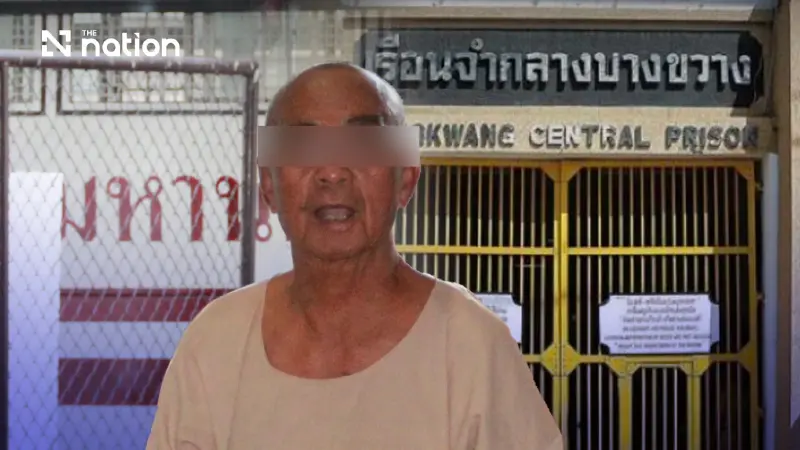


Drug kingpin Lao Ta Saenlee was released earlier than expected following six royal pardons, good conduct and elderly-prisoner provisions, the Department of Corrections says.
- Lao Ta Saenlee, originally sentenced to life for a drug offense, was released after his sentence was progressively reduced by six royal pardons.
- His sentence was further shortened due to his "excellent" prisoner classification for good behavior and additional reductions for being an elderly prisoner over the age of 70.
- The combined reductions lowered his total sentence to 8 years, 3 months, and 28 days; he was released because his time served of 9 years, 10 months, and 8 days exceeded this new term.
- The Corrections Department stated his release followed all existing laws and rules without discretion, but will review regulations for serious cases in response to public concern.
The Department of Corrections has explained the legal basis for the release of Lao Ta Saenlee from Bang Kwang Central Prison on August 14, following public questions over how a prisoner originally sentenced to life imprisonment was able to leave prison after less than 10 years in custody.
The department outlined Lao Ta’s sentence history, prisoner classification, conduct while incarcerated and the six royal pardons that progressively reduced his prison term.
Lao Ta, 85, had been held in custody since October 11, 2016, after being convicted of conspiracy to commit a serious drug-related offence. The Criminal Court handed down its final judgment on December 12, 2019, sentencing him to life imprisonment, with detention in lieu of a 2.5 million baht fine.
As it was his first term of imprisonment, Lao Ta was initially classified as a newly admitted convicted prisoner in the middle prisoner class under Clause 20 of the Justice Ministry’s 2016 regulation.
The department explained that he did not fall under Clause 3(5) of the 2019 ministerial regulation, which would have required him to be placed in the “needs major improvement” prisoner class. That regulation took effect on January 14, 2020.
Six royal pardons reduced life sentence
According to the department, Lao Ta maintained good behaviour throughout his imprisonment and committed no prison disciplinary offences. His prisoner classification was consequently upgraded until he reached the “excellent” class in 2022.
He received royal pardons on six occasions during his imprisonment. His life sentence was first commuted to 50 years before being reduced further in proportion to the terms set out in each royal pardon decree.
Lao Ta also qualified for additional sentence reductions because he was an elderly prisoner aged over 70, under Sections 12(2) and 14 of the applicable royal pardon provisions.
He received his first and second royal pardons in 2020, his third and fourth in 2021, his fifth in 2025 and his sixth in 2026. Following the latest pardon, his sentence was reduced to 8 years, 3 months and 28 days.
The department calculated that Lao Ta had been held from October 11, 2016, until August 14, 2026 — a total of 9 years, 10 months and 8 days. As this exceeded his sentence following the latest reduction, he entered the legal release process.

Corrections to review rules for serious cases
The Department of Corrections acknowledged public concern over the case and indicated that it would review and propose changes to rules, regulations and laws governing sentence administration.
The review will focus particularly on prisoners sentenced to death or life imprisonment, as well as those convicted in serious cases or offences that have a major impact on society.
The department explained that any changes should ensure that sentence administration reflects the seriousness of an offence and the principle of proportionality in punishment, while also taking public safety and the wider interests of society into account.
It maintained that Lao Ta’s sentence administration and release were carried out under laws and rules applied equally to all prisoners, without discrimination or the exercise of personal discretion.
The release process also required screening and rehabilitation procedures in accordance with prescribed criteria.
The department has forwarded information about Lao Ta to relevant anti-narcotics agencies and local administrative authorities so that his conduct can be monitored following his release.
