
China’s auto exports drive growth while NEV sales share tops 60%
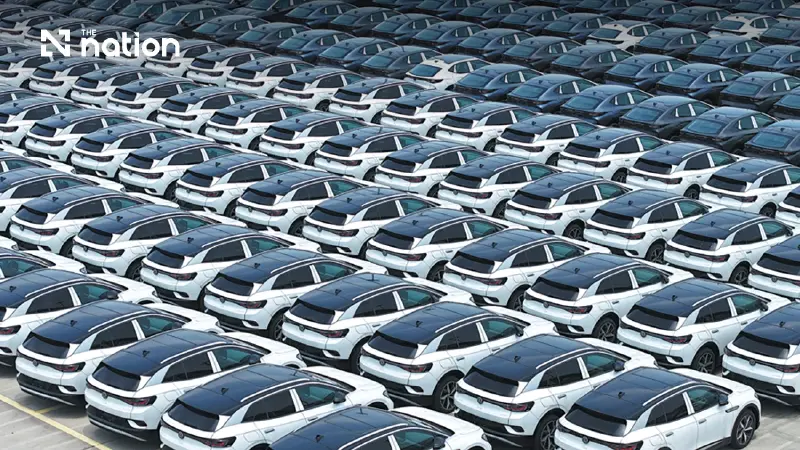


Chinese carmakers are extending their overseas push from finished vehicles to regional industrial systems while domestic electrification gathers pace.
- China's auto exports have become the primary growth driver for its automotive sector, with shipments exceeding 1 million units in July for the second consecutive month.
- New Energy Vehicles (NEVs) reached a milestone in the domestic market, accounting for 60.4% of all new vehicle sales in July, the first time their share has surpassed 60%.
- NEVs are a significant factor in export growth, with 553,000 units shipped in July, a 145.5% year-on-year increase, making up more than half of all vehicle exports.
- Chinese automakers are shifting their international strategy from simply exporting cars to establishing broader industrial networks, including local manufacturing, after-sales support, and charging infrastructure.
China exported 1.043 million vehicles in July, an increase of 81.3% from a year earlier and the second consecutive month in which shipments exceeded 1 million units.
New energy vehicles (NEVs) contributed 553,000 units to the total. Their exports surged 145.5% year on year and accounted for more than half of all vehicles shipped overseas for a second straight month.
“The domestic market features weak internal demand yet buoyant overseas trade. Exports have become the key stabiliser and primary growth driver for the entire automobile sector,” said Chen Shihua, deputy secretary-general of the China Association of Automobile Manufacturers (CAAM).
Between January and July, China exported 6.14 million vehicles. NEVs accounted for 2.91 million of those shipments, more than double the volume recorded during the same period a year earlier.
Chinese manufacturers are expanding their international operations beyond the sale of completed cars and developing broader industrial networks tailored to individual markets.
GAC AION has established dedicated spare-parts warehouses in Britain to reduce waiting times for after-sales support. Chery has taken a different approach in Egypt, launching localised new energy brands and manufacturing bases suited to North African road conditions and uneven charging infrastructure.
The overseas push also covers battery manufacturing, high-power charging networks, after-sales services and smart mobility systems supplied to markets in Europe, Southeast Asia and the Middle East.
Cui Dongshu, secretary-general of the China Passenger Car Association, linked the change to a longer-term transformation in the industry’s export strategy.
“Chinese carmakers no longer treat overseas expansion as a supplementary channel to ease fierce domestic price competition,” Cui said.
“The industry is shifting focus from exporting individual cars to delivering customised industrial systems compatible with varied regional regulations and consumer demands across the globe,” he added.
The rapid international growth of Chinese NEVs is putting greater pressure on established European and US manufacturers that have spent decades concentrating on internal-combustion-engine technology.
Chinese brands captured 16.3% of Western Europe’s NEV market in July, compared with 9.2% a year earlier. At the same time, their expansion has created further opportunities for cooperation between Chinese and multinational manufacturers.
Global carmakers are using China’s established industrial supply chain to lower research, development and manufacturing costs while adapting cockpit functions to local driving habits. Volkswagen, BMW and Stellantis have enlarged their local research operations and joint-venture activities as they accelerate their transition towards electrification.
Volkswagen operates its largest overseas R&D hub in Hefei, Anhui province. By drawing on extensive real-world road data and China’s intelligent-driving ecosystem, the facility has helped reduce vehicle development cycles by nearly 30%.
GAC Honda is also giving its China-based teams greater authority over vehicle development, replacing its previous approach of offering “global models adapted for China” with “China-defined products”.
“Those who live and drive in China every day should define the vehicles Chinese consumers use every day,” the company said.
Under a planned “product director system”, teams from the joint venture will determine product requirements and coordinate resources provided by both shareholders.
The growing importance of electrified vehicles is also reflected in China’s overall sales figures. CAAM data showed that 1.56 million NEVs were sold in July, representing a year-on-year increase of 23.7%.
NEVs made up 60.4% of all new passenger and commercial vehicles sold during the month. It was the first time their share had exceeded 60% under statistics covering the industry as a whole.
Sales during the first seven months reached 9 million units, an increase of 9.6% from the corresponding period last year. The cumulative NEV share of overall vehicle sales surpassed 51.2%.
Analysts attributed the continued increase to several factors. Lower energy expenses have made electrified vehicles more financially attractive to mainstream households, while Chinese manufacturers now offer models ranging from affordable urban vehicles and family SUVs to premium intelligent cars.
Longer battery ranges, faster charging and improved smart cockpit systems have also helped reduce consumer concerns about vehicle range. Supporting that transition is the world’s largest network of charging points and battery-swapping stations, covering both Chinese cities and rural areas.
Despite its expansion, China’s NEV industry is moving away from growth driven largely by production scale and towards more focused technological competition amid prolonged price wars.
International operations present separate difficulties. Carmakers must adapt to differing emissions requirements, incompatible charging protocols and varied consumer preferences across markets.
Chen described the combination of a comprehensive NEV sales share above 60% and monthly vehicle exports exceeding 1 million units as a new crossroads for China’s automotive industry.
He said the sector would continue upgrading domestic industry, competing fairly in international markets and deepening cross-border technological cooperation to advance carbon neutrality in transport worldwide.
Source: China Daily
