
Global Energy Chokepoints Force Rethink on Supply Security, Dangote and B.Grimm Chiefs Say
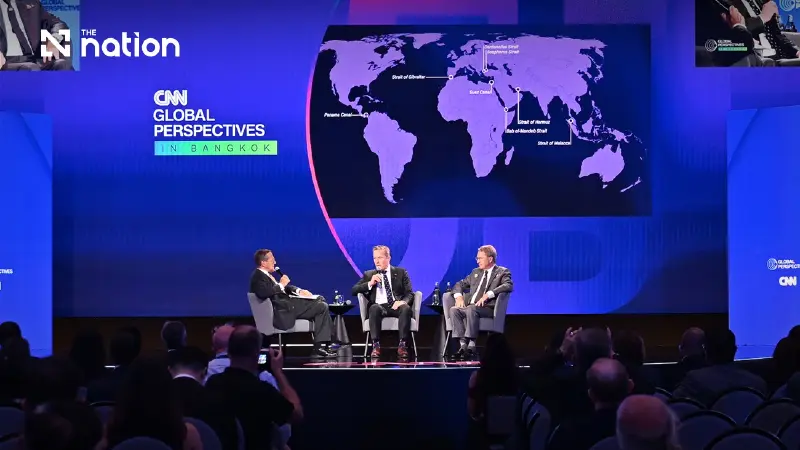


At CNN Global Perspectives in Bangkok, energy leaders warn that global chokepoints and geopolitical shocks require a major supply chain rethink
- Energy leaders from Dangote and B.Grimm warn that geopolitical shocks and reliance on maritime chokepoints, such as the Suez Canal and Strait of Hormuz, have exposed the vulnerability of global supply chains.
- The crises are prompting a strategic shift away from prioritizing low cost to equally valuing supply security and resilience, challenging a complacency bred by globalization.
- One proposed solution is building massive, efficient refining capacity in new locations, like Dangote's refinery in Nigeria, to create alternative supply hubs and shorten vulnerable transport routes.
- Another strategy involves strengthening regional energy cooperation, such as Thailand sourcing from its neighbors, to establish more stable and local supply corridors over dependence on distant markets.
At CNN Global Perspectives in Bangkok, energy leaders warn that global chokepoints and geopolitical shocks require a major supply chain rethink.
Trust is critical in any business. What happens when the stability behind it falls apart? That question opened "Chokepoints and Power Corridors: Securing the Global Flow", a session at CNN Global Perspectives in Bangkok on Wednesday (October 14).
It examined the narrow sea lanes and long supply chains that the world's energy depends on. CNN's Richard Quest moderated a conversation between David Bird, chief executive of Dangote Refinery in Nigeria, and Dr Harald Link, chairman and chief executive of Thailand's B.Grimm.
A graphic on screen showed the key chokepoints: the Strait of Malacca, the Strait of Hormuz, the Bab el-Mandeb, the Suez Canal, the Bosphorus and Dardanelles, Gibraltar and the Panama Canal.
Energy markets, Quest suggested, are "the number one example" of what happens when things fall apart.
Resilience, not just low cost
Bird said the market has proved "incredibly resilient", describing that as "the beauty" of the oil and gas industry. The shock that mattered most when it happened, he said, was Russia's invasion of Ukraine, from which the market "moved on quite quickly".
Today, he said, attention has shifted to the Strait of Hormuz and the Bab el-Mandeb and towards the Red Sea and Suez.
"We sort of knew that this was going to end badly," he said, "because there's no obvious way around it."
The lesson, he argued, is that globalisation bred complacency. "We should have learned through Covid; we should have learned through Russia," he said.
The outcome is a push to stress-test supply chains and make investments that "equally value security of supply and resilience, not just low cost".

Questions about dependence on a single chokepoint, he added, now reach company boardrooms. "For some reason, when it came to supply chains, we became a bit complacent and a bit blind."
Link took a more philosophical view. "The oil or gas is where it is. The ports are where they are," he said. Crises, he suggested, are inevitable, and the real question is where the next one will strike.
He also offered a note of optimism: "Life has never been better," he said, so a crisis can be a useful prompt to improve.
A refinery for Africa
Bird said the answer to supply risk includes building capacity in new places. Dangote's refinery was designed to process 650,000 barrels a day, he said, and has been pushed up to 700,000.
That is roughly the fifth largest in the world, he said, and the company plans to double it to 1.4 million barrels a day, which would make it the world's largest.
Quest put the headline cost at about $17bn, a figure Bird said includes land reclamation and other elements.
"I can think of many places that I would willingly want to build a refinery of that size and scale," Quest said, adding that Nigeria had not been first because of "the traditional difficulties".
Bird said the project sits within a larger story of African industrialisation.
He noted that 1.2 billion people live on the continent and that most remain in energy poverty. He also pointed to the Dangote group's position as the world's largest fertiliser company, a business made more important by the disruption to supply after Russia's invasion of Ukraine.

Bird also made a claim about Europe. The refinery, he said, supplies about 20 per cent of Europe's aviation fuel, having overtaken the United States, and has "filled the breach" of supply that used to depend on the Middle East.
"For any Europeans in the audience that enjoyed your summer holidays," he said, the fuel may well have come from Nigeria.
Quest pointed to the map, noting that the West African coast sits on the open ocean with few obstacles, apart from the south. Bird said that within two to three days' sailing there are about 3.2 million barrels of daily crude production in a basin he compared with Southeast Asia.

Efficiency, and the case for fossil fuels
Bird defended the project on environmental grounds. Nigeria's 240 million people need fuel to move goods and harvests, he said, and for years crude left the region on ships to be refined in Europe and returned as a product.
The average European refinery, he claimed, is 70 years old, "small", "dilapidated" and carbon-intensive. By his company's calculations, cutting out that round trip has removed a million tonnes of CO2 from the equation.
"Reinvesting in energy efficiency is not about demand growth," he said.
Fossil fuels will remain part of the mix for the long term, he argued, because plastics, petrochemicals, wind turbine blades and aviation fuel still depend on oil and gas.
Even if demand falls and older, less efficient refineries close, he said, "the average energy efficiency of the refining step will improve, and that will be a good thing for the planet."
He said the Dangote refinery aims to process "the most efficient crude barrel in the world".

Thailand's case for neighbours
Asked how well placed Thailand is, Link said the country had "missed our chance" over the past decade to explore more gas in Myanmar, though he said the new government there is trying to do so.
Thailand, he said, has the opportunity to develop gas to its west and hydropower in Myanmar and Laos. Buying from neighbours has a further benefit: "You pay them with baht. They will then buy consumer products from Thailand. It's a win-win all the time."
Quest asked whether that would simply create a different chokepoint. Link rejected the premise. He pointed to Europe, where France and Germany, once at odds for centuries, are now close partners, and argued that a mindset of cooperation can replace one of competition.
"It's not a zero-sum game," he said. "We are not competing. We try to create a better world together." What is stopping it, Quest asked. Link cited vested interests among those who want to import gas from elsewhere and what he called sanctions imposed by the United States.
He urged people to be open to doing business with countries, whatever their political systems, and asked for "a broader mindset". When Quest observed that the world is moving towards narrower mindsets, Link agreed but stood by his view.
Even the business-school idea that companies exist to maximise profit, he said, is "nonsense". He added that people favour convenience, and that globalisation made cheap supply from afar the easy choice.
"Now you have to think maybe differently," he said, and look to nearer sources such as Malaysia, Myanmar and Australia. B.Grimm, he said, is now active worldwide, mainly in renewable energy outside Thailand.
A rewiring of supply?
Closing the session, Quest asked whether ongoing conflicts and supply disruptions have forced a fundamental rewiring of global energy networks.
For Thailand and the wider region, Link answered with an emphatic yes, noting that while distant suppliers may offer lower costs, global uncertainty means "one day you get it, the other day the door is closed."
Looking ahead to the demand side, the transition faces an unexpected accelerator. Until the artificial intelligence boom, it seemed fossil fuels could be steadily phased out as battery technology advanced.
Instead, the staggering electricity appetite of modern data centres has upended those timelines. "Do we use less AI? No, we will use more AI," Link warned.
With energy demand only set to surge, the ultimate solution will require an unprecedented, multi-billion-dollar blend of fossil fuels, renewables, and massive investments in next-generation battery infrastructure—leaving energy markets to navigate a complex new era where security and scale outweigh cheap convenience.
