
Clean Energy Cheaper But Faster Transition Needed, CNN Bangkok Panel Warns
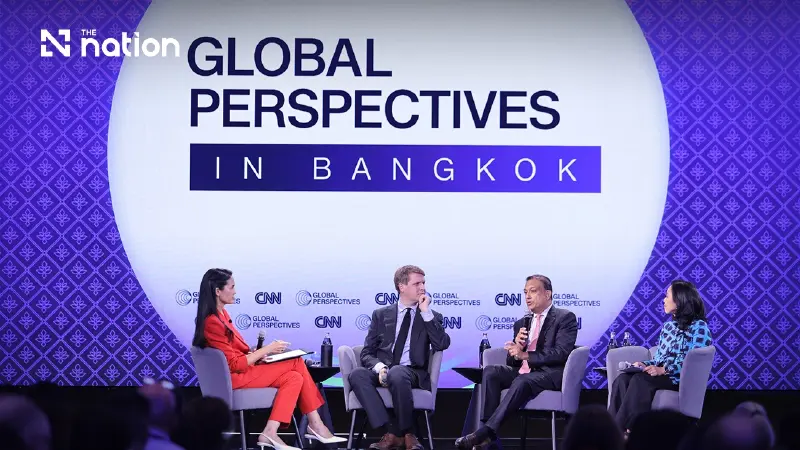


At CNN Global Perspectives, leaders discuss how Asia can scale renewables, overcome fossil fuel reliance, and finance a faster transition
- A CNN panel in Bangkok concluded that while clean energy is often the cheapest option for generating electricity, the speed of the transition and its financing remain significant problems.
- Panelists warned that the transition is not happening fast enough to address the urgent climate crisis, with one expert estimating it will take 40-50 years to replace the current energy system.
- The push for a faster transition is motivated not only by climate change but also by energy security, the economic costs of air pollution, and the role of energy access in alleviating poverty.
- Key obstacles slowing the shift include the high costs of energy delivery (batteries and grids), the difficulty of decarbonizing non-electricity sectors like steel and aviation, and financing models that are too slow to scale.
At CNN Global Perspectives, leaders discuss how Asia can scale renewables, overcome fossil fuel reliance, and finance a faster transition.
Energy demand is soaring, fuel prices have been rattled by conflict in the Middle East, and much of Asia still runs on coal. Can renewables step in fast enough?
A panel at CNN Global Perspectives in Bangkok on Wednesday (October 14), "Powering the Next Economy", answered with a cautious yes.
Clean power is now often the cheapest option, the speakers said, but the speed of the shift and who pays for it remain the problem.
The session was moderated by CNN's Kristie Lu Stout. It featured Åsmund Aukrust, Norway's Minister of International Development, Sumant Sinha, founder, chairman and chief executive of India's ReNew, and Elizabeth Yee, executive vice president of programs at the Rockefeller Foundation.
Security, as well as climate
Aukrust, in Bangkok for the IMF and World Bank meetings, said renewables were at the top of his agenda.
"The climate crisis is not a future scenario," he said. "It's here right now."
The transition, he added, has also become a question of security.
"We have seen how countries have been too dependent on one country or one energy source and how vulnerable we end up being."
He said Norway's government had proposed in its state budget last week a 75 per cent increase in its development finance institution, which invests in the global south.
Most of the money, he said, would go to Asia "because in Asia there is the greatest potential for emission reduction". He added that Norway's last two months had been the warmest in its history and that no region can solve the problem alone.

Aukrust also stressed that access remains the core development problem.
"There are no good schools or good hospitals without energy," he said. "It's not possible to create jobs without energy."
The development and climate crises, he argued, must be solved together. He said he was concerned about speed, adding, "We need to speed up."
Cheaper, but not yet cheap enough
Sinha said renewables are now cheaper than fossil fuels in most countries for generating electricity. The question, he said, has moved from generation to delivery.
Batteries and expanded grids add costs, so the industry must now look at "the full delivered cost" of stable power. Even so, in most places it remains competitive with fossil alternatives, and he expects the power sector to move almost entirely to clean energy by 2040 or 2050.
The harder task is everything else.
"Decarbonising the non-electricity part of the energy system is the much bigger part of what we need to do," he said, citing steel, cement, aviation and shipping.
Technologies there are still at a "nascent stage".
"No company on its own is going to shift towards more expensive technologies," he said, because mass adoption requires that the economics also work.
He gave a picture of India's scale. ReNew generates about 8 per cent of the country's renewable energy. India has about 300 gigawatts of installed renewable capacity out of a total system of about 550 gigawatts, so renewables have "crossed the 50 per cent threshold".
The country is adding roughly 50 gigawatts a year, making it the world's second-largest market for new renewable capacity after China. ReNew itself adds around three to three and a half gigawatts annually and has begun making its own solar panels.

Sinha was blunt about the timeline. Most Asian countries have no oil or gas, he said, so their systems run on coal, and gas "is not good either" because of methane.
An energy system built over 200 years cannot be replaced in 20 or 30, he said. "It's going to take us 40 to 50 years."
He also called for countries to examine their scope 3 emissions, the emissions from burning the fuels they sell, noting that Norway "pumps a lot of oil and gas that ultimately is consumed".

Energy as the pathway out of poverty
Yee said the Rockefeller Foundation has worked in Thailand since 1913, beginning in public health. Her argument was economic as well as humanitarian: "Energy is the pathway out of poverty."
She said 655 million people still have no power and three billion face unreliable supply.
"If that's your reality, you can't actually be part of the modern economy today."
People in energy poverty, she said, have a 99 per cent chance of another form of poverty, such as food or housing insecurity.
She described the foundation's work across India, Thailand and the wider region, including its Asia Exchange gathering this week and grants to organisations such as the Global Energy Alliance.
She cited a project in Delhi that she said is India's first battery energy storage system for a community. It lets a distributor buy power when it is cheap, store it, and use it at peak times, cutting peak load by 40 per cent.
"Not only does this community now have access to reliable electricity, it has affordable electricity," she said.
Lu Stout raised the pressures facing Southeast Asia. Energy ministers had met in Manila only days earlier, she noted, to discuss the Middle East conflict's effect on prices and supply, with calls to stockpile fuel and renewed interest in a shared regional grid.
Yee said clean energy was "absolutely top of mind" at the World Bank meetings because it offers energy independence. She added that the stakes are not only environmental.
She cited figures that 90 per cent of the population of the region, about four billion people, breathe air the World Health Organization does not consider clean and said the World Bank estimates that air-pollution deaths could cost the region $600bn by 2050.
"It's actually an economic challenge if we don't do it right," she said.

Money, and a 'plus one' for China
On finance, Yee was candid about the limits of the current approach. Blended finance, which combines public or philanthropic money with private capital, was a recurring theme at the World Bank meetings, but "every single transaction is bespoke", she said, which "is not going to move us at the speed that you're asking us for".
Philanthropy, she argued, should use its capital to build replicable "blueprints" and proof points and help customers without formal finance build creditworthiness.
Lu Stout then raised the concentration of clean-technology supply chains in China and asked whether India could be an alternative.
Sinha said the world needs diversification. India has a large domestic market, supportive policy and relatively low costs, making it "a natural other place" for a supply chain that can act as "a plus one to China".
He said ReNew plans to move further up the value chain, from panels and cells towards batteries. He urged other countries to diversify their purchases deliberately, "even if the cost is a little bit different", while acknowledging that China's 25 to 30 years of development means others will need time to catch up.
Aukrust said the lesson of the energy crisis after Russia's invasion of Ukraine is that dependence on one source or one country is dangerous.
"We should never go back to a place where we are dependent on either one energy source or one country," he said.
Asked which mix works best in the region, Lu Stout recalled visiting Sarawak in Malaysia, where hydropower, floating solar and other sources, using Chinese technology, supply most of the state's needs.
The panellists agreed there is no single answer.
"You need all of the above," said Sinha, including geothermal and nuclear, "as long as the power source is affordable and it's clean."
Aukrust said, "I say yes to the whole menu."
Yee noted that in a "super El Niño" period, with Asia, the world's most disaster-prone region, diversity matters for resilience as well as cost, with drought already threatening hydropower elsewhere. She said her foundation is looking closely at small nuclear reactors and that the sector needs the workforce to deliver new technologies.
