
WHAUP Urges Bangkok to Fast-Track Direct PPA Rules as Data-Centre Demand Surges
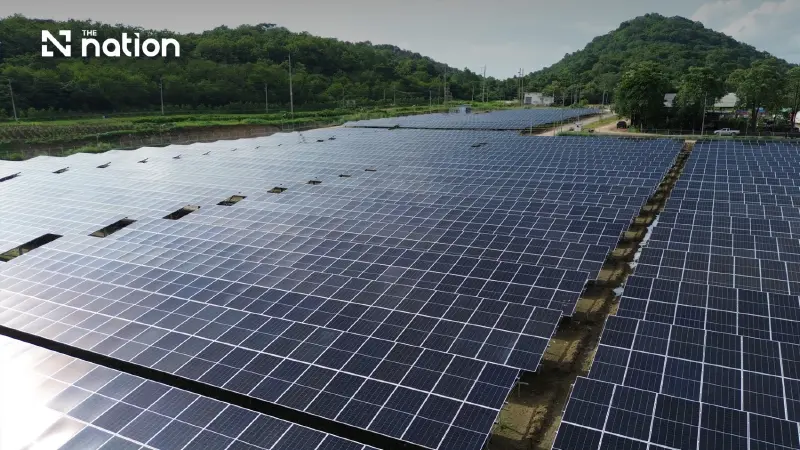


CEO Akarin says regulatory delay on direct clean-power deals risks Thailand's data-centre pipeline, as utility posts 35% Q1 profit growth
- WHA Utilities and Power (WHAUP) is urging the Thai government to accelerate the launch of its long-delayed Direct Power Purchase Agreement (PPA) scheme, calling it the most critical factor in attracting data-center investment.
- The company warns that regulatory delays risk Thailand losing out to regional rivals, as access to clean energy is now the top criterion for data-center investors needing to meet global sustainability standards.
- Direct PPAs would allow large users, starting with data centers, to buy renewable power directly from generators, a change from Thailand's current "Single Buyer" model where a state utility buys all power.
- While the government has approved a 2,000-megawatt pilot for data centers, the final rules and commercial terms remain in draft form, stalling potential projects despite surging demand.
CEO Akarin says regulatory delay on direct clean-power deals risks Thailand's data-centre pipeline as the utility posts 35% Q1 profit growth.
WHA Utilities and Power (WHAUP), the water and energy arm of WHA Group, used a media briefing on Monday to call on the Thai government to accelerate the long-delayed launch of its Direct Power Purchase Agreement (Direct PPA) scheme, arguing that the policy has become the single biggest factor determining whether Thailand keeps pace with rivals in the race for data-centre investment.
Akarin Prathuangsit, WHAUP's chief executive, said that although Thailand's strategic location, government incentives and infrastructure remained attractive to global manufacturers relocating supply chains, the number one criterion investors now screen for is "access to clean energy" that satisfies international sustainability requirements such as the EU's Carbon Border Adjustment Mechanism (CBAM) and the RE100 corporate renewables initiative.

"WHAUP has already prepared its Green Energy Platform," Akarin told reporters, pointing to a memorandum of understanding signed to trial a Direct PPA and Third Party Access (TPA) model with Apex Circuit (Thailand), covering a 17-megawatt project, alongside the rollout of its RENEX energy-trading platform and its CO₂Zero carbon-management platform. The company said these tools were ready to be deployed in full "the moment the regulator unlocks the rules".
Akarin called on the authorities to finalise, without further delay, the criteria for the 2,000-megawatt Direct PPA pilot earmarked for data centres and urged regulators to consider widening the quota to other power-hungry sectors such as automotive and steel manufacturing.

He added that signs the government was open to broadening the scheme beyond data centres and raising the overall gigawatt cap were "a good sign" for the policy's direction, suggesting authorities recognised that demand for direct clean-power access extended well beyond the initial pilot's scope.
What is Direct PPA, and why the urgency
Thailand has for decades run its electricity market under a "Single Buyer" model, in which state utility EGAT purchases all privately generated power and resells it via the Metropolitan and Provincial Electricity Authorities.
Direct PPAs would allow large users — initially data centres promoted by the Board of Investment with at least 50 megawatts of IT load — to contract directly with renewable generators, with power wheeled over the state grid under a Third Party Access code.
The National Energy Policy Council approved the pilot's principle in June 2024, and the ERC published draft Direct PPA and TPA regulations in October 2025, initially targeting a launch around the turn of the year.

As of mid-2026, however, the rules remain in draft form, with wheeling charges and other commercial terms still being finalised – a delay that has left developers and prospective off-takers waiting even as data-centre investment approvals continue to pour in.
WHAUP argues that every month lost is a month in which rival South-East Asian hubs can offer investors a clearer route to verified renewable power.

Water demand from data centres also climbing fast
The briefing, held under the theme "Water, Energy and Sustainability: Driving Strategic Infrastructure for the Industries of the Future", also highlighted surging demand for industrial water. Data centres, Akarin noted, require 12 to 16 times more water than typical industrial users for cooling, and WHAUP is in advanced negotiations to supply an additional 17 to 29 million cubic metres a year to large data-centre customers, on top of existing volumes.
In the first quarter of 2026, WHAUP's combined water sales and management volumes across Thailand and Vietnam reached 43 million cubic metres, up 7% year on year, with Thailand volumes of 34 million cubic metres (up 9%) and Vietnam contributing nine million cubic metres. Water revenue for the quarter rose 64% year on year to 945 million baht, driven largely by capacity-charge income as data-centre customers began drawing on contracted supply.
To secure long-term supply, WHAUP said it holds strategic reserves from seven large natural reservoirs — including Nong Kho, Dok Krai and Prasae — with combined capacity exceeding 800 million cubic metres, and is pursuing a "Water-Positive Growth" strategy aimed at returning more water to nature than it withdraws, through wastewater treatment, reclamation and premium-water production.

Investment plans and financial strength
Prapon Chinudomsub, WHAUP's chief financial officer, set out a five-year investment plan for 2026-2030 worth approximately 29 billion baht. Of this, 2.9 billion baht is earmarked for 2026 alone, split roughly 57% toward power and 43% toward water utilities, with a focus on generating steady recurring income.
On the power side, the company is targeting an additional 60 megawatts of Solar Private PPA contracts in Thailand this year, having already signed 32 megawatts in the first quarter, alongside construction of 136 megawatts of Feed-in Tariff solar capacity due to be commissioned between 2027 and 2030.
In Vietnam, WHAUP is targeting a further 29 megawatts of solar contracts in 2026 and is scouting mergers and acquisitions in wind, solar and battery energy storage under Vietnam's PDP8 power development plan, as well as assessing opportunities in a third regional market.

Prapon said the balance sheet had ample headroom to fund this expansion, with a debt-to-equity ratio of around 1.0 times, well inside the 2.5-times covenant ceiling set by lenders.
That financial strength was underlined by a 4-billion baht bond issuance in early 2026, comprising a 3-billion baht, three-year zero-coupon bond priced at a 2.10% discount rate and a 1-billion baht, five-year green bond carrying a fixed 2.75% coupon; the green tranche was more than three times oversubscribed.

Group-wide results and 2026 targets
For the group as a whole, WHAUP reported first-quarter revenue and share of profit of Bt1,003 million, up 7% year on year, while net profit jumped 35% to Bt303 million, lifting its net margin to 27%. Its net interest-bearing debt to equity ratio stood at a conservative 1.15 times.
In the power business, first-quarter revenue from Solar Private PPA reached Bt163 million, up 30% year on year, with cumulative signed Private PPA capacity of 372 megawatts.
The company also completed all six Feed-in Tariff projects after signing an additional 9.9 megawatts, taking equity FiT capacity to 136 megawatts. Total equity power capacity stood at 1,058 megawatts, of which 735 megawatts are operating and 323 megawatts are under development.
For the full year, WHAUP is targeting cumulative signed power capacity of 1,124 megawatts, of which 596 megawatts, or roughly 53%, would come from renewables, alongside 170 million cubic metres of water sales and management — 129 million in Thailand and 41 million in Vietnam, an increase of about 6% on 2025.

Longer-term sustainability goals
Looking to 2030, WHAUP is targeting a 42% cut in Scope 1 and 2 emissions from its 2021 baseline under the Science Based Targets initiative, building on operational carbon neutrality it says it has held since 2021.
It also aims for 1,222 megawatts of equity renewable capacity — avoiding roughly 803,000 tonnes of CO₂ equivalent annually — a 25-million-cubic-metre cut in natural water withdrawal, saving customers an estimated Bt290 million a year, and a shift toward zero waste to landfill or incineration without energy recovery.
Executives said the combination of WHA Group's industrial estate footprint, WHAUP's financial headroom and its readiness to deploy Direct PPA infrastructure positioned the company to serve as a long-term partner for global investors — provided, they stressed, that regulators move quickly to finalise the rules that would let those partnerships begin.
