
Amata Chief: Thailand Can Host 2,000 Chinese Factories by 2036
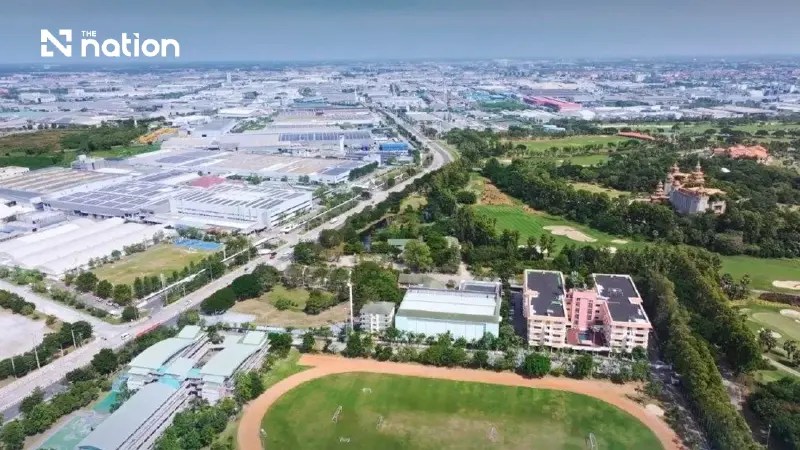


Chinese firms now drive 70 per cent of new investment into Amata’s industrial parks, as founder Vikrom Kromadit sets his sights on hosting 2,000 factories within a decade
- Amata Corporation's chief, Vikrom Kromadit, aims to increase the number of Chinese factories in his Thai industrial parks from approximately 400 to 2,000 within a decade.
- Chinese companies are driving this growth, currently accounting for 70% of new investment in Amata's estates as they relocate manufacturing operations to Southeast Asia.
- The trend is supported by Thailand's cost competitiveness, with significantly lower labor costs than in China, and Amata's full-service model that handles all external requirements for its tenants.
- Kromadit argues that Thailand should embrace this wave of foreign direct investment from China as a major economic opportunity, similar to the previous wave of Japanese investment.
Chinese firms now drive 70 per cent of new investment into Amata’s industrial parks, as founder Vikrom Kromadit sets his sights on hosting 2,000 factories within a decade.
Thailand's industrial estates are positioning themselves to capture a historic shift in foreign direct investment, as Chinese manufacturers increasingly relocate production to Southeast Asia, according to Vikrom Kromadit, founder and chief executive of AMATA Corporation.
Speaking to The Nation in a side interview during the second day of the 17th FutureChina Global Forum at the Sands Expo and Convention Centre on Friday (September 25), Vikrom — who has spent more than 50 years developing industrial parks across Thailand, Vietnam, Laos and Myanmar — said Chinese investors now account for 70 percent of new investment entering Amata's estates, and he aims to grow the number of Chinese-linked factories on his sites from around 400 today to 2,000 within a decade.
"I have a dream — 400 factories of Chinese, I want to make it 2,000," he said. "Maybe within 10 years. I'm not young any more, so I want to make it happen faster."
A shifting source of capital
Vikrom traced the evolution of foreign investment into his industrial parks across three distinct eras: an early period dominated by American capital, followed by a large wave of Japanese manufacturers that ultimately built more than 770 factories across Amata's estates, and now a current era defined by Chinese investment.

Over the past three to five years alone, more than 400 Chinese factories have set up operations within Amata's parks. The scale of that activity has become significant to the national economy: total industrial output across Amata's estates reached US$50 billion last year, equivalent to nearly 10 percent of Thailand's entire GDP.
He said the operational success rate among Chinese tenant companies has climbed from around 70–80 percent in earlier years to more than 98 percent today.
The "inside and outside the fence" model Vikrom attributed that success rate to Amata's service framework, under which tenant companies focus entirely on production while the company itself manages every external requirement.
"Your job is just to manage the inside of your factory — outside of your fence, everything belongs to me," he said, describing a full-service model covering government liaison, permits, environmental compliance, utilities and logistics.
"I call it a service centre, so that they can just focus on their production, their management and their sales."
He also pointed to cost competitiveness as a draw for investors.
Labour costs across the Greater Mekong Subregion average around US$3,200 a year, he said, compared with roughly US$14,000 in major manufacturing hubs in China, while Amata's industrial land is priced around 20 percent below prevailing market rates, bundled with its turnkey support services.

Don't fear FDI, exploit it
Reflecting more broadly on Thailand's approach to foreign investment, Vikrom argued that the country should resist the instinct to view rising FDI inflows, particularly from China, with suspicion or alarm.
His view, as he put it to The Nation, was straightforward: investment arriving is preferable to investment staying away, and the more productive question for Thailand is not whether to be wary of it, but how to structure policy and industrial planning so the country captures the greatest possible benefit from it.
He suggested that framing FDI primarily around its risks — competitive pressure on domestic firms, dependency on a single source country — risks obscuring the larger opportunity at hand.
In his view, the more useful posture for Thailand is to treat the scale of this investment as a challenge to be actively managed and shaped, rather than a threat to be resisted, with the right mindset determining whether the country converts the opportunity into lasting economic gain.

Learning from Japan's trajectory
Vikrom said the scale of investment now flowing from China reflects the depth of research and development behind many of the companies setting up in his parks.
Visiting the headquarters of Chinese client firms, he said he had encountered single corporations employing more than 100,000 research and engineering staff.
"Unbelievable — I found some of these companies have R&D staff of over 100,000 people," he said.
He drew a parallel with Japan, South Korea and Taiwan's industrial development several decades ago, arguing that Chinese manufacturing is following a similar trajectory from being seen as a low-cost alternative toward recognition for quality and innovation.
"In the old days, people always said Japanese products were cheap and not good quality. But today they are the best quality," he said. "I think in the next ten years, Chinese products will be the same — they will go everywhere in the world with the quality and the price to match."

"Second home" for Chinese investors
Beyond the economics, Vikrom described a pattern of long-term cultural integration among Chinese executives and factory managers who relocate to Thailand.
He said those who stay for three to five years are often reluctant to return home.
"The Chinese who live and work in Thailand for over five years, they don't want to go back home," he said. "Even if they go back for a week, they say they get sick — sick in the body, and homesick too."
He described the relationship between Chinese investors and ASEAN as one built on genuine familiarity rather than transactional convenience.
"I don't see anywhere else in the world with a better partnership than ASEAN and China," he said.

ASEAN's stability as an asset
Vikrom also reflected on the broader geopolitical backdrop, expressing some caution about developments elsewhere in the world — including rising defence spending in Northeast Asia, unpredictability in international trade policy, and prolonged conflicts in Ukraine and the Middle East.
Against that backdrop, he described ASEAN as a comparatively stable and unified region that has avoided the kind of conflict seen elsewhere.
"ASEAN has no conflicts — ASEAN is one family," he said, noting that more than half of ASEAN's capital flows have gone into Singapore in recent years, which he attributed to the city-state's reputation for financial security. "A lot of people send their money there because they feel safe."
A call for unity
Vikrom closed his remarks with a broader appeal for international cooperation, urging business leaders and governments to look past cultural and political divisions.
"I really think about one thing only — how we can make all the people in the world think they are one family," he said. "Don't look at someone's face; don't look at what they wear or what they eat. If we can reduce conflict and choose peace, the future will be good for everyone."
For Thailand, his message carried a practical undertone: as global manufacturing continues to realign, industrial estates that combine cost efficiency, streamlined services and regional stability are well placed to convert that shift into sustained, tangible economic benefit.
Photo credit: Amata Corporation, FutureChina Global Forum
