
CPF Bets on AI, Genetics and Robotics to Turn Thailand's Food Volume into Lasting Value
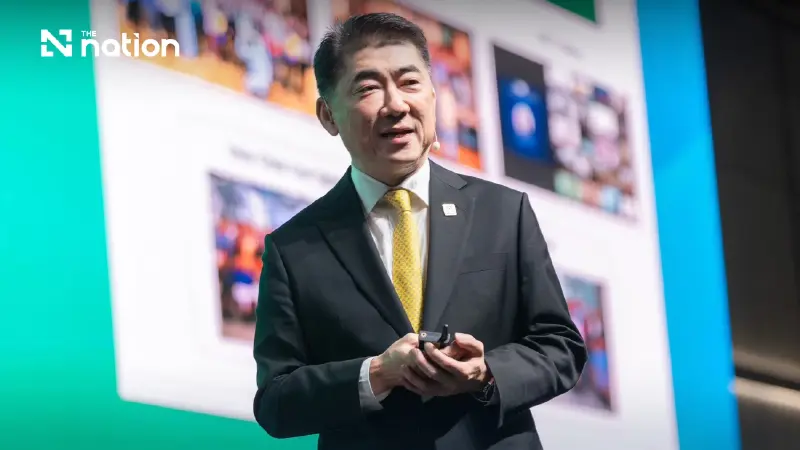


CEO Prasit Boondoungprasert says AI will run through CPF’s value chain, from farms to sales, as it aims to be a “national capability builder”
- Charoen Pokphand Foods (CPF) is shifting its strategy from being a high-volume producer to creating more value from its output, aiming to establish food as a strategic national asset for Thailand.
- The company is integrating Artificial Intelligence (AI) across its entire value chain, from breeding and feed formulation to processing and sales, to boost productivity and accelerate decision-making.
- Building on its core foundation in genetics, CPF is also heavily investing in automation and robotics, with a long-term goal of achieving highly automated or even unmanned manufacturing operations.
- To fund this transformation, CPF is sharply increasing its technology investment, dedicating several billion baht annually to its engineering, AI, and robotics teams—roughly double the level of a few years ago.
CEO Prasit Boondoungprasert says AI will run through CPF’s value chain, from farms to sales, as it aims to be a “national capability builder”.
Charoen Pokphand Foods (CPF) is transforming from a volume-driven protein producer into what its chief executive terms a “national capability builder”, leveraging artificial intelligence, genetics, and automation to boost productivity across Thailand’s food chain.
Speaking on the final day of the CP Innovation Exposition & Symposium, held at True Digital Park from 20 to 22 October under the theme “Rise Together, Innovate Beyond”, Prasit Boondoungprasert said food could become a strategic national asset within a decade and that AI would run through every stage from breeding to sales.
He then set out the group’s strategy, expansion and technology plans in a media briefing.
From Volume to Value
Thailand’s long-standing strength as a major global food exporter has historically rested on sheer volume. Yet despite the country’s vast agricultural workforce, farming incomes remain modest, according to Prasit.
"How do we take the same volume and create more value from it?" he asked during a media briefing following the CP Innovation Exposition & Symposium.
He linked the strategic imperative directly to climate risk, warning that increasingly frequent and unpredictable floods threaten Thailand's traditional reputation as a land of agricultural abundance.
"We are comfortable in Thailand, the land of rice and water, but we do not know whether it will stay this way for long," he said.

With competing nations treating food security as a national priority and institutional investors acquiring farmland as a hard asset, Prasit predicted a fundamental shift in perspective.
"Within ten years, food may become a strategic asset of the country," he noted.
Thailand remains relatively well placed due to a milder climate compared to Europe or parts of China, alongside the global popularity of Thai cuisine. However, no single firm can carry the burden alone.
"Thailand is small, so a single company is too small. We must combine the strength of companies into Thailand and take Thailand to the global market," he said.
AI integration
To deliver on this vision, CPF is embedding technology across every stage of production—from breeding and feed formulation to processing and retail delivery.
While genetics remains the core foundation—building on the group’s historical breakthroughs in maize, shrimp, and swine breeding—biotechnology, automation, and robotics are now being combined with artificial intelligence (AI).
AI is being deployed for predictive analytics, early problem-solving, and accelerating decision-making cycles. While corporate implementation presents greater complexity than consumer applications due to the need for proprietary datasets, modern AI architectures have made structuring internal data far more efficient.
Across the wider Charoen Pokphand Group, approximately 70% of meeting time is now dedicated to AI integration. Encouraging rapid execution over prolonged planning, Prasit urged: "Wherever AI can be built first, build it. Waiting step by step is too slow."

Feed milling represents CPF's most technologically advanced operational segment. Automated systems now analyse live data to adjust production schedules in real time, optimising power usage against fluctuating electricity tariffs and solar power generation.
Concurrently, sales teams are collaborating with various consulting companies, including McKinsey, on AI-driven pricing optimisation, while R&D teams leverage data to refine formulations for animal feed and human nutrition.
AXONS, the group’s technology arm, is transitioning into a dedicated AI enterprise working alongside engineering teams.
"AI is not a separate part. It is embedded in the business," Prasit stressed.
On the factory floor, CPF’s long-term goal is to achieve highly automated, or even fully unmanned, manufacturing operations—an ambition he acknowledged remains a considerable challenge.
Capital allocation
For 2027, CPF estimates capital expenditure at approximately 20 billion to 25 billion baht, broadly in line with recent years. With corporate budgets currently being compiled against a subdued economic backdrop, spending will favour operational efficiency gains over physical footprint expansion.
Within that capex envelope, technology investment is rising sharply. CPF invests several billion baht annually in its engineering, AI, and AXONS teams—roughly double the level of a few years ago. The remainder is directed towards machinery, automation, and robotics.
Following CP Group’s recent launch of a dedicated robotics venture, CPF will deploy these solutions alongside third-party suppliers. The company also anticipates a substantial surge in visual hardware acquisitions. Modern camera networks combined with computer vision serve as operational monitoring "eyes" across facilities.
"Next year we will have to buy an enormous number of cameras, because every business unit wants them," Prasit said.
Joint ventures and greenfield facilities fall outside the core budget envelope and will be funded separately as opportunities arise. To support this digital transition, CPF is constructing an internal "AI pyramid" workforce model: all staff are expected to achieve basic AI literacy, each business unit will embed specialised experts, and a core group of data scientists will lead strategy from the top. Executive attendance at specialised AI modules is mandatory.
Portfolio dynamics
Addressing market sentiment and broker revisions regarding CPF shares, Prasit pointed to the group’s inherent "two-speed" portfolio structure. While processed foods deliver stable, higher-margin growth, fresh meat remains exposed to agricultural cycles.
Because the swine cycle spans approximately five years, quarterly financial results can offer a misleading picture.
"We do not look at the short term, and we do not look quarter by quarter," he explained.
While short-term investors might find this approach frustrating, the business is engineered for long-term value creation. CPF will continue investing in fresh meat operations through genetic selection, biosecurity, and farm efficiency, while progressively shifting volume into processed products.
Pork processing presents higher capital demands than poultry; higher raw material costs mean a pork product priced at 60–70 baht compares with a 45-baht equivalent in chicken.
Furthermore, Thai pork export access remains restricted to four or five markets, including Japan, Singapore, and Hong Kong, with mainland China not yet open. Internationally, CPF typically enters high-population markets with high-volume fresh meat where its genetic capabilities confer a cost advantage, subsequently building out downstream processing infrastructure.
He cited the Philippines—with a population of roughly 120 million and higher meat price points than Thailand—as a primary growth driver, alongside processing expansions in Vietnam and Cambodia. Supply reliability, he emphasised, is as vital as pricing power.
"What customers fear most is having nothing to sell. Price comes second," he said, comparing food access to basic utilities like electricity and tap water.

Supply chain support
A core pillar of CPF’s national capability strategy involves upgrading its supplier network. The company works with roughly 5,500 suppliers on knowledge transfer, quality assurance, and cost reduction.
Engineering teams are deployed directly to vendor facilities, with operational savings reinvested into carbon reduction and environmental sustainability initiatives. Similarly, smart farming tools are being commercialised to systematise agricultural know-how for contract farmers.
As an illustrative example, Prasit highlighted a fresh lime juice line launched two years ago. Positioned as a premium chilled product analogous to fresh milk versus UHT, the limes are sourced from local farms that CPF partnered with nearly a decade ago to raise quality standards.
CPF purchases all grades and sizes, eliminating agricultural waste. Similar farm-sourcing models exist for holy basil and garlic.
He also highlighted Thai chicken's compliance certification for consumption by astronauts aboard NASA space missions—a multi-year endeavour undertaken alongside the Department of Livestock Development to demonstrate space-grade safety standards and promote "Thai chicken" as a global benchmark.
Future horizons
Looking ahead, CPF is focusing its R&D pipeline on enzymes, probiotics, and functional foods in partnership with institutions including Mahidol University. While medical food development requires extended lead times—typically seven years per product—platform building is expected to shorten commercialisation cycles.
Enzyme technology is also being deployed to retain flavour in reduced-sodium and reduced-sugar items, while demand for high-protein products remains robust globally across both CPF’s meat operations and CP-Meiji’s dairy lines.
Regarding the planned listing of its Vietnamese subsidiary, Prasit confirmed CPF remains awaiting regulatory approval, noting the timeline rests entirely with local authorities. Identifying primary business vulnerabilities, he cited cybersecurity as the single greatest threat, particularly as threat actors incorporate generative AI into malicious tools.
"We fear cyber-attacks most. What happens when they become generative-AI based?" he asked, pointing also to data governance risks.
Despite these headwinds, he emphasised that agility remains imperative.
"There is no wrong in using AI, only more right or less right," he concluded, stressing that the era of "good but expensive" products has passed. "Products must now be both high quality and affordable, and technology is the only viable mechanism to bridge that gap."
