
BIG's LNG innovation links industrial growth with net-zero goals
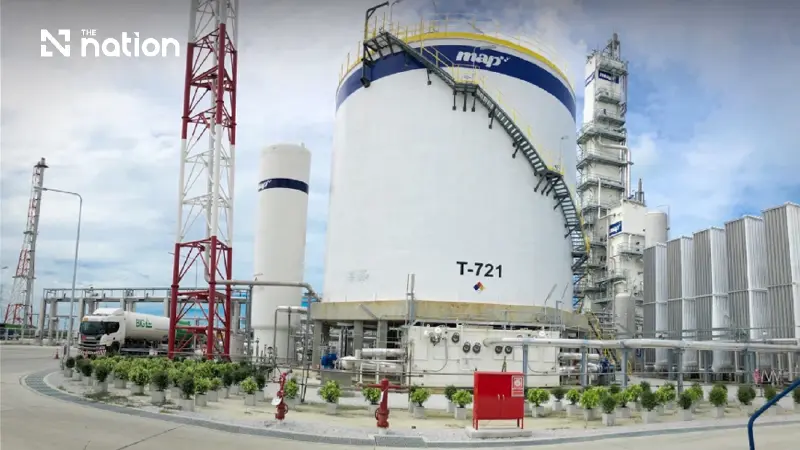


BIG's Map Ta Phut plant in Rayong uses cold energy from LNG to make lower-carbon industrial gases, support essential industries and advance Thailand's net-zero transition.
- Bangkok Industrial Gas (BIG) is utilising the cold energy released when liquefied natural gas (LNG) is regasified to produce essential industrial gases with significantly lower energy consumption.
- This innovative process, implemented at its Map Ta Phut plant in Thailand, reduces greenhouse gas emissions by over 93,000 tonnes of carbon dioxide equivalent annually.
- The lower-carbon production of gases like oxygen, nitrogen, and argon supports vital industries crucial for economic growth, including healthcare, electronics, and emerging high-technology sectors.
- The company's products have received carbon footprint certifications verifying emissions reductions of over 50% compared to conventional methods, and a second plant is being built to double capacity and emissions savings.
Recovering the extreme cold released when liquefied natural gas (LNG) is converted back into gas offers Thai businesses a way to produce essential industrial gases with less energy and lower emissions. The benefits extend beyond factories, as oxygen, nitrogen and argon support industries ranging from healthcare and food production to the electronics that shape everyday life.
By using this cold energy to manufacture lower-carbon industrial gases, companies can improve production efficiency and reduce their environmental footprint while maintaining the supply of materials essential to economic growth and people's quality of life.
MAP turns LNG cold energy into lower-carbon gases
Bangkok Industrial Gas Co Ltd (BIG) is putting this technology into practice at its Map Ta Phut Air Separation Plant (MAP) in Rayong. Operated by a joint venture between BIG and PTT, MAP is the first plant in Thailand and Southeast Asia to use cold energy from LNG regasification in industrial gas production, according to the company.
The technology captures cold energy available as LNG returns to its gaseous state and uses it in air separation, reducing the energy required to produce oxygen, nitrogen and argon.
MAP began commercial operations in 2021 and has an annual production capacity exceeding 450,000 tonnes of industrial gases. BIG estimates that the technology can reduce greenhouse gas emissions by more than 93,000 tonnes of carbon dioxide equivalent annually.


Orla Charoenlarp, managing director of BIG, views the plant as part of the company's broader role in helping industries improve efficiency and reduce the environmental impact of their operations.
“BIG is more than a producer and supplier of industrial gases. We develop innovations and solutions that help customers improve efficiency, use less energy and cut greenhouse gas emissions,” she explained.
This approach forms part of BIG's Generating a Cleaner Future business strategy, which focuses on developing low-carbon technologies and solutions that support customers' sustainability objectives.
Orla also highlighted the largely unseen presence of industrial gases in everyday life, from the manufacture of components used in mobile phones to the provision of medical oxygen. Although consumers rarely encounter these gases directly, they are essential to many products and services.
MAP supplies gases for established industries, including petrochemicals, steel, electronics, food and beverages, and healthcare. Its role is also becoming increasingly relevant to emerging sectors such as semiconductors, electric vehicles, data centres and clean energy technologies.
These industries are important to Thailand's future economic development, particularly as manufacturers seek to strengthen competitiveness while responding to growing demand for lower-carbon production.
Certified products help customers cut emissions
Beyond its infrastructure investments, BIG is developing industrial gas products with measurable and independently certified carbon footprints.
The company has obtained Carbon Footprint of Product (CFP) certification for six principal products: liquid oxygen, liquid nitrogen, liquid argon, gaseous oxygen, gaseous nitrogen and hydrogen. According to BIG, the production of these gases can reduce greenhouse gas emissions by more than 50% compared with conventional processes.
Liquid nitrogen and hydrogen have also received Carbon Footprint Reduction (CFR) certification, marking what BIG describes as the first such recognition for industrial gas products in Thailand.
The certifications reflect improvements in production processes and energy management, with emissions reductions assessed against criteria established by the Thailand Greenhouse Gas Management Organisation (TGO).
“Obtaining both CFP and CFR certifications reflects our commitment to developing products and processes that deliver tangible greenhouse gas reductions while supporting our customers' sustainability goals,” Orla noted.

MAP2 expansion to support advanced industries
BIG is now expanding its low-carbon production infrastructure through MAP2, a second air separation plant being developed with PTT.
Once operational, MAP2 is expected to increase the two facilities' combined production capacity to nearly 900,000 tonnes annually, while the two plants could together reduce greenhouse gas emissions by more than 186,000 tonnes of carbon dioxide equivalent a year.
According to the company, MAP2 is under construction and is expected to begin operations in 2028. The additional capacity will strengthen industrial gas supply and support investment in the Eastern Economic Corridor (EEC), particularly among high-technology industries.
“Investment in MAP and MAP2 will strengthen industrial gas supply, support the expansion of high-technology industries and development of the EEC, and help drive Thailand towards a sustainable, low-carbon future,” Orla added.
Clear rules and incentives key to net-zero progress
Looking ahead, BIG's focus on certified carbon reductions reflects the growing importance of measurable sustainability performance rather than environmental commitments alone.
Orla emphasised the urgency of the transition, questioning whether the world would wait for those moving too slowly towards cleaner energy and lower emissions.
She indicated that accelerating progress towards net-zero emissions requires clear rules and a combination of incentives and penalties. Such measures could encourage businesses to adopt cleaner technologies and move more quickly towards their environmental objectives.
For BIG, the practical response involves continued investment in low-carbon production infrastructure, improvements in energy efficiency and solutions that help customers measure and reduce their emissions.
Thailand's broader challenge is to extend these efforts across industries. Clear policy direction, incentives for investment, cooperation between businesses and measurable emissions reductions will be essential if the country is to maintain industrial competitiveness while advancing towards net-zero carbon emissions.
