
WHA WHAUP Outlines THB20bn to Power and Water Infrastructure for Thailand’s Future Industries
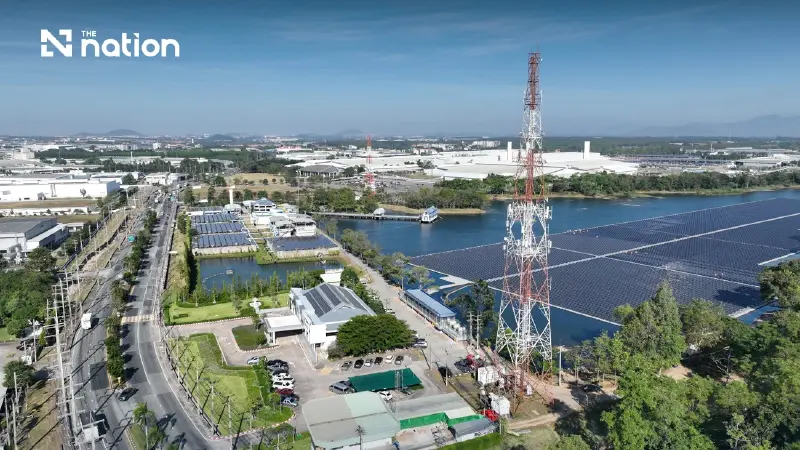


Utilities and Power arm of WHA Group unveils 14 MW solar at AAT and outlines water reclamation, Direct PPA and storage plans to serve next-generation industries
- WHA Utilities and Power (WHAUP) has announced a five-year, THB 20 billion investment plan for power and water infrastructure to support Thailand's growing AI and data centre sectors.
- The investment will be split evenly, with THB 10 billion allocated to the power division and THB 10 billion to the water division.
- The water infrastructure plan focuses on expanding water reclamation and recycling capabilities to meet the high demand from data centres, which consume 12-16 times more water than typical industrial clients.
- Investment in the power division will target clean energy solutions, including solar projects, battery storage, and preparing for Direct Power Purchase Agreements (PPAs) to ensure resilient supply.
- The overall strategy is to provide the synchronized, uninterrupted, and sustainable water and power supply that is foundational for next-generation industries like AI and data centres.
The Utilities and Power arm of WHA Group unveils 14 MW solar at AAT and outlines water reclamation, Direct PPA and storage plans to serve next-generation industries
WHA Utilities and Power Plc (WHAUP) is positioning integrated water and clean-energy solutions as core infrastructure for Thailand’s expanding data centre and artificial intelligence sectors, with a five-year capital expenditure plan of approximately THB 20 billion (£450 million).
The investment will be split evenly between its power and water divisions, executives announced at a media briefing during a press tour of WHA industrial estates in Rayong on Friday (November 6).
The briefing also marked the commercial launch of a 14-megawatt (MW) solar installation for AutoAlliance (Thailand) Co., Ltd. (AAT). WHAUP is one of five core business pillars within the WHA Group ecosystem, alongside industrial estates, logistics, digital platforms, and electric-vehicle services.
Data Centres Reshape Industrial Water Demand
Hyperscale data centres are already altering the scale of WHAUP’s water operations. Over the past two years, the company has secured minimum-volume contracts for roughly 60 million cubic metres of water—equivalent to nearly half of the 120 million cubic metres it manages annually across Thailand.

Executives noted that data centres consume between 12 and 16 times more water than standard industrial tenants.
Akarin Prathuangsit, Chief Executive Officer of WHAUP, emphasised that while Thailand possesses sufficient raw water, climate pressures demand rigorous management. Drawing from eight interconnected water sources, WHAUP focuses on zero-loss distribution, flood mitigation, and balancing industrial supply with agricultural needs during dry spells.
“Water and power are the foundational pillars of industrial operations, particularly for next-generation industries that require uninterrupted, resilient supply,” Akarin said. “By synchronising energy and water solutions, WHAUP empowers manufacturers to optimise costs, mitigate resource volatility, and drive long-term operational resilience.”

Scaling Up Circular Water Systems
To meet escalating demand without overtaxing natural reserves, WHAUP is expanding its water-recycling capabilities. In 2017, the company launched its first wastewater reclamation plant at WHA Eastern Industrial Estate (Map Ta Phut).
Operating at a capacity of 25,000 cubic metres daily, the facility supplies roughly 25% of the estate’s total water needs while diverting 9.12 million cubic metres of wastewater from discharge each year. The multi-stage treatment process incorporates advanced filtration and reverse osmosis (RO).
The resulting high-grade RO permeate commands a 60% tariff premium over standard industrial water, enabling clients such as GPSC and GC to recycle water through multiple production loops and cut overall intake.

By 2030, WHA Group aims to reduce natural water extraction by 25 million cubic metres annually—saving THB 290 million a year in raw-water costs, an amount equal to the consumption of 685,000 people.
The group also intends to power 100% of its water treatment facilities using renewable energy and ultimately eliminate wastewater discharge across all estates.
Technology underpins these targets. Inbound wastewater quality is monitored via real-time sensors, while AI models forecast membrane performance and guide pressure and chemical dosing, extending membrane lifespans to around five years.

At Map Ta Phut, a micro-turbine system named Hydro XS generates continuous electricity from residual water pressure, while a centralised Unified Operation Centre provides real-time monitoring of utilities and flood-prevention systems.
Clean Power: AAT Serves as Proof of Concept
The newly commissioned solar project for AAT demonstrates WHA Group’s integrated business model. AAT—a Ford–Mazda joint venture established in 1995 operating a 529-rai (around 209.15 acres) manufacturing plant in the Eastern Seaboard—initially contracted WHAUP for water services before adding clean energy, alongside industrial infrastructure from WHA Industrial Development and logistics support from WHA Logistics.
Under a fully funded model, WHAUP financed, constructed, and now operates a 6 MW rooftop solar array alongside an 8 MW floating solar system under a long-term power purchase agreement (PPA).
Connected directly to AAT’s production lines, the 14 MW installation required zero upfront capital from the manufacturer and now supplies 25% of the facility's power. AI-driven monitoring has raised daytime system availability from 97% to 99.98%.
“The global automotive industry has reached a decisive turning point where decarbonisation and renewable energy adoption are vital to long-term competitiveness,” said Silvio Illi, president and CEO of AAT. “Over the long term, AAT is targeting 100% clean energy. We are confident that partnering with an industry leader like WHAUP will be instrumental in enabling our energy transition.”
WHAUP’s total solar portfolio currently stands at 251 projects, either operational or under construction, spanning rooftop, floating, ground-mounted, and car park arrays.

Policy Tailwinds: PDP 2026 and Direct PPAs
Regulatory shifts are expected to unlock further growth. The draft Power Development Plan (PDP 2026) prioritises grid modernisation and clean-energy integration. Akarin noted that while the Thai government has established clear tariff categorisations for data centres, the market still awaits definitive rules on how hyperscalers can access green power directly, given the national grid's ongoing reliance on fossil fuels.
A critical milestone will be the rollout of regulations governing Direct PPAs via Third-Party Access (TPA), which would allow industrial consumers to procure renewable energy directly from independent power producers.
Akarin highlighted this mechanism as a key "quick win", enabling immediate connection of solar installations across rooftop and spare land assets within WHA estates.
“WHAUP is uniquely positioned to seize policy-driven opportunities,” he said. “Our diversified renewable portfolio, paired with extensive infrastructure and a deep industrial client base, provides a solid launchpad to scale Direct PPA offerings once regulatory frameworks are finalised.”
Rising international compliance requirements—specifically pressure on global supply chains to reduce Scope 2 and Scope 3 emissions—are further accelerating tenant demand.

Storage, P2P Trading, and Carbon Tools
Decreasing battery storage costs are expanding customer options.
“Customers are asking whether clean energy coverage can be extended from four hours to six, or six to eight, while remaining cost-competitive with grid power,” Akarin observed.
WHAUP is actively negotiating a large-scale battery storage project designed to lift a major customer's renewable energy share past 20%, with others requesting configurations of up to 40% or 60%.
In addition, WHAUP operates RENEX, a peer-to-peer (P2P) energy trading platform within its industrial estates. The platform currently connects four rooftop solar "prosumers" (supplying up to 2 MW) with over 30 industrial consumers (representing up to 20 MW of peak demand).
WHAUP also provides Renewable Energy Certificate (REC) procurement alongside its proprietary CO2ZERO emissions-tracking platform.

Financial Targets and Long-Term Horizon
For 2026, WHAUP has set a target of 170 million cubic metres in total water supply and wastewater management volume—including 41 million cubic metres in Vietnam and 11 million cubic metres of value-added water products.
In power, the company aims to reach a cumulative secured PPA capacity of 1,124 equity MW, including 596 MW of renewables. By 2030, WHA Group targets 1,200 MW of renewable equity capacity, offsetting 683,000 tonnes of CO₂ equivalent annually.
Capital expenditure is projected at approximately THB 3 billion this year and a similar figure next year, contributing to the total THB 20 billion five-year plan.
Power allocation will cover solar, battery storage, Direct PPA readiness, community energy projects, and civil works for Thailand’s “Big Lot” renewable scheme, where WHAUP has secured over 120 MW.

Water spending will target new industrial capacity and further reclamation plants. Management confirmed full-year operational targets remain on track.
Looking further ahead, Akarin noted that while energy storage and high-efficiency photovoltaic panels will dominate the market over the next four to five years, Small Modular Reactors (SMRs) are likely to play an essential role in the long term, with national planning envisaging a first deployment within 12 years. Public education regarding safety will be crucial to adoption, he added.
