
World Bank Group, NESDC and KASIKORNTHAI FOUNDATION pilot Natural Capital Accounting in Nan
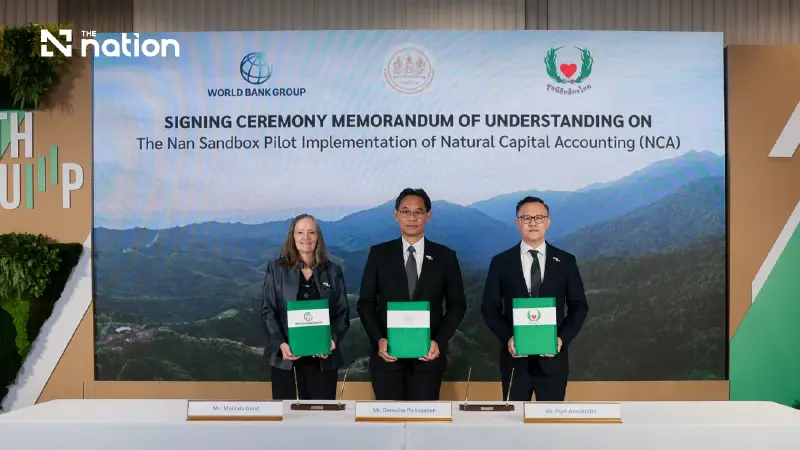


World Bank Group, National Economic and Social Development Council (NESDC) and KASIKORNTHAI FOUNDATION (KTF) are working together to pilot natural capital accounting (NCA) in Nan province, in a move aimed at placing measurable economic value on Thailand’s natural resources while supporting livelihoods and environmental sustainability.
A memorandum of understanding on the “Nan Sandbox Pilot Implementation of NCA” was signed recently during Earth Jump 2026: A Bridge to Empowered Actions, held at Siam Paragon in Bangkok.
The first phase of the project will focus on assessing the natural capital value of the Nan watershed, which serves as a major watershed forest area for the Chao Phraya River. Around 85% of the Nan province is classified as reserved forest.
The Bank Group’s Global Program on Sustainability (GPS) will support data collection and measurement under the pilot, which could provide input for the NESDC’s preparation of the 14th National Economic and Social Development Plan.
The project is intended to help Thailand examine how data systems for NCA should be managed, how natural assets should be valued, and how public-sector standards could support future pricing approaches and possible and private-sector participation. The pilot is also expected to highlight how natural capital data can support local livelihoods and community participation, ensuring that valuation work reflects both ecological importance and the people who depend on these resources.
What Natural Capital Accounting means
According to the Bank Group, natural capital accounting measures the stocks and flows of natural assets and converts them into metrics that are compatible with existing national accounting systems.
This allows governments and investors to weigh economic variables alongside ecological variables, offering a clearer picture of how an economy is performing not only financially but also environmentally.
NCA can cover several types of accounts, including water, land, forestry and energy accounts, as well as accounts linked to externalities such as air pollution. The accounts used by each country depend on its natural resource base and what it considers valuable. The United States offers one example: when its natural capital assets were calculated, their value was estimated at around US$1 trillion. This raises a similar question for Thailand: what is the real value of the country’s natural assets, and what is being lost when those resources are used without their true economic and environmental value being taken into account?
Turning that question into usable policy and investment tools, however, takes time. While NCA can be applied in many ways, building the accounts normally requires a two- to three-year process before they become fully usable for government policy-making and investor decision-making.
World Bank Group sees opportunity in Thailand’s 14th plan
Melinda Good, World Bank Division Director for Thailand and Myanmar, said the MoU would help Thailand apply global standards for natural capital accounting in a practical way.
She described the timing as especially important, as Thailand looks ahead to the 2026 IMF-World Bank Group Annual Meetings in Bangkok and as the NESDC is preparing the 14th National Economic and Social Development Plan. By assigning value to Thailand’s natural resources, NCA could help the government make more informed decisions on how those assets should be used, protected and sustained.
“The idea of NCA is that, on the government side, you can actually put value to Thailand’s hugely rich natural resources,” Good said. “Put that into the planning to help decide how we can sustain those resources.”
That valuation, she added, could also support blended finance. Once natural assets are properly measured and their long-term sustainability is clear, private investors would have greater confidence in sectors such as agribusiness, health and wellness, and tourism.
Good noted that these industries are among Thailand’s natural comparative advantages, but they also rely heavily on the country’s environmental assets.
“If we are going to attract investment into these sectors that will help boost Thailand, if we are making a bet on those sectors, we need to be valuing that natural capital in order to attract that sort of investment,” she said.
She added that natural capital is a key part of Thailand’s competitive strength and if the country can bring natural capital into the heart of economic planning, it will not only protect nature, it will strengthen the economy and help build Thailand’s future today.

Natural capital as a future asset class
Pipit Aneaknithi, Chairman Global Sustainability at KASIKORNBANK, on behalf of KTF, explained that the Bank Group’s role would help translate natural capital accounting into a new language of cost and value aligned with global standards.
He described natural capital as a potential new asset class that could eventually be invested in and traded, changing the way countries approach economic development.
Pipit outlined KTF’s role in two areas. The first is to help build the foundation for the Nan pilot as a replicable model, showing that Thailand does not need to start from zero because there are already domestic players willing to develop the concept.
The second is to encourage the Thai government to test and strengthen the foundation so that the model can later be replicated in other projects or adapted from international examples.
He compared the goal with carbon credits, where global standards allow participants to speak the same language. In the long term, he suggested, natural capital assets could potentially be recognized or exchanged not only within Thailand but also across borders, subject to appropriate standards and governance.
Pipit added that once buying and selling systems emerge, banks could also play a role as intermediaries between buyers and sellers of this new type of asset.
“Because this work is rooted in Nan, those working in the area can help collect data and facilitate the process,” he explained. “We do not yet know whether to count forests by the tree or soil by the grain, or how measurement, scope and sampling should be designed. That is the technical expertise the Bank Group already has, while we are on the ground and can work together”.
He expected the collaboration to help allocate funds and capital in a way that strengthens “optimum systemic resilience”, shifting the economic model from extractive capitalism to regenerative capitalism.
Under that approach, he explained, resource use would be better reflected in costs, and environmental impacts would be more systematically priced, creating a new market mechanism.
Pipit also raised the possibility of linking the old GDP-based economy with a new “GDP Plus” model, in which additional value from natural capital is gradually added to conventional economic value.
If the economy currently runs 99% on the old GDP system and 1% on new value, he suggested, the balance could gradually shift to 90% and 10%, helping create a more balanced economy.
He also pointed to the implications for corporate disclosure, noting that companies listed on the stock exchange could one day report natural capital accounts as part of their measurement and disclosure frameworks.
This would not be limited only to green or nature-related activities, he explained. Companies that create social value could also account for it, helping mobilize private capital to support the government in national development.

NESDC says stronger data is needed for policy-making
Danucha Pichayanan, Secretary-General of the NESDC, acknowledged that collaboration on natural capital accounting would not be easy and would take time.
He said the work covers a wide range of complex areas, from biological and technical issues to natural resources, ecosystems and cultural resources. Thailand’s existing database, he added, is not yet complete, making data availability one of the key limitations.
Beyond building a stronger database, Thailand must also study how natural assets should be valued. Danucha stressed that this would require genuine cooperation and the Bank Group’s technical expertise to ensure the results can properly represent the country’s natural capital.
If successfully implemented, he said, NCA could become an important tool for development policy by giving decision-makers evidence-based figures rather than relying mainly on broad statements.
He added that the framework could help Thailand strike a better balance between using natural resources for national development and sustaining them for the future. It could also support climate-change mitigation and adaptation.
“I think this is an important step for Thailand in the next decade,” Danucha said. “When we have this tool — even while it continues to be refined— we can use it to help shape and implement national policies more carefully.
“We can better understand the positive and negative impacts that may occur. Most importantly, it can be a tool to help us sustain resources for future generations.
