
Thailand on alert as US shifts trade war to Section 301 probes
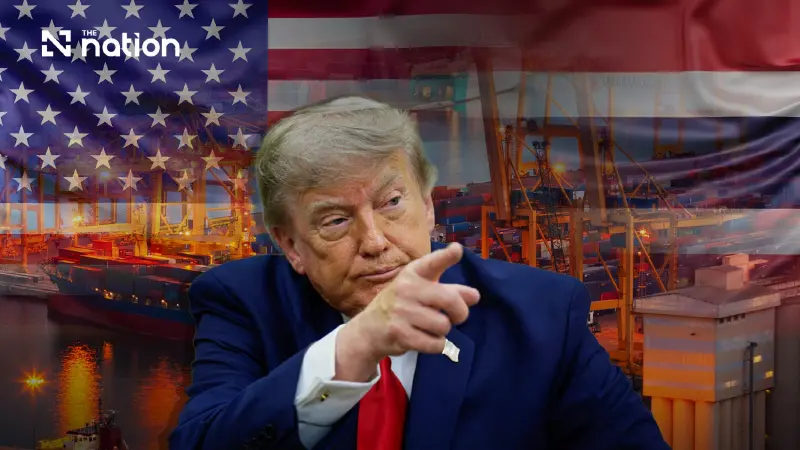


The US is moving from broad reciprocal tariffs to targeted Section 301 investigations, putting Thailand under scrutiny over forced labour controls and industrial overcapacity.
- The U.S. is shifting its trade war strategy from broad tariffs to targeted investigations under Section 301 of the Trade Act, creating new uncertainty for Thailand.
- Thailand is specifically identified as one of the countries under scrutiny by the U.S. Trade Representative (USTR) in these new probes.
- The investigations into Thailand are focused on two primary concerns: the use of forced labour in supply chains and structural excess capacity in industrial production.
- Key Thai industries, including fisheries, seafood, steel, and electronics, could face countermeasures like new tariffs or import restrictions if the U.S. finds grounds for action.
Thailand is entering a new phase of trade uncertainty as the United States shifts its strategy from broad-based reciprocal tariffs to targeted investigations under Section 301 of the US Trade Act of 1974.
The move marks a change in Washington’s trade-war playbook under President Donald Trump, after earlier attempts to use sweeping reciprocal tariffs were constrained by a US Supreme Court ruling. Rather than ending the trade conflict, the ruling has pushed Washington towards legal tools with a more specific and potentially longer-lasting impact.
Section 301 is not, by itself, a tariff. It is a legal mechanism that allows the Office of the United States Trade Representative, or USTR, to investigate whether a trading partner’s policies or practices are unfair or burdensome to US commerce. If the investigation finds grounds for action, Washington may impose countermeasures, including additional tariffs, import restrictions or suspension of trade benefits.
For Thailand, the concern is no longer only about negotiating tariff rates. Thansettakij reported that Thailand is among the countries under USTR scrutiny, with attention focused on two key issues: forced labour and structural excess capacity in industrial production.
The first issue relates to supply-chain labour standards. Under US trade law, especially Section 307 of the Tariff Act of 1930, the US bans imports of goods made with forced labour. Section 301 gives USTR room to examine whether trading partners have adequate systems to prevent such goods from entering the US market, directly or through third countries.
Industries that could come under closer watch include fisheries, processed seafood, processed agricultural products, labour-intensive goods and sectors employing large numbers of migrant workers. Although Thailand has continued to improve labour laws and traceability systems, the key challenge is to convince Washington that Thai oversight can effectively prevent forced-labour-linked products from entering export supply chains.
The second issue, structural excess capacity, reflects a broader change in US trade thinking. Washington is increasingly looking beyond dumping prices and asking whether a country’s industrial structure produces more than market demand, especially where state support may distort competition.
For Thailand, industries likely to attract attention include steel and metal products, chemicals and petrochemicals, some electrical appliances and electronics, and cost-sensitive industrial goods. However, being under investigation does not mean these products will automatically face new tariffs. It means the US has opened a process to assess risks and decide whether countermeasures are justified.
The timing is also important. US temporary tariff measures under Section 122 are due to expire around July 24, 2026, making the period a critical moment for Washington to decide whether Section 301 will become the next major instrument in its trade policy.
If additional Section 301 tariffs are imposed in the future, Thai exporters could face higher costs, weaker price competitiveness and pressure from US buyers to reassess sourcing decisions. Foreign investors using Thailand as a production base for exports to the US may also have to recalculate supply-chain risks.
The wider lesson is that global trade competition is shifting from a price war to a standards war. Future export competitiveness will depend increasingly on transparent supply chains, labour standards, environmental compliance and the ability to prove product origin.
For Thailand, the task ahead is clear: engage Washington with credible information, strengthen traceability systems, show that Thai industry competes on market principles, and reduce dependence on any single export market.
The new US trade game may be more targeted than past tariff battles, but it is also more complex. Thailand’s best defence will be not only negotiation, but proof that its production systems meet the new rules of global trade.
Source: Thansettakij
