
Global plastic pollution efforts focus on recycling and cooperation
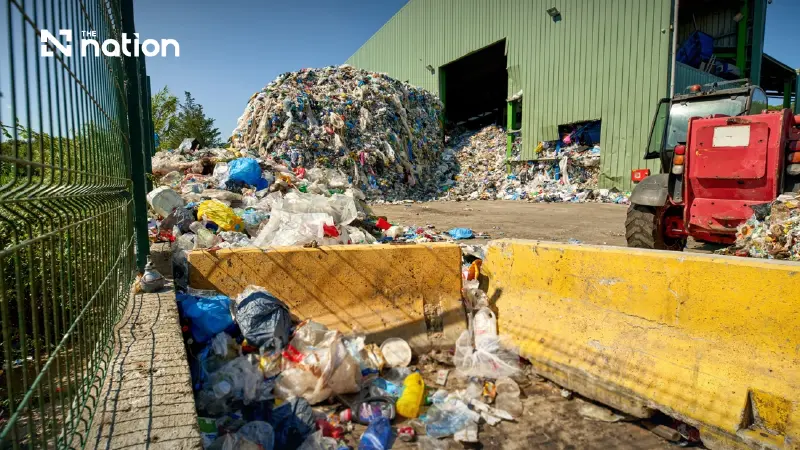


As plastic use could triple by 2060, countries including Thailand are expanding recycling systems, circular-economy measures and cross-sector partnerships.
- The US$4.5 trillion in lost economic value is attributed to systemic inefficiencies across the entire plastics lifecycle, from design and production to recovery.
- This economic loss corresponds to the more than 460 million tonnes of plastic waste generated annually, representing a massive failure to recover and reuse valuable materials.
- Solutions to capture this lost value focus on multi-stakeholder cooperation and systemic change,
The world is sinking under more than 460 million tonnes of plastic waste each year.
More alarming than the figure itself is the fact that about 19 million tonnes escape into the environment, wreaking havoc, damaging biodiversity, worsening the greenhouse-gas crisis and ultimately harming our own health.
If the trend continues, global plastic use could triple by 2060.
The message from global forums, from London Climate Action Week to efforts to advance the Global Plastics Treaty, is consistent: “incremental” measures are no longer enough. What is needed is a “major structural transformation”.
More than a waste problem: a systemic failure
If we continue to view the plastic problem only as “end-of-life waste”, solutions will miss the root cause.
The real problem is inefficiency across the entire materials cycle, from design and production to use and recovery.
Ignoring these economic dimensions means losing material value, incurring extremely high system costs and placing immense pressure on natural resources.
The value of these lost economic opportunities reaches US$4.5 trillion.
Although negotiations on the Global Plastics Treaty have dragged on since around 2125, this has become an opportunity to reconsider “what can be done in practice and is already working today”.
Regions around the world are showing that national action can move forward alongside the global process.
Innovation is not the problem.

Cooperation is the key
The good news is that technology and innovation are not in short supply.
Many countries have improved collection systems, expanded recycling infrastructure and redesigned products for sustainability.
Africa is a clear example.
The absence of a common standard for food-contact recycled plastic (rPET) had discouraged investment, but key bodies including ARSO, ACEA and UNEP have now worked together to establish a new rPET standard for Africa, helping unlock investment and intra-regional trade.
The Philippines, meanwhile, faces more than 163 million discarded flexible plastic sachets each day and loses US$890 million in recyclable value each year.
It has established a plastics working group bringing together government, business and civil society to advance end-to-end recycling technologies.
The World Economic Forum’s Global Plastic Action Partnership (GPAP) has 25 countries working together to develop National Plastic Action Roadmaps.
Nigeria is a strong example of the potential: applying circular-economy measures in earnest could lift the plastic recycling rate to 58%, cut pollution by 67% and create nearly 97,000 new jobs by 2040.

Thailand steps up its national fight against plastic waste
In Thailand, plastic waste remains a pressing national priority.
According to the Pollution Control Department, the country is continuing to implement the Action Plan on Plastic Waste Management Phase 2 (2023–2027), building on earlier campaigns to reduce the use of plastic carrier bags and foam food containers, which cut waste by hundreds of thousands of tonnes.
Government Public Relations Department
The Phase 2 plan sets clear targets for 2027.
These include bringing 100% of targeted plastics, including plastic bottles, bottle caps, single-layer plastic films, carrier bags and plastic cups, into the recycling system, while reducing plastic waste leaking into the sea by 50%.
They are to be supported by management tools such as extended producer responsibility (EPR) legislation and environmentally friendly product standards, together with cooperation with the private sector and research institutions to develop bioplastics and reduce the burden of residual waste in the environment.
Ministry of Natural Resources and Environment
However, lessons from around the world and Thailand’s own context reinforce the same conclusion: “No single organisation can solve this problem alone.”
Addressing plastics at national and international levels requires government policy, funding from financial institutions and the industrial sector to move in the same direction.
As the next round of Global Plastics Treaty negotiations moves forward, global and Thai leaders must build on “what has already worked” and scale it up.
Plastic pollution is not a distant issue.
It is a systemic crisis in which the environment, the economy and the air we all breathe are at stake.
Source: Bangkokbiznews
