
Cabinet asked to ease levy for Andaman gas exploration
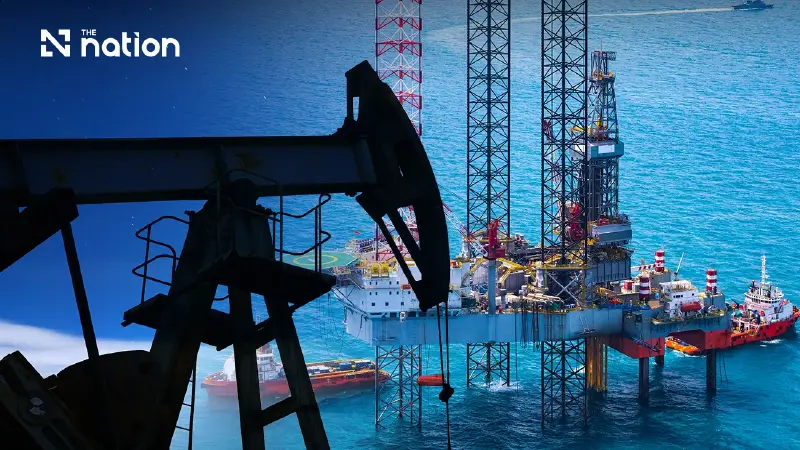


Thailand is seeking lower SRB charges in the 26th round bidding to attract deep-water bidders as proved gas reserves are estimated to cover only 4.6 years.
The Energy Ministry has asked the Cabinet to consider reducing a special levy on the successful bidder for a deep-water petroleum block in the Andaman Sea, as Thailand seeks new domestic gas supplies to offset declining production from the Gulf of Thailand.
An Energy Ministry source said the proposed incentive would apply to the 26th petroleum exploration and production bidding round, which the Department of Mineral Fuels (DMF) plans to open in the southern Andaman Sea within 2026.
Thailand’s proved natural gas reserves, known as 1P reserves, were estimated at the end of 2025 to be sufficient for only another 4.6 years, according to DMF data. Proved and probable reserves, or 2P reserves, would extend the estimated remaining period to 8.6 years.
Without further exploration and development of new fields, Thailand would face a widening domestic gas shortfall.
The country already relies heavily on imported energy, bringing in around 90% of its crude oil requirements and meeting about 46% of its natural gas demand through liquefied natural gas imports.
Lower SRB proposed for high-risk exploration
The proposal submitted to the Cabinet concerns the calculation of the Special Remuneratory Benefit (SRB), an additional annual payment collected from petroleum concessionaires when projects generate high excess profits.
Under Thailand’s petroleum law and the progressive fiscal regime known as Thailand III, concessionaires may be required to pay the state an SRB equal to between 0% and 75% of revenue, depending on a project’s profitability.
The ministry is seeking more flexible and favourable parameters for the Andaman block, effectively providing a fiscal incentive to offset the high initial risks and costs of deep-water exploration.
The source said the measure would not remove the SRB but could reduce the amount payable if a company invested in exploration and subsequently made a commercially viable discovery.
“Investment in the Andaman Sea involves a very high level of risk,” the source said.
“If a private company is prepared to bear the cost of drilling a deep exploration well at almost 1 billion baht and later succeeds in finding petroleum, the government would collect the SRB at a lower rate to compensate for that initial risk.”
Frontier block spans more than 26,000 sq km
The 26th bidding round will cover exploration block A1/68, an area of approximately 26,223 square kilometres in the southern Andaman Sea.
The block is classified as a Frontier Basin because it is a largely unexplored area where petroleum resources have not yet been commercially established.
Officials nevertheless consider the block highly promising because of its thick sedimentary layers and geological connections to Indonesia’s North Sumatra Basin.
Major discoveries have already been reported on the Indonesian side of the Andaman region. They include:
The Timpan field, estimated to contain up to 1.4 trillion cubic feet of gas
The Layaran field, estimated at up to 3.3 trillion cubic feet
The Tangkulo field, with more than 2 trillion cubic feet
A discovery of more than 7 trillion cubic feet announced by Mubadala Energy in Indonesia’s South Andaman block
The DMF is conducting detailed studies of the Thai block’s petroleum potential, compiling geological and geophysical information and defining the exploration boundaries before issuing the invitation to apply.
Thai Andaman could hold up to 10 TCF
Preliminary studies indicate that the Thai section of the Andaman Sea could contain as much as 10 trillion cubic feet of natural gas.
The ministry source said that if half of that potential volume were discovered and successfully developed, the supply could strengthen Thailand’s energy security for as long as 20 years.
Domestic production would also reduce exposure to imported LNG prices, which can fluctuate sharply because of international supply conditions and geopolitical conflicts.
The Andaman Sea is therefore regarded as a potential source of gas during Thailand’s transition towards a different energy mix, although the scale and commercial viability of any resources will remain uncertain until exploration drilling is completed.
One exploration well could cost US$27 million
Deep-water drilling requires advanced technology and substantial capital. The cost of drilling a single exploration well in the proposed block could reach US$27 million, or almost 1 billion baht.
The ministry believes more flexible fiscal terms could encourage international energy companies with the necessary technology and financial capacity to participate.
According to the source, Chevron, TotalEnergies, Eni, Exxon and PTT Exploration and Production (PTTEP) have expressed interest in the 26th bidding round.
The DMF expects to announce the invitation and open applications for exploration and production rights before the end of 2026.
Onshore bidding winners await Cabinet approval
The ministry is also advancing the 25th petroleum bidding round, covering nine onshore exploration blocks with a combined area of 33,444.64 square kilometres.
Seven blocks are in the Northeast: L1/66 to L5/66, L7/66 and L9/66. Two blocks, L6/66 and L8/66, are in the Central region.
The exploration areas cover several provinces, including Khon Kaen, Udon Thani, Nakhon Ratchasima and Ratchaburi.
Five companies submitted eight final applications in total.
The DMF has completed its selection of the successful bidders, and the results are being prepared for submission to the Cabinet for approval. The Cabinet is expected to consider the winners by the end of 2026.
Source: Thansettakij
