
Finance Chief, Central Bank Chart Thailand's Path to Global Trust
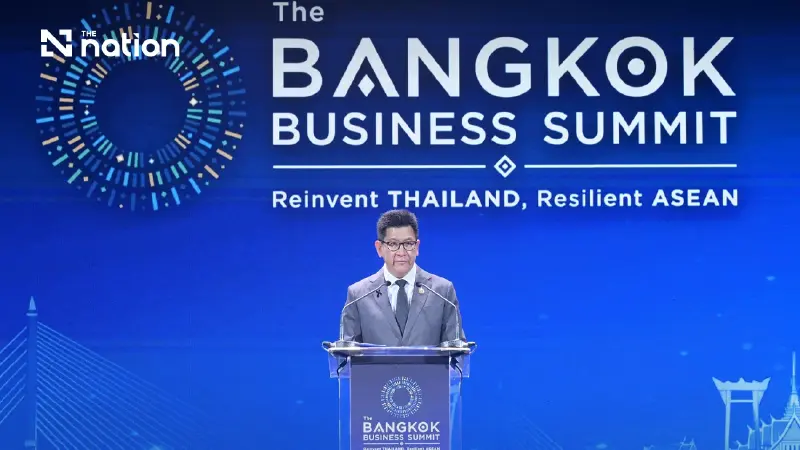


Thailand's finance chief and central bank governor set out at Bangkok's summit how the kingdom aims to become Asia's trusted economic partner
- Thailand's top economic policymakers are promoting "trust" as the country's next key competitive advantage, aiming to position it as a stable and reliable economic partner in Asia.
- The Finance Minister outlined a strategy to build trust by leading a regional ASEAN response to four borderless challenges: geopolitical shifts, artificial intelligence, climate change, and aging populations.
- The central bank is earning trust in practice by combating the rise in digital financial fraud and cyberattacks, successfully cutting losses and developing a "Bangkok Blueprint" for fraud resilience as an international standard.
Thailand's finance chief and central bank governor set out at Bangkok's summit how the kingdom aims to become Asia's trusted economic partner.
Thailand's top economic policymakers used Thursday's Bangkok Business Summit to argue that the kingdom's next competitive advantage will not be cost or geography alone, but trust — its ability to prove to investors and ASEAN neighbours that it can be relied upon as a stable connector in a fracturing global economy.
Deputy Prime Minister and Finance Minister Ekniti Nitithanprapas explained why that trust is under strain, citing four borderless shifts no single ASEAN country can manage alone.
Bank of Thailand Governor Vitai Ratanakorn set out how Thailand is earning that trust in practice, detailing rapid growth in digital finance alongside a rise in fraud and cyberattacks and the central bank's response.
Payong Srivanich, chairman of the Thai Bankers' Association and of the Joint Standing Committee on Commerce, Industry and Banking (JSCCIB), closed by urging the ideas be converted into regional action.
The three delivered keynotes at the Bangkok Business Summit: Reinvent Thailand, Resilient ASEAN, organised by the Joint Standing Committee on Commerce, Industry and Banking (JSCCIB) with the Finance Ministry, the Bank of Thailand, the National Economic and Social Development Council, and the World Bank.
Ekniti: four borderless disruptions demand a regional response
Speaking under the theme "Unlocking the New Regional Growth Engine with Thailand's New Horizon", Ekniti said the global economy was undergoing fundamental change Thailand could not navigate alone and that the country needed to link its strengths with ASEAN neighbours.

Thai growth has historically rested on trade, investment and openness, he said, but openness alone was no longer enough, since investors now weighed supply-chain security as heavily as cost.
He identified four structural shifts ASEAN must confront jointly.
The first was geopolitics and geoeconomics: firms that once chose locations on cost alone now had to factor in tariffs, export controls, subsidies and rules of origin. That, he argued, required governments to cooperate on regulation, infrastructure and standards, while private firms link up through regional supply chains.
The second was artificial intelligence — a new source of productivity and competitiveness resting not only on the technology itself but also on semiconductors, computing power, data centres and skilled workers.
AI could sharpen manufacturing efficiency and spawn new business models, he said, but would also reshape the skills the economy needs.
Thailand and ASEAN, he argued, should not treat AI purely as a contest to attract investment but should extend digital infrastructure and AI adoption to small and medium-sized businesses and communities, not just large firms.
The third was climate change, linked to food security and production stability: drought in one region can move food prices worldwide, while floods elsewhere can halt production given how tightly global supply chains are linked.
He cited the ASEAN Power Grid as the kind of energy cooperation needed to use regional resources efficiently and strengthen energy security.
The fourth was ageing populations, squeezing the workforce, productivity and public finances — but which he framed as an opportunity too, citing medical, wellness and pharmaceutical industries.
Demographic diversity across ASEAN, he argued, could become a shared strength: Thailand and Singapore have experience adapting healthcare for older populations, while Vietnam, the Philippines and Laos retain younger, larger workforces that, linked together, could turn ageing into a basis for cooperation rather than a constraint.
What unites all four shifts, Ekniti said, is that none respect national borders — so no ASEAN country can manage them alone. What the region must build instead is a network of "trusted connectors" turning each country's strengths into shared power.
Thailand's role is to be open, reliable and globally connected, he said, but one connector is not enough; the region needs a network linking every ASEAN state, with the government setting strategy and the private sector converting ideas into investment.

Vitai: built digital trust, but fraud is rising just as fast
Governor Vitai, delivering the special keynote "Thailand's New Horizons: Empowering People, Building Resilience", opened with the past decade's toll: pandemic, geopolitical conflict and rapid technological change have pulled Thailand's trend GDP growth down from an average of 5.3 per cent after the 1997 Asian financial crisis to 3.7 per cent following the 2008 global crisis to roughly 2.4 per cent since Covid-19.
The task now, he said, is not merely recovery but building lasting resilience and competitiveness.
He noted Thailand will host the IMF-World Bank Group Annual Meetings for only the second time in 35 years this October, welcoming over 15,000 delegates from 191 countries under four pillars: digital and AI transformation; resilience in a fragmented world; climate-adaptation finance; and a longer-lived economy.
On digital infrastructure, he pointed to PromptPay, Thailand's fee-free instant transfer system, which has over 83 million registered accounts and processed as many as 2.5 billion transactions in February 2026 alone, and to the Krung Thai Bank-developed "Pao Tang" app, used by more than 40 million people to distribute state assistance. Digital payment transactions surged from 21 billion baht in 2021 to 48 billion baht in 2025, he said, while digital financial service use grew nearly 70 per cent to 141 million accounts in five years.
That expansion has been matched by rising risk. Asia accounts for roughly two-thirds of global losses from online scams, Vitai said, and Thai losses from digital financial fraud have exceeded 40 billion baht — about 0.2 per cent of GDP — while cyberattacks on Thailand's banking sector rose 45 per cent in 2025, mostly DDoS attacks, malware and phishing.
In response, the central bank has worked with the IMF and World Bank on a "Bangkok Blueprint for Fraud-Resilient Financial Services" to launch at October's annual meetings as an international reference standard.
Domestically, measures have cut unauthorised "money-draining app" withdrawals to zero since January 2025, alongside a mule-account crackdown and daily transfer limits that cut losses from authorised push-payment scams from a peak of 8.6 billion baht in the second quarter of 2024 to 1.8 billion baht a year later — nearly 80 per cent.
Four further measures target illicit flows: scrutiny of cash withdrawals above five million baht, cutting high-value withdrawals by 52 per cent; tighter reporting on gold bullion withdrawals above two kilogrammes, cutting withdrawal volumes by 70 per cent; stricter foreign-exchange rules; and cooperation with the Securities and Exchange Commission on abnormal USDT trading.
On 10 September the central bank will launch a "Framework on Safeguarding the Financial Sector from Illicit Activity", backed by over 2,000 financial institutions and payment providers pledging not to facilitate illicit or corrupt transactions.

Payong: turning potential into results, and dialogue into action
Closing under the theme "Resilient ASEAN: Asia's Next Growth Story Starts Here", Payong said the summit's purpose was to give government, business, financial institutions and international organisations a shared platform to set Thailand's economic direction amid geopolitical conflict, the AI transition, the energy transition and restructuring global supply chains.
Thailand has strong economic and industrial foundations, ready infrastructure, a strategic location and a stable financial system, he said, but the task ahead is converting that potential into results — lifting businesses from large corporates to SMEs so they can participate more fully in regional and global value chains.
Strengthening Thailand's competitiveness also strengthens ASEAN's supply chains, he argued, with low-carbon infrastructure and digital connectivity key to new regional opportunity.
He pointed to three milestones: the World Bank's flagship report, "Building Thailand's Future Today", charting a roadmap to high-income status; Bangkok hosting the IMF-World Bank Annual Meetings in October, its second time as host since 1991; and Thailand's ASEAN chairmanship in 2028.
The goal, he said, was to move "from dialogue to action", with government unlocking constraints and the private sector driving investment — so growth reaches the broader public, not a concentrated few.
