
Thailand and South Korea deepen copyright ties on AI and piracy
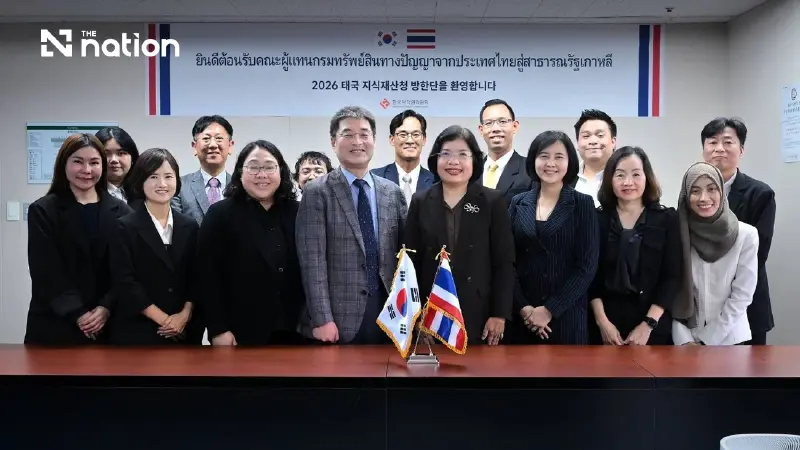


Thailand’s Department of Intellectual Property is expanding cooperation with four South Korean partners on AI, online piracy, music rights and IP financing.
- Thailand and South Korea are strengthening their copyright partnership, focusing on policies that balance the promotion of artificial intelligence (AI) with the protection of creators' rights.
- Discussions addressed the use of copyrighted works for AI training, with South Korea exploring fair use policies while Thailand now requires the disclosure of AI in copyright notifications.
- The nations are collaborating to combat online piracy, with South Korea sharing its model of using administrative powers and AI technology to block infringing websites without needing a court order.
- The cooperation also covers music rights management, including South Korea's policy of not registering fully AI-generated music, and exploring new intellectual property financing models.
Thailand’s Department of Intellectual Property (DIP) has held bilateral talks with four major South Korean organisations involved in copyright policy, protection and rights management as part of efforts to strengthen cooperation, improve copyright protection and create more income opportunities for Thai creators.
The four partners were South Korea’s Ministry of Culture, Sports and Tourism (MCST), the Korea Copyright Commission (KCC), the Korea Copyright Protection Agency (KCOPA) and the Korea Music Copyright Association (KOMCA).
DIP Director-General Auramon Supthaweethum explained that discussions with the MCST focused on policies to support the creative industries, particularly how the legal framework could balance the promotion of artificial intelligence (AI) innovation with the protection of creators’ rights.
The two sides also exchanged views on intellectual property (IP) financing, including the possibility of using copyrighted works as collateral for bank loans. Challenges remain, however, over confidence in asset valuations and the risks involved in selling them at auction if borrowers default.
South Korean representatives shared their experience with alternative fundraising models, including fractional investment in music royalties. The DIP could study such approaches as a way to broaden access to finance and generate greater economic value from intellectual property for Thai creators and businesses.
On AI-related copyright issues, the department held discussions with the KCC, led by chairman Seogweon Kang, on how policy could balance AI developers’ need to access data for model training with the rights of copyright owners whose works may be used.

Thailand has already begun requiring disclosure of AI use in copyright notification forms, while South Korea is studying the appropriate treatment of fair use and text and data mining (TDM) and consulting stakeholders on how such practices can be made transparent without undermining the legitimate rights of copyright holders.
The DIP also met KOMCA, a major South Korean music rights organisation which the department reported has a 99% market share. Discussions covered rights management, including blanket licensing and claim-basis licensing, as well as the distribution of royalties to rights holders.
According to the DIP, KOMCA does not accept the registration of music created entirely by AI, while works eligible for registration must be primarily created by humans or involve more than 50% human creative contribution.
Thailand and its South Korean counterparts also discussed unauthorised copyright claims on digital platforms involving older songs whose copyright has expired.
The South Korean side shared its experience of having collective management organisations (CMOs) enter into direct agreements with platforms to establish clearer procedures for managing rights. Such arrangements can also provide formal channels for examining and resolving disputes involving improper claims over works whose copyright has expired.
The same mechanisms can be used to deal with orphan works for which the rights holder cannot be identified, helping ensure that royalties are distributed correctly.

The DIP subsequently held talks with KCOPA, led by president Sungchun Yoon. According to the department, KCOPA has administrative powers to direct internet service providers (ISPs) to remove infringing content or block copyright-infringing websites without waiting for a court order.
KCOPA also uses AI and big data to collect and analyse information to detect copyright-infringing websites around the clock.
The two sides discussed ways to tackle cross-border rogue servers, including blocking access to disrupt advertising revenue and reducing the visibility of infringing sites on search engines. Cooperation against cross-border copyright infringement involving Internet Protocol television (IPTV) set-top boxes was also discussed.
KCOPA expressed its willingness to work with Thailand on investigations through its Digital Forensic Centre, which the DIP believes could strengthen Thailand’s capacity to tackle cross-border online copyright infringement.

The department believes closer cooperation with South Korean copyright organisations will help the bilateral cooperation framework keep pace with new economic and technological challenges, particularly those arising from AI.
It also expects the cooperation to strengthen copyright administration and online enforcement while improving confidence and creating more opportunities for businesses in both countries to expand bilateral trade and investment over the longer term.
