
World Bank and IMF leaders back practical AI to drive jobs and growth
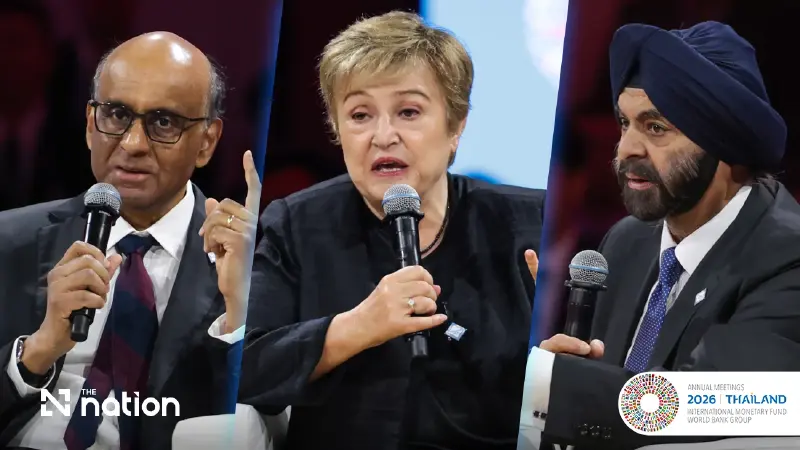


At the 2026 IMF–World Bank meetings in Bangkok, leaders say practical AI could create jobs and sustain economic growth, but warn that young workers face disruption.
- Leaders of the World Bank and IMF believe practical, affordable AI can create jobs and accelerate economic growth in developing countries, particularly in sectors like agriculture and healthcare.
- Investment in AI infrastructure is already helping to sustain global economic growth, with wider adoption of the technology expected to deliver the next major gains.
- The leaders warned that AI poses a significant risk to the labour market, potentially affecting 40% of jobs worldwide and widening the gap between economic growth and job creation.
- To realise AI's benefits, developing nations need reliable infrastructure, skilled workers, and government policies that support private investment and prepare the workforce for disruption.
Artificial intelligence (AI) could create new jobs, raise productivity and accelerate economic growth in developing countries, global economic leaders told delegates at the 2026 Annual Meetings of the International Monetary Fund (IMF) and World Bank Group in Bangkok on Monday (October 12).
At the Queen Sirikit National Convention Center, World Bank Group President Ajay Banga, Singapore’s President Tharman Shanmugaratnam and IMF Managing Director Kristalina Georgieva discussed how affordable, practical AI tools could benefit farmers, healthcare workers, businesses and entrepreneurs.
Their session, “Small AI: More and Better Jobs”, focused on technology suited to the needs and resources of developing economies.

AI investment supports global growth
Georgieva explained that surging investment in AI infrastructure was helping sustain global economic growth at around 3%, despite the energy supply shock. The expansion has particularly benefited Asian suppliers of AI hardware and infrastructure, including Thailand.
She estimated that the investment boom could add 0.5 to 1 percentage point to growth in advanced Asian economies and 0.2 to 0.8 percentage point in emerging Asian economies. These gains could also help offset the economic drag from ageing populations.
While the first wave of AI spending has largely involved infrastructure, Georgieva expected wider adoption to deliver the next major gains.
“The next wave of AI would be adoption. And there everybody can participate,” she told the gathering.
However, she stressed that developing economies needed reliable electricity, digital infrastructure, skilled workers and safeguards against misuse to realise the technology’s potential.

World Bank puts job creation at centre of AI strategy
Banga warned that approximately 1.2 billion young people would turn 18 over the next 15 years, making the creation of meaningful employment a development priority.
He argued that public investment in schools, healthcare, transport and training should be viewed through the lens of job creation. While governments could create the conditions for investment, private businesses would remain the main source of employment.
“It is private capital that creates jobs. Governments enable,” Banga explained, adding that the private sector generates between 75% and 85% of jobs.
He identified three conditions needed to attract investment: strong physical and human infrastructure, transparent governance and business-friendly policies, and government support to manage risks that deter private investors.
Banga highlighted five areas with strong potential for job creation: infrastructure, smallholder agriculture, primary healthcare, tourism and value-added manufacturing. He pointed to Thailand’s tourism sector as an example of opportunities for further job creation.
He argued that affordable “small AI” applications, rather than relying exclusively on expensive, advanced AI systems, could deliver practical benefits in developing economies.
In Indonesia, for example, clinic staff could use AI to assess patients and connect remotely with doctors for specialist support. In India, digital services were helping farmers access better seeds, fertilisers, crop insurance and credit, while securing better prices for their produce.
“The opportunity from small AI to build jobs and build productivity is enormous,” Banga emphasised.

AI could help entrepreneurs but widen the jobs gap
Tharman suggested that AI could reduce the cost of running a business, allowing individuals to reach customers, manage administration and start enterprises with fewer resources.
“AI is going to blur the distinction between being an employee and being an entrepreneur,” he observed.
However, economic expansion alone would not guarantee more jobs. He pointed to China, India and developing Southeast Asia, where relatively strong growth had not produced a comparable rise in job creation.
“Growth is going to be critical to secure good jobs, but growth is not itself going to be sufficient to achieve those good jobs,” Tharman warned.
He cautioned that AI could widen the gap between economic growth and job creation if governments failed to support workers, particularly those with intermediate skills and recent graduates.
Governments urged to prepare workers for disruption
Georgieva likened AI to a “slow-moving tsunami” approaching the labour market. The IMF estimates that AI could affect about 40% of jobs worldwide, enhancing some roles, downgrading others and eliminating some entirely. The share rises to 60% in advanced economies, compared with 23% in low-income countries.
She also cited findings that about one in ten jobs in the United States already required AI skills. As routine work declines, younger workers could struggle to gain the experience needed to advance their careers.
Tharman urged governments and employers to create more opportunities for graduates through internships, practical training and workplace learning, rather than relying solely on academic qualifications.
Georgieva called for closer monitoring of labour market trends, reforms to education and greater opportunities for lifelong learning. Governments would also have to reconsider tax policy if AI shifted income generation away from human labour and towards capital.
Despite the risks, the leaders stressed that technology could improve working lives if its benefits were shared widely.
“Get AI to do all the stuff we don't want to do and let us enjoy the things we love to do,” Georgieva concluded, adding that higher productivity and living standards should be accompanied by the preservation of human dignity and social worth.
