
Thailand outlines air force restructuring and air defence upgrades
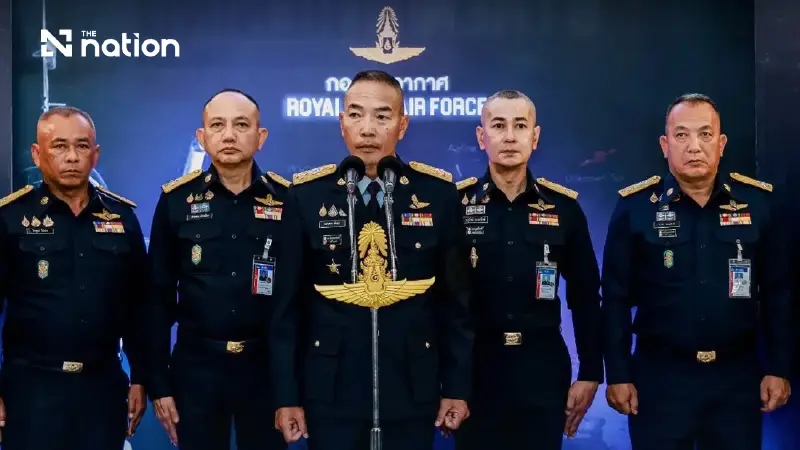


The air force chief outlines plans for three main combat wings, more drones and advanced weapons, with delivery of the first Barak MX phase expected in 2029.
- The Royal Thai Air Force (RTAF) will restructure over the next 10 years to become a smaller force, concentrating its main combat operations into three wings (Wings 1, 4, and 7) and dedicating other units to special missions and unmanned aircraft.
- Key procurement plans focus on quality over quantity, including new fighter/attack aircraft, unmanned combat air vehicles (UCAVs), precision-guided munitions, and long-range stand-off weapons.
- Air defence capabilities will be significantly upgraded through enhanced command and control systems, integrated air defence for bases, and the procurement of the Barak MX air and missile defence system, with the first phase delivery expected in 2029.
Royal Thai Air Force (RTAF) commander ACM Seksan Kantha outlined his policy intentions for 2027–2028 at the Chaloem Akat conference room of the Navaminda Kasatriyadhiraj Royal Air Force Academy in Muak Lek district, Saraburi. He gave two reasons for being there. The first was to commemorate the benevolence of His Majesty King Bhumibol Adulyadej the Great, Rama IX, who bestowed the academy’s name in 2013.
The occasion also marked the academy’s 74th anniversary. Seksan noted that King Rama IX would have turned 100 in 2027 and also referred to the RTAF’s 90th anniversary. He said he had come to express his loyalty.
The academy produces the RTAF’s core officers, instilling discipline, ideals and an honour system that prepare them for technical support, flying and combat duties, he explained.
The second reason was to review the many developments since his first policy statement in 2025. These included national defence operations from Monday (December 8, 2025) to Saturday (December 27), which provided lessons about threats that required a reassessment of priorities. The overall direction remained unchanged. The review covered strategy and doctrine in line with the white paper, focusing on key issues.
Seksan said he followed King Rama IX’s resolve to “accept death to uphold honour and place gold leaf on the back of the Buddha image” as a guiding principle in his service. The RTAF remained committed to strengthening air power and building a stronger, more effective air force to protect national interests in airspace and space.
He said the political intentions of unfriendly countries persisted. They continued provocations involving information, cyber operations and drones to continually test Thai capabilities, while strengthening their combat power. This meant that threats to national security remained. To win the next war, the RTAF needed capabilities in cyberspace, space and the electromagnetic spectrum, together with weapons and equipment using modern technology and robust data networks connecting all military services. These would support superiority in decision-making and joint operations.
“My duty is to ensure that the government and the public can be confident that budgets funded by taxpayers are used to build and sustain readiness at all times. When the country faces war, there is no room for trial and error, because the stakes are sovereignty, territory, national honour and dignity, and people’s lives.
“We must therefore train hard, from commanders and staff officers down to operational personnel, so that when we have to fight, our enemy immediately realises that they have made a mistake,” Seksan said.
The RTAF’s true capability depended on more than possessing technologically superior equipment. It also required personnel who could use that equipment effectively and complete their missions, with leadership, integrity, competence, mental resilience and strong morale.
He also called for cooperation with friendly countries based on mutual trust. Such relationships were essential during crises to sustain capabilities, support joint combat operations and maintain regional security.
Assessing the situation around Thailand, Seksan cited an unnamed Chinese philosopher’s observation that it was “as though the trees were moving, yet there was no wind”. He said threats remained, referring to intelligence assessments, checks on information and actions, and warned that Thailand could not afford to be complacent.
Discussing equipment procurement, Seksan reiterated the RTAF’s commitment to “Strengthening Air Power towards Unbeatable Air Force”. Development would follow its strategy, doctrine and white paper to protect national interests in airspace and space, as well as sovereignty and the Thai people. The approach prioritised quality over quantity in personnel, equipment and technology. Continuing projects and other key work would shape the air force over the next 10 years in six groups.
Group 1: Air operations
- Phases 1 and 2 of the replacement fighter/attack aircraft procurement project.
- Phase 1 procurement of a strategic unmanned combat air vehicle (UCAV) system.
- Phase 2 procurement of targeting pods.
- Procurement of precision-guided munitions.
- Procurement of supersonic stand-off weapons.
- Procurement of long-range precision weapons.
Group 2: Command and control and air defence
- Development and upgrading of air defence systems (Datalink to Command and Control, D2C2).
- Development of airborne control and warning capabilities.
- Phases 1 and 2 of RTAF military base defence development through an integrated air defence system (IADS).
Group 3: Detection systems
- Development of real-time intelligence, surveillance and reconnaissance (ISR) capabilities assisted by artificial intelligence (AI).
- Phase 11 development and upgrading of air defence systems at Hat Yai reporting station.
- Phase 12 development and upgrading of air defence systems at Phuket reporting station.
- Development of space operations involving satellites.
Group 4: Air transport
- Phase 1 procurement of multipurpose tactical transport aircraft.
- Procurement of aircraft for transporting dignitaries to replace Type 19 transport aircraft.
- Procurement of medium-sized helicopters for transporting dignitaries.
- Procurement of helicopters for transporting dignitaries.
Group 5: Sustaining readiness and research and development
- Phase 2 development of logistics support capabilities for Gripen 39 C/D multirole fighters.
- Procurement of tactical training simulators (Tactical Simulator Center).
- Research and development of tactical armed unmanned aircraft systems.
Group 6: Public assistance and morale
- Modification of BT-67 aircraft for royal rainmaking missions.
- Construction of housing for government officials.
- Construction of a stupa to house Buddha relics.
- Development of recreational areas for government officials and their families.
Seksan emphasised that technological quality must take precedence over quantity, although equipment numbers also had to be appropriate. Priorities included precision, beyond-visual-range and long-range capabilities, and high destructive power. Weapons should be formidable and frightening, he said. If an enemy knew that a weapon coming from 100 kilometres away could pass through a window or door opening measuring no more than one metre, they should be fearful. Technology also needed to be applied effectively.
Operational priorities included reviewing and updating doctrine, integrating technological capabilities and improving RTAF training. Seksan also referred to government-assigned responsibilities involving the management, control and countering of unmanned aircraft, particularly the protection of important sites such as air bases, wings, the Flying Training School, the Nam Phong training centre and Task Force 9.
The air warfare centre would serve as a hub for air tactics knowledge and systematic combat readiness.
Combat command and control would follow the Thai armed forces’ “one team” approach, reflecting the importance of joint operations. Priorities included upgrading the Air Force Operations Center and strengthening the Air Operation Center, along with cyber countermeasures and electronic jamming. He also called for improvements to early warning and air defence systems to strengthen detection capabilities, referring to counter-drone systems and ballistic missiles.
“In 10 years, when the RTAF reaches its centenary, the air force will be smaller. We will have main air bases for three principal combat wings, Wing 1, Wing 4 and Wing 7. The remaining wings will handle special missions, air transport and unmanned aircraft, with more needed.
“We will have unmanned and crewed aircraft that can carry out missions together, integrating their technology. We will have highly capable helicopter squadrons and ground mission units that coordinate targeting and conduct joint manoeuvres with other forces and air power. We will develop a strong network,” Seksan said.
On procurement of the Barak MX modular, multipurpose air and missile defence system, Seksan described it as an important advance that could change the RTAF’s air defences. He said there was no doubt about its quality. Sufficient numbers were needed, with planning and development continuing into a second phase.
He said technology transfer needed to be included in the package. He also stressed the need for training and infrastructure development to ensure that threats could be countered and important sites would not be attacked during war. Delivery of the first phase, which had already been procured, was expected in 2029.
