
Asia's Next Chapter Hinges On Policy Choices, IMF Book Panel Hears
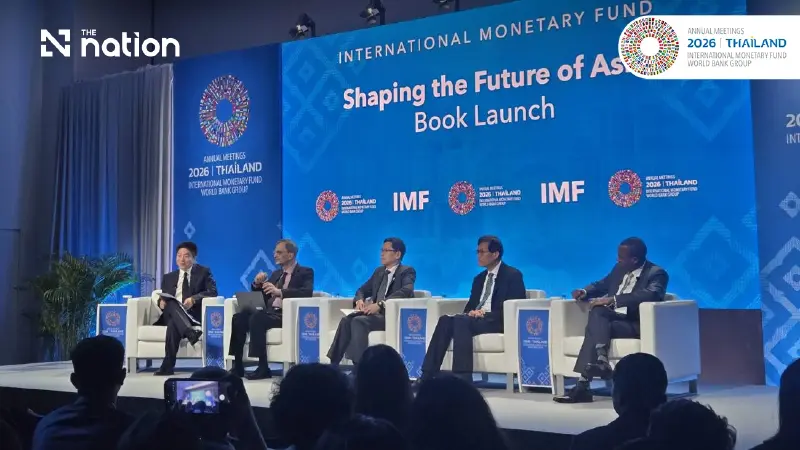


Former central bank chiefs and India's chief economic adviser weigh ageing, AI and trade fragmentation at IMF's Asia book launch in Bangkok
- At an IMF book launch, a panel of senior policymakers concluded that Asia's future economic success will depend on making effective policy choices, just as its past rise was a product of deliberate policies.
- The key challenges identified that will shape Asia's prospects and require strategic policy responses are ageing populations, the rise of artificial intelligence (AI), and geopolitical trade fragmentation.
- Policymakers view AI as a potential solution to offset the economic drag from ageing populations through productivity gains, but also warn that policies are needed to manage risks like job displacement and widening inequality.
- A key policy recommendation to counter global fragmentation is to deepen intra-regional trade within Asia, which could provide a significant boost to the region's economies.
Former central bank chiefs and India's chief economic adviser weigh ageing, AI and trade fragmentation at IMF's Asia book launch in Bangkok.
Asia's extraordinary rise was the product of deliberate policy choices, and the next stage of its development will depend on making better ones, a panel of senior policymakers has told the launch of the International Monetary Fund's new flagship book on the region.
Speaking at the IMF-World Bank Annual Meetings in Bangkok, the panellists agreed that ageing populations, artificial intelligence and geopolitical fragmentation would shape Asia's prospects, but differed on where the greatest risks lay.
The discussion followed the launch of Shaping the Future of Asia: Opportunities and Challenges, produced by the IMF's Asia and Pacific Department. Lessons from the past Nigel Clarke, the IMF's Deputy Managing Director, said Asia's transformation was "a result of policy choice".
He pointed to a shift from agriculture into manufacturing and services, deep integration into global supply chains, heavy investment averaging about 27 per cent of GDP, and a demographic dividend that brought more than a billion people into the workforce.
Asia now accounts for 68 per cent of world growth, up from about a quarter in 1990, he noted. The lesson for other regions,Clarke said, was that "openness pays", but only when accompanied by heavy investment, macroeconomic stability and policy credibility.
He said the Asian financial crisis of 1997 had acted as a catalyst for reform across the region.

Changyong Rhee, a former governor of the Bank of Korea, argued that governance mattered as much as any specific policy.
South Korea's early success, he said, rested partly on the integrity of its senior officials, which allowed foreign aid to be channelled into development and unpopular measures such as value-added tax to be introduced.
He urged the IMF to keep stressing governance in its surveillance work, even if some governments resist. Professor Rhee also described the 1997 crisis as a "hidden blessing" for Korea, because it forced a move from state-led to private-sector-led growth.
He said he was watching China closely to see whether it could make the same transition without a crisis.
Veerathai Santiprabhob, a former governor of the Bank of Thailand, credited his country's rise to export-oriented policies, infrastructure investment such as the Eastern Seaboard industrial hub, and strong technocratic institutions that endured political volatility.
Thailand, he said, had avoided another crisis since 1997. Universal health care and education helped spread the gains.
V. Anantha Nageswaran, chief economic adviser to the Government of India, traced his country's performance to investment in higher education, the liberalisation of the 1990s and, more recently, public investment, an insolvency code, a national goods and services tax and digital public infrastructure. He also acknowledged that "serendipitous factors", such as the Y2K software scare, had played a part.
AI: windfall and warning
The sharpest exchange of views came on AI. Clarke said AI-driven productivity gains could "insulate or neutralise" the drag from demographics, provided governments invested in skills, ensured competition and put sensible guardrails in place.
Professor Rhee was more cautious. Korea was enjoying a semiconductor "super cycle", he said, with nominal growth of 21 per cent in the first half of the year.
Samsung and SK Hynix now account for around half of the stock market's capitalisation and of the country's exports, he added.
He urged the government to use the windfall to tackle structural problems, such as the concentration of more than half the population in the Seoul area, which he linked to housing and education costs and falling fertility.
He also warned that past technological revolutions took 20 to 30 years to deliver productivity gains, and that Korea's heavy exposure to AI left it vulnerable to a market correction.
"In the short term," he said, expecting AI to solve ageing and geopolitical tensions "is too much".
Veerathai focused on who would share the benefits. AI could widen gaps between small and large firms, and between those with and without access to technology, he said.
He called for priority to be given to low-productivity sectors on which livelihoods depend, namely agriculture, education and public services, as well as to small and medium-sized enterprises.
Governments, he said, should make creating good jobs a primary objective, noting that the next phase of structural change would rely on services and high-value manufacturing, which do not generate jobs in large numbers.
He also warned that workers aged 45 to 60 could be made redundant easily.
Nageswaran said India's size and diversity argued for differentiated policies across its states, with advanced manufacturing in richer ones and labour-intensive manufacturing and services elsewhere, helped by trade deals such as the one in force with Britain.
He called for trade skills to carry the same social status as university degrees, as in Singapore, and said deregulation was in effect an employment policy because small businesses create most jobs.
Fragmentation and the "elephant in the room"
On trade, Clarke said deeper integration within Asia could counter "the gathering storms of fragmentation". He said intraregional trade in final goods was about 30 per cent of the total, against about 60 per cent in Europe, and that gains for the 11 ASEAN economies could be as much as 4 percentage points of GDP.
Nageswaran went further than the book's language of fragmentation.
"Geopolitical contestation is going to be the defining feature of the 21st century," he said, adding that multilateral institutions had limits on what they could say openly but that "we are missing the elephant in the room" if the scramble for resources went unacknowledged.
In a closing round, Nageswaran said Asia's capacity to absorb best practice gave him hope, while the contest for resources kept him awake at night. Mr Veerathai wanted more attention on adapting to climate change, since the poor suffer most from extreme weather.
Clarke said Asia, as the biggest beneficiary of an open, rules-based trading system, should lean in to support it.

What the report found
Presenting the book's findings, Krishna Srinivasan, director of the IMF's Asia and Pacific Department, said the region's growth had rested on capital, labour and openness.
Asia's share of world trade rose by 10 percentage points to 40 per cent between 2000 and 2025, he said.
Looking ahead, he said the share of people aged 65 and over would rise from 11 per cent to 20 per cent by 2050, and that "post-dividend" economies such as China, Japan and Korea could lose up to a quarter of their workforce.
Raising women's employment to match men's would add 112 million workers, he said. AI could lift annual growth by 0.5 to 1 percentage point in advanced Asian economies and 0.2 to 0.8 points in emerging and developing ones, but these were "scenarios, not forecasts", he stressed.
Regional trade agreements covering a broader range of enforceable provisions could raise real GDP by about 1.8 per cent in the long term. His central message was that productivity growth of 0.8 per cent could offset the demographic drag entirely, even in post-dividend economies.
He urged governments to match spending on AI adoption with spending on diffusion so that workers can use the technology.

Georgieva: "Imagine 1 per cent more growth"
Opening the event, IMF managing director Kristalina Georgieva said the region's success was real but the future was uncertain. Extreme poverty in Asia has fallen from more than 25 per cent to under 5 per cent, she noted.
Georgieva said that if countries capture AI-driven productivity, the gains "will more than offset" the pressure from ageing, adding: "Imagine 1 per cent more growth." She said the IMF wanted to work with the parts of Asia with the strongest potential for integration, citing ASEAN, and to help countries identify opportunities they were missing.
She warned that the world faced "more frequent shocks", citing El Niño, and said the task was to steer through them "together".
