
Fed Chief Warsh Takes Home Lessons of Unexpected Global Strength and Synchronised Rate Policy
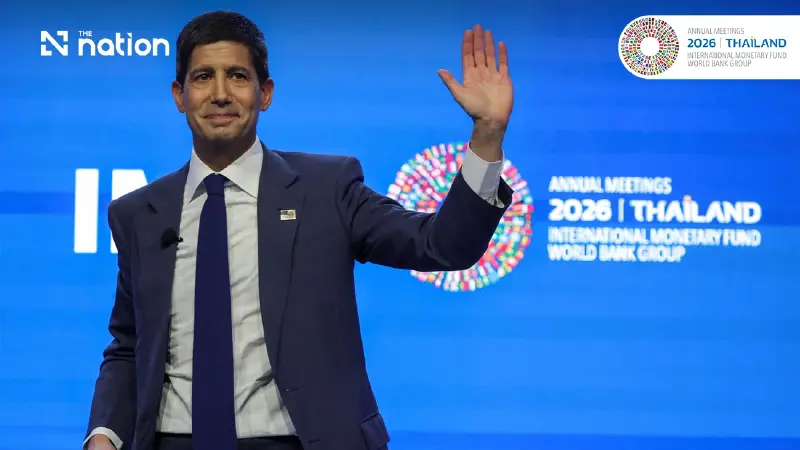


The Federal Reserve chairman tells the IMF-World Bank meetings in Bangkok he is struck by global resilience and a shared resolve to tame inflation
- Federal Reserve Chairman Kevin Warsh identified unexpected global economic strength and resilience as a key takeaway from the IMF-World Bank meetings, noting it was more widespread than he would have predicted.
- Warsh's second lesson was the shared resolve among global central banks to fight inflation through synchronized policy tightening, a development he views positively as it means there are "no free riders."
- He observed that inflation is a shared global problem, and the coordinated response from his international colleagues to ensure price stability was a major theme of the meetings.
The Federal Reserve chairman tells the IMF-World Bank meetings in Bangkok he is struck by global resilience and a shared resolve to tame inflation.
When Federal Reserve chairman Kevin Warsh took the stage on Friday (October 16) at the IMF-World Bank Annual Meetings 2026, the hall was packed with delegates, and the overflow room was full too. Within minutes he had the audience laughing. He also left it with two clear lessons from a week of talks with the world's finance chiefs.
Asked by IMF Managing Director Kristalina Georgieva what he would take home to Washington, Warsh pointed first to resilience. "Almost everywhere in the global economy", he saw strength he "wouldn't have predicted five or six months ago, given what's happening in geopolitics and hot spots around the world".
Had he been asked for a forecast, he said, he might have said it of the United States, but not of "so many members of the G20".
His second lesson was that inflation is a shared problem and that central banks are meeting it together.
"Inflation is not unique to the United States, so we're looking at it together," he said. "I heard resolve from my colleagues around the world to deliver price stability."
Over recent months, he noted, most countries had tightened policy in step, each acting on its own mandate.
"That means there's no free riders," he said. "I view that as a positive development."
Georgieva agreed. A common vision on price stability, she said, gives businesses and households the confidence that growth needs, and it was one of the big messages of the meetings.

A shock now, a surge later
The conversation turned to artificial intelligence, which Warsh called "probably the most consequential change to the US and the global economy in my lifetime".
Georgieva, sidestepping a transatlantic quarrel over pronunciation, suggested calling it "non-human intellect". Warsh said he took the technology seriously but "soberly, responsibly".
Its first impact, he explained, is on the demand side, well before supply feels any benefit.
"If you're a central banker, you've got to recognise this as a shock," he said. "But it's a positive supply shock in the medium term. I do fundamentally believe that."
He also expects it to change how central banks work. Policymakers today spend their time distilling noisy, lagging data.
"We torture data with old-fashioned models to try to find out what's underlying inflation trends," he said. "Not so long from now, it won't be torture."
With tools able to draw on "all the information in the world", he said, central bankers will be far better placed to tell a real signal from mismeasurement.
The path to higher productivity, he cautioned, will be uneven. Nobody knows the effect on jobs over the next 12 to 18 months or which companies will profit.
"I want you to hear from me optimism," he said, "but optimism leavened by the seriousness of purpose to the day jobs that you and I have."
To prepare, the Fed has set up external task forces. One, on productivity and jobs, will hold its first field hearing in the San Francisco Bay Area on 16 November.
"I'm pretty sure I've got the right questions, not sure I have the right answers," Warsh admitted. He described the work as "global public goods" that the IMF and other G20 central banks might adopt.

Booming in some places, battered in others
Georgieva set out the paradox facing policymakers. Some economies are being lifted by enthusiasm for AI, while others are dragged down by war. Nearly all are contending with stubborn price pressures, including from the energy shock in the Middle East.
Warsh's method, he said, is to look "out the window" as clearly as possible, rather than rely on lagging data or imperfect forecasts. The Fed's September meeting reached a judgement on the global economy, and "the world has broadly conformed to our expectations" since.
The United States, he said, is enjoying "a massive investment surge", and he credited policy, not luck. He recalled that economists once talked of secular stagnation as something inevitable.
"Policy matters," he said. "The investment surge isn't by accident."
Sound macroeconomic policy and strong microeconomic foundations, he argued, had delivered it. Yet he was careful to be balanced, "as we central bankers have to be".
The Fed, he said, had promised price stability and removed "a dose of accommodation" about a month ago. He would not say what might come at the October and December meetings.
"I don't prejudge meetings," he said, drawing a mock-disappointed reaction from some in the room.

148 days in the chair
Georgieva noted that Friday was Warsh's 148th day as chairman, give or take a time zone.
He said his five and a half years at the Fed before had served him well, leaving him "on the edge of the inside", with enough inside knowledge to temper an outsider's appetite for change.
His first lesson was a pleasant surprise. He had feared the talent might have left in his 15 years away.
"There's an amazing amount of talent that's still there," he said, "and they're incredibly dedicated to the mission we have."
His second was a confession. About 75 per cent of the Fed's 23,000 staff do not work directly on monetary policy. They work on supervision and regulation, payment systems, and consumer and community affairs.
Warsh conceded that his attention had been drawn elsewhere.
"I haven't been as good as I need to be to make sure they know I care about their issues as much as I care about the conduct of monetary policy," he said. "The head of the Fed needs to be the head of all parts of the Fed."

The stakes, he argued, go beyond morale.
"It's not the printing press. It's a powerful tool. It's neat. If you guys had one, you'd love it," he joked. "But the power really comes from institutional credibility."
A stumble in supervision or payments, he said, damages that credibility as surely as a policy error. His pledge for the next 100 days is equal attention to every part of the institution.
He also set out a cultural creed. Staff should return to first principles "instead of, well, we do it this way because that's how we've always done it".
He prefers frameworks to "mean-regressing models", he said, and does not want to hear that "the model says this will happen".
Asked how he hoped to be remembered as the 17th chairman, he deflected but praised Paul Volcker, Alan Greenspan and Ben Bernanke, who each "met the moment of their times".
The lesson, he said, was not to copy them.
"There's no status quo ante to return to," he said. "The world, in my view, is changing faster than at any point in my adult life."

Scar tissue and cautious optimism
Georgieva had introduced her old friend as the youngest-ever Fed governor, appointed at 35 during the global financial crisis, who "saw crisis from the inside".
She called it her favourite part of his career, then added: "I do not wish you ever to repeat this experience." Warsh politely disagreed. "That is not my favourite part," he said.
Returning to IMF and G20 meetings, he admitted, still brings back "a little bit of scar tissue from the deepest, darkest days of the global financial crisis".
Then came the line that raised the biggest laugh: "I might be overscarred from that period, but better overscarred than underscarred, I presume."
He recalled being sent, as a young nominee, to meet Volcker because a senator thought he looked too young.
"If it were these days, I would have brought one of these cell phones and done a selfie," he joked. "I probably brought an autograph book showing that I was still a child."
The memory, he suggested, shapes both his caution and his curiosity. He hopes his remaining three years and eight months will be "nothing but benign", though he does not expect it.
His discipline is to "interrogate reality", and he cited Orwell's remark that the hardest thing to know is what is right in front of you. That, he said, is why he listens as much as he talks at gatherings like this one.
Georgieva, who had praised his habit of listening to views unlike his own, asked whether she had missed anything. "Invite you to my next press conference," Warsh replied, saying her questions were far more cordial than those he usually faces.
He closed on gratitude and measured confidence. He thanked his colleagues, the Fed's staff and "the remarkable openness to new ideas" he had found among his G20 peers.
"I believe, optimistically, you might think naively, at least in the US, we're going to come out of this stronger, with a more durable economy," he said. Then he added, "It's not zero-sum."
