
Thai Hotels Association warns draft law could weaken safety checks



Thailand's draft Accommodation Act would simplify lodging approvals and allow refunds for misleading adverts, but the Thai Hotels Association warns of safety gaps.
- The Thai Hotels Association (THA) fears the proposed law's tiered system will allow smaller properties to operate with minimal oversight, potentially bypassing essential building safety inspections.
- The association warns that the draft legislation fails to adequately regulate online booking platforms, calling for stricter rules to prevent them from advertising illegal accommodation.
- A key concern is that the law's vague definition of "accommodation establishment" could create loopholes for unsafe conversions of commercial buildings, such as offices and factories, into short-term lets.
- The THA argues that the new law does not address the main barriers for businesses, which are existing building control and planning laws, and may instead create new regulatory gaps.
The Thai Hotels Association has warned that Thailand's proposed accommodation law could weaken building safety checks and leave online booking platforms inadequately regulated, despite simplifying approval procedures for smaller properties.
The draft Accommodation Act, approved in principle by the Cabinet on September 29 would replace the Hotel Act of 2004. It would introduce a three-tier regulatory system based on accommodation size and risk while strengthening consumer protection.
The association wants several provisions revised before the legislation proceeds through Parliament, particularly those concerning building safety, land use and illegal accommodation operations.
Three levels of accommodation regulation
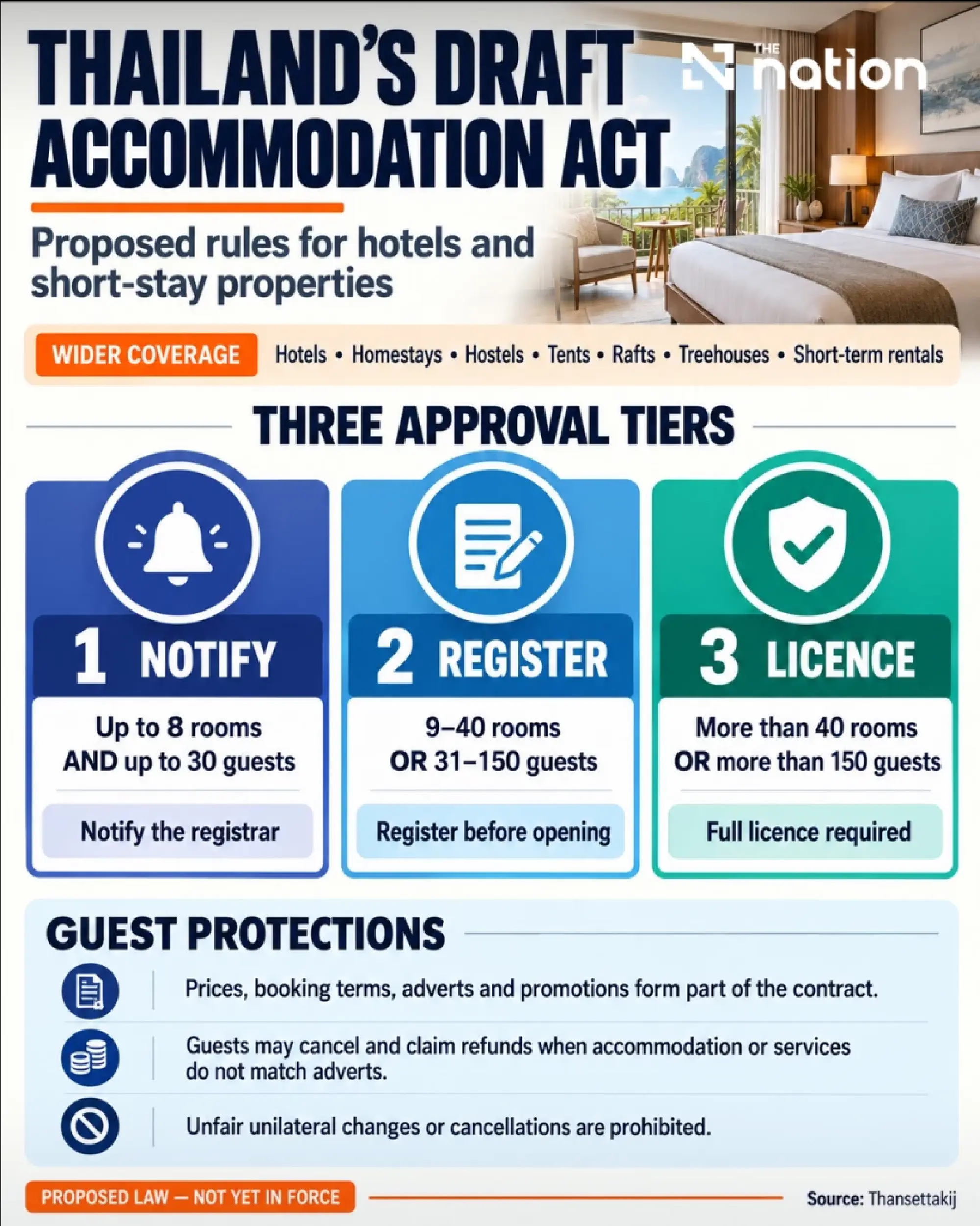
The proposed legislation would broaden the legal definition of accommodation beyond conventional hotels to include hostels, homestays, holiday homes, tents, treehouses and short-term rental properties.
The reforms aim to bring smaller accommodation businesses into the formal regulatory system through three levels of oversight based on property size, guest capacity and risk.
The proposed categories are:
- Category 1 – Notification: Properties with no more than eight rooms and capacity for up to 30 guests, including temporary residential accommodation comprising no more than eight units, would only need to notify the registrar before operating.
- Category 2 – Registration: Establishments with nine to 40 rooms or capacity for 31 to 150 guests would need to register before opening. This would reduce administrative procedures and processing time for medium-sized hotels. The category would also cover temporary residential accommodation comprising nine to 40 units.
- Category 3 – Full licence: Properties with more than 40 rooms or capacity for over 150 guests, including temporary residential accommodation comprising more than 40 units, would still require a full operating licence because they present greater risks and potentially wider impacts.

Single licence could cover 10 related businesses
The draft also proposes a Super Licence system to reduce the number of separate approvals required by larger accommodation businesses.
Under the proposal, operators in the third category could use their main accommodation licence to cover up to 10 related business activities, provided they request this when applying.
These activities could include restaurants, spas, swimming pools, fitness facilities and the sale of alcohol or tobacco.
The arrangement would simplify dealings with government agencies, although operators would still have to comply with laws governing each activity.
Guests would gain stronger protection against misleading adverts
The draft would make advertised room rates, booking conditions, promotional statements and photographs legally binding parts of accommodation contracts.
Guests could cancel reservations or terminate their stays and receive refunds if the accommodation or related services failed to match what was advertised. Refunds would take into account any services already used.
The proposed law would also prohibit unfair booking conditions, including clauses allowing operators to cancel agreements unilaterally or requiring customers to waive their rights in advance.
Electronic guest records and fire safety requirements
Accommodation operators would still have to meet safety requirements despite the proposed simplification of approval procedures.
Properties would need clearly displayed identification signs, fire-escape plans and emergency exit notices.
Unconventional accommodation, including tents, treehouses, trailers and converted shipping containers, would be subject to fire safety requirements suited to their structures.
Operators would also be required to maintain electronic guest registers and submit the records every 24 hours.
Information concerning foreign guests would then be forwarded to Thailand's Immigration Bureau through the designated electronic system.

Thai Hotels Association questions building safety safeguards
Thienprasit Chaiyapatranun, president of the Thai Hotels Association, told Thansettakij that the existing Hotel Act was not the main obstacle preventing some accommodation businesses from obtaining licences.
Instead, he identified building control, town planning and environmental laws as the principal barriers.
The current Hotel Act already classifies hotels into four categories based on their services, ranging from properties offering accommodation alone to those with restaurants, entertainment facilities and conference services.
Thienprasit noted that existing ministerial regulations already allow certain older buildings and commercial properties to be converted into hotels, provided they meet the relevant legal requirements.
He argued that these underlying restrictions should be addressed rather than introducing a new law that might create additional regulatory gaps.
Concerns over building inspections and protected areas
A major concern for the association is that the draft uses the broader term "accommodation establishment" without clearly defining which types of buildings can legally operate.
Thienprasit warned that this could allow commercial buildings, shophouses, offices and factories to be converted into short-term accommodation without sufficient safety checks.
He also questioned whether properties requiring only notification or registration would undergo adequate inspections before opening.
Under the existing hotel regulatory framework, certain properties must undergo annual engineering safety inspections or meet environmental assessment requirements.
The association fears that some establishments could avoid these obligations under the proposed classification system.
Thienprasit also raised concerns about accommodation developments in conservation areas and along beaches, warning that simpler registration procedures could make unauthorised construction and land-use violations harder to control.
Online booking platforms face calls for tighter regulation
The association also wants stronger controls on online accommodation booking platforms.
According to Thienprasit, Section 52 of the draft refers to platform services but does not clearly establish registration requirements or penalties for platforms advertising illegal accommodation.
The THA wants online platforms to list only properties with valid notification certificates, registration documents or operating licences.
It also proposes fines for platforms advertising unauthorised accommodation and closer coordination with the Ministry of Digital Economy and Society.
Thienprasit questioned whether the proposed financial penalties would provide a sufficient deterrent.
He cited daily fines of up to THB10,000 for some violations and THB50,000 for others, arguing that businesses charging high room rates might simply absorb these costs.
Some accommodation businesses, he noted, could generate daily revenue of THB1 million to THB2 million, making stronger enforcement necessary.
Short-term condominium rentals remain subject to existing laws
The draft would not automatically legalise daily rentals in condominiums or housing estates.
Under Section 18, such properties could receive notification certificates, registration documents or operating licences only if existing condominium or land allocation laws permitted the activity.
Thienprasit emphasised that condominium management bodies and residents could not override legal restrictions simply by voting to approve short-term rentals.
He also opposed retrospective changes allowing older condominium developments to offer daily accommodation, warning that they could affect existing owners who purchased their properties specifically for residential use.
Although Thienprasit acknowledged that the government-backed legislation could secure parliamentary support, he maintained that the association wanted its concerns over safety, environmental protection, online platforms and enforcement addressed during the legislative process.
