
Registration opens for solar panel subsidies for a million Thai homes
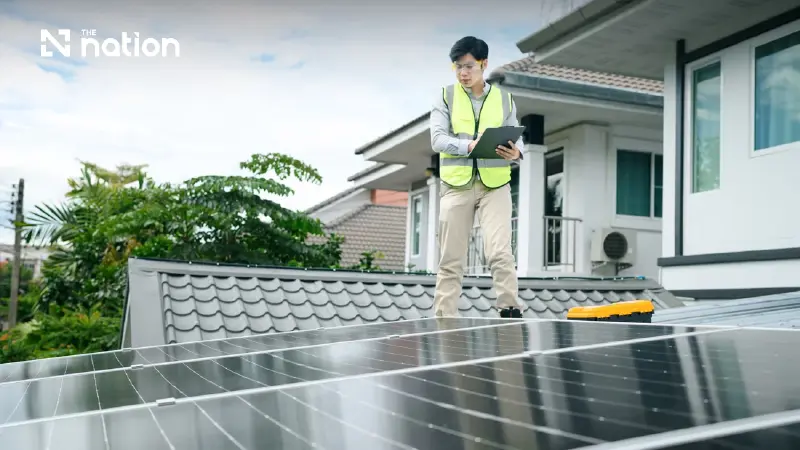


Three state banks will offer seven-year loans at 2.5% interest, with subsidies cutting household borrowing to THB90,000 and no upfront payment required.
Lavaron Sangsnit, permanent secretary at the Ministry of Finance, said the Cabinet had formally approved a household solar programme targeting one million homes nationwide.
The programme will support rooftop, ground-mounted and floating solar power systems, with a government subsidy of THB50,000 per household towards a standard THB140,000 package using equipment certified by the electricity utilities.
Three state financial institutions will provide loans on the same terms: Government Savings Bank, Government Housing Bank (GHB) and the Bank for Agriculture and Agricultural Cooperatives (BAAC).
The loans will carry an annual interest rate of 2.5%, with repayment over seven years.
Subsidy cuts borrowing to THB90,000, with no upfront payment
Lavaron said participants would not need to use their own cash on the first day of installation.
Once the system begins operating, the banks will draw down the government’s THB50,000 subsidy in monthly rounds and use it to reduce outstanding loan balances, bringing each household’s actual borrowing down to THB90,000.
Those who can afford to pay in cash may instead pay the installer the full package price and claim the THB50,000 subsidy directly from the government through PromptPay.
Electricity sales to the state at THB2.20 per unit; THB700 in extra monthly income

The programme is assessed as suitable for households with average electricity bills of THB3,500–4,000 a month or more.
For homes with lower bills, the investment may not be worthwhile.
In an example involving a household normally paying THB4,000 a month, a five-kilowatt solar system would allow 40% of its electricity output to be used in the home during the day, saving approximately THB1,100–1,200 a month.
The remaining 60% could be sold back to the electricity utility at THB2.20 per unit, generating additional income of more than THB700 a month.
Combined savings and electricity sales revenue are estimated at about THB1,800 a month.
After allowing for monthly loan instalments of approximately THB1,100, the household’s net electricity cost would fall to THB3,200–3,300 a month, providing an immediate saving of about THB700 a month throughout the repayment period.
Once the seven-year loan has been repaid, instalments would end and households would retain the full benefit of monthly savings of approximately THB1,100 for the panels’ remaining service life of around 13 years, based on an average total lifespan of 20 years.

No credit bureau checks; solar systems to serve as collateral
The banks will relax their lending conditions by dispensing with credit bureau checks, as the solar systems themselves will serve as collateral.
Lending risk is considered low because the electricity utilities will collect loan instalments through electricity bills.
During the seven-year repayment period, the systems will also be guaranteed by the banks, with panel-cleaning services provided to maintain full generating efficiency.
However, an exact level of electricity output cannot be guaranteed because generation depends on daily weather conditions and sunlight.
One entitlement per meter; registration from Tuesday (October 27, 2026) to Sunday (January 31, 2027)
Eligibility is limited to one entitlement per electricity meter, based primarily on the name of the utility’s contract holder or meter owner.
Buyers of second-hand homes must first ensure that the meter is transferred into the correct owner’s name.
People who own several meters may register more than one home, but the THB50,000 subsidy is limited to one entitlement per meter.
A central database will be used to check for duplication.
The government opened registration for expressions of interest in the programme on Tuesday (October 27, 2026) and will keep it open until Sunday (January 31, 2027).
Applicants can register online through the Metropolitan Electricity Authority and Provincial Electricity Authority websites, or visit one-stop service points at the utilities, where participating financial institutions will also provide services.
Teams from approximately 400 vendors accredited by the electricity utilities will then inspect sites for technical suitability, including roof strength and orientation towards sunlight.
Surveys are due to be completed by Wednesday (June 30, 2027).
The number of qualifying households will then be finalised to determine the actual loan funding required, based on the number of homes where installation is feasible.
More than THB70 billion in borrowing for solar, smart meters and training
The programme’s estimated funding package, financed through an emergency borrowing decree, exceeds THB70 billion.
It comprises THB50 billion in solar subsidies, more than THB10 billion each for smart meter upgrades at the Metropolitan Electricity Authority and Provincial Electricity Authority, and a further THB1 billion in borrowed funds for the Department of Skill Development to train unemployed workers to enter the labour market as solar panel installers.

