
Suphachai identifies five opportunities to turn Thailand into a global economic hub
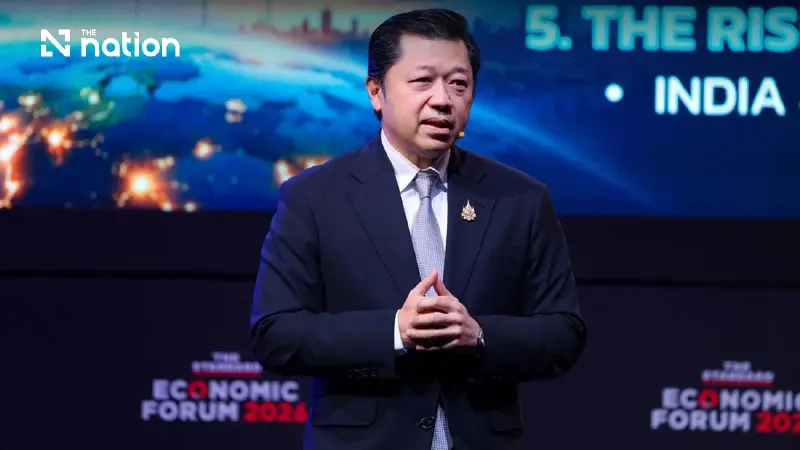


Suphachai Chearavanont identifies five hubs in technology, innovation, talent, food and healthcare, and trade, calling for reforms to boost Thailand's growth.
Thailand has the potential to become a major hub in the global economy by developing five new growth engines, but must accelerate economic restructuring, technological development and investment reforms to remain competitive, according to Suphachai Chearavanont.
Suphachai, Senior Vice Chairman of Charoen Pokphand Group (CP Group) and Chairman and Chief Executive Officer of Arise Ventures Group, presented his vision at THE STANDARD Economic Forum 2026, held under the theme "Reinvent Thailand".
Speaking during the session "Opportunity Thailand: From Thailand Advantage to Thailand Next Growth Engine", he argued that the country's future economic strategy must begin with an understanding of fundamental changes in the global economic order.
As part of international supply chains, Thailand cannot remain isolated from transformations affecting technology, investment and trade. Its challenge is not simply to adapt but to identify where it can generate greater value within the global economy.

Five global forces reshaping economic competition
Suphachai identified five structural changes that will influence the direction of the world economy.
The first is geopolitical fragmentation, with the international system shifting beyond traditional divisions between two major powers towards a more complex, multipolar order.
The second is technological disruption, particularly artificial intelligence (AI), which is transforming industries alongside advances in deep technology, space technology and quantum computing.
The third involves the transition to cleaner energy. As the costs of renewable technologies become increasingly competitive, alternatives such as small modular nuclear reactors could play a larger role in future energy systems.
The fourth is the expansion of digitalisation and digital currencies, which are changing financial services and international transactions.
The fifth is the restructuring of global trade and supply chains, creating opportunities for countries to establish new positions in the international economy.
Suphachai noted that countries are competing to become centres of emerging industries, particularly those associated with AI.
He cited investment in US AI infrastructure worth US$3.8 trillion as an indication of the scale of the transformation, arguing that investment in the AI era is substantially greater than during the expansion of the internet.

1. Technology and new economy hub
Thailand's first opportunity lies in building a broader technology ecosystem around data centres, cloud computing, AI and semiconductor manufacturing.
Suphachai explained that data centres require substantial numbers of advanced processing chips, which generally need replacing as technology evolves, potentially creating recurring demand approximately every five years.
Attracting major regional data centres could therefore encourage semiconductor manufacturers and related industries to establish operations in Thailand.
He also identified robotics, automation and autonomous technologies as promising industries, particularly as Thailand faces an ageing population and a shrinking workforce.
Electric vehicles (EVs) represent another opportunity. Building on its established automotive manufacturing industry, Thailand could maintain its position among the world's 10 leading vehicle-producing countries while becoming an ASEAN centre for EV production and exports.
However, Suphachai cautioned that Thai manufacturers must adapt quickly to changing supply chains. Those unable to make the transition could lose economic value and market influence as foreign producers expand their presence.
2. Technology and innovation hub
The second opportunity focuses on strengthening domestic research and development rather than relying exclusively on foreign investment.
Suphachai compared Thailand's research spending, equivalent to approximately 0.9% of gross domestic product (GDP), with China's 2.8%.
China had previously targeted research spending of around 2% of GDP roughly a decade ago, demonstrating the importance of sustained investment in technological capabilities.
He proposed that investment incentives offered through the Board of Investment (BOI) should encourage international companies to establish research and development centres in Thailand.
Cooperation between foreign corporate research facilities and Thai universities would help transfer knowledge, develop domestic expertise and support technological innovation.
Potential growth industries include biotechnology, AI, digital technology, quantum computing, space technology, food technology and nanotechnology.
Suphachai also highlighted the need for a stronger technology start-up ecosystem.
Singapore has approximately 50,000 registered technology start-ups, compared with around 2,000 in Thailand. Although Thailand's total has increased from roughly 500 three years ago, the gap remains substantial.
He suggested that Thailand could eventually target as many as 200,000 technology start-ups by offering tax incentives, matching funds and government-backed financing.
Such measures could attract Thai and foreign entrepreneurs to establish businesses and research facilities in the country.
3. Human capital hub
Developing a skilled workforce is the third essential component of Thailand's economic transformation.
Suphachai stressed that investment and technological infrastructure alone cannot deliver sustainable competitiveness without people capable of using and developing new technologies.
He called for educational reforms that integrate AI into learning from primary school through university, supported by lifelong learning and reskilling programmes.
Closer cooperation between universities, businesses and start-ups would also help ensure that education responds to changing labour market requirements.
Thailand currently has approximately two million university students and produces around 500,000 graduates annually.
Over the next three to four years, roughly two million young people are expected to enter the workforce, making their readiness for the AI economy a critical concern.
Suphachai argued that education should encourage students to develop meaningful projects and innovations rather than focusing exclusively on examination results and qualifications.
Universities should provide incubation programmes, financial support and opportunities for young innovators to gain recognition.
He pointed to China, Singapore and South Korea, where AI education is being introduced from primary school, as examples of preparing students for technological change from an early age.
4. Food security and healthcare hub
Thailand's agricultural resources, food industry and healthcare system provide another foundation for developing internationally competitive industries.
According to Suphachai, the country's grain production exceeds domestic consumption requirements by approximately 19%.
With stronger investment in water management, irrigation and smart farming, agricultural productivity could potentially increase twofold or threefold, and possibly as much as fivefold.
He proposed moving beyond traditional agricultural production towards higher-value industries involving food technology and biotechnology.
Processed food, ready-to-eat meals and nutritional supplements could generate additional value from existing agricultural resources.
Durian provides one example. Thailand's durian exports are worth approximately THB140 billion, yet some production remains underutilised.
Suphachai argued that technological development could help turn these resources into new products and additional sources of income.
Healthcare presents similar opportunities.
Thailand's established medical infrastructure could support further expansion into wellness tourism, a global market he valued at approximately US$1 trillion, with projected growth to US$1.4 trillion by 2030.
5. Global trade hub
The fifth opportunity is to use Thailand's geographical position to strengthen its role in international trade.
Located in the heart of ASEAN, Thailand connects regional markets with China and India and has the potential to support trade routes linking the Indian and Pacific oceans.
Suphachai estimated Thailand's international trade at approximately US$700 billion, placing it 22nd globally but still behind Singapore, Malaysia and Vietnam.
He compared Thailand's position with Singapore, which has a land area only about 20% larger than Phuket but generates approximately US$1 trillion in international trade.
Singapore's success demonstrates how a country can create economic value by positioning itself as a major trading centre, he argued.
Strengthening Thailand's international trade role could generate additional opportunities in logistics, banking, finance and domestic capital circulation.
Rather than relying primarily on its domestic market, Thailand could capture a greater share of the value generated across regional and global supply chains.
Five conditions for stronger competitiveness
Suphachai stressed that turning these opportunities into economic growth would require five supporting conditions.
Geopolitical neutrality is the first. Thailand should maintain balanced relations with major powers, avoid taking sides and establish itself as a trusted partner while preserving domestic stability and unity.
Political stability and policy continuity form the second requirement. He attributed part of Thailand's prolonged period of GDP growth of only 1–2% to inconsistent government policies.
A more stable political environment would allow economic reforms and national development strategies to continue over periods of four to 10 years.
Transparency and good governance are the third priority. Suphachai called for greater public access to information on government performance, budget expenditure and infrastructure investment.
AI could help improve oversight and administrative efficiency, while a transition towards a cashless society could make financial transactions more traceable.
Stronger cybersecurity and AI-based defence capabilities would also be necessary to protect economic systems and national security.
Energy security is the fourth condition. Thailand could benefit from connections to clean energy resources in neighbouring countries, including Laos and Myanmar, alongside natural gas supplies.
Suphachai recommended medium- and long-term energy planning to strengthen supply security and improve the country's cost competitiveness.
Investment competitiveness is the fifth requirement, particularly the ability to attract foreign direct investment (FDI).
He noted that Vietnam attracted approximately US$30 billion in FDI last year, compared with around US$9 billion for Thailand.
Although Thailand's investment figures approximately doubled during the first nine months of 2026, he argued that stronger incentives would be needed to support an economic growth target of 4–5%.
Thailand's relatively liquid capital market provides an advantage within ASEAN, but greater credibility and a more supportive investment ecosystem are needed.
He recommended additional measures including matching funds, tax incentives and policies to attract skilled foreign professionals to establish businesses and work in Thailand.
Regional investment essential to inclusive growth
Suphachai emphasised that the benefits of new economic industries must extend beyond Bangkok and established commercial centres.
Investment should reach regional, provincial and district economies to reduce inequality and create more balanced development.
Priority infrastructure includes roads, water systems, irrigation networks, railways and urban development, alongside improvements in education and public healthcare.
He also identified agricultural cooperatives as an important mechanism for strengthening rural economies.
By working collectively, farmers could become joint owners of water infrastructure, manage resources more effectively and improve productivity and income.
Suphachai cited Switzerland, Germany, Japan and South Korea as examples of countries where strong cooperative systems allow farmers to participate in higher-value economic activities rather than remaining solely agricultural producers.
He also suggested examining whether some of Thailand's international reserves and other financial resources could be used to support domestic infrastructure and development projects that improve competitiveness, reduce inequality and distribute wealth more widely.
Ultimately, he maintained that economic transformation, stronger grassroots businesses and the development of all five proposed global hubs would depend on Thailand's ability to embrace AI.
"We have entered the AI era. AI offers solutions to all these challenges. AI is our answer," Suphachai concluded.
