
Oil Fuel Fund Committee cuts petrol by 1 baht/litre and B7 diesel by 0.75 from Nov 6
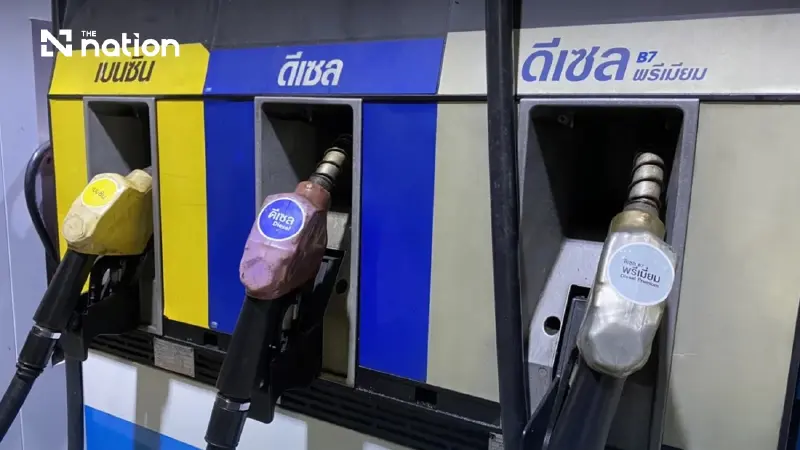


Thailand’s B7 diesel will cost 41.79 baht a litre from November 6 as lower global prices allow pump-price cuts and reduced diesel subsidies.
- Effective November 6, Thailand's Oil Fuel Fund Committee is cutting the retail price of petrol and gasohol by 1 baht per litre and B7 diesel by 0.75 baht per litre.
- The price reduction is a response to falling international fuel prices, allowing the committee to lower costs for motorists while also reducing its own subsidy expenditure.
- As a result of the changes, the new retail price for B7 diesel will be 41.79 baht per litre, and petrol will be 49.33 baht per litre.
- While most fuel prices are decreasing, the retail price for B20 diesel will remain unchanged, though the subsidy applied to it will be lowered.
Thailand’s Oil Fuel Fund Committee has agreed to cut retail B7 diesel prices by 0.75 baht a litre and petrol and gasohol prices by 1 baht a litre from November 6, 2026, as falling international prices create room to lower motorists’ costs while reducing diesel subsidies.
The committee’s decision on November 5 combines pump-price reductions with changes to the levies and subsidies applied to individual fuel grades. B20 diesel is the retail-price exception, remaining unchanged despite a reduction in its subsidy.
The latest adjustment follows earlier petrol and gasohol price cuts introduced on November 5.
B7 diesel falls to 41.79 baht while B20 holds steady
B7 diesel will retail at 41.79 baht a litre under the new schedule, while petrol will fall to 49.33 baht. The Oil Fuel Fund will reduce support for both diesel grades and collect higher levies on most petrol-based fuels, although the subsidy for E85 will increase.
The revised fund rates take effect on November 6, according to the Oil Fuel Fund Office’s published notice.

The following prices and Oil Fuel Fund adjustments take effect on November 6, 2026:
- B7 diesel: The retail price will be 41.79 baht a litre, with the fund subsidy reduced by 0.96 baht to 2.37 baht a litre.
- B20 diesel: The retail price will remain unchanged, while the fund subsidy will fall by 1.45 baht to 3.91 baht a litre.
- Petrol: The retail price will be 49.33 baht a litre, with the fund levy increased by 0.51 baht to 11.29 baht a litre.
- Gasohol 95: The retail price will be 39.84 baht a litre, with the fund levy increased by 0.38 baht to 3.37 baht a litre.
- Gasohol 91: The retail price will be 39.47 baht a litre, with the fund levy increased by 0.38 baht to 3.37 baht a litre.
- Gasohol E20: The retail price will be 31.80 baht a litre, with the fund levy increased by 0.23 baht to 2.73 baht a litre.
- Gasohol E85: The retail price will be 30.63 baht a litre, with the fund subsidy increased by 0.58 baht to 0.99 baht a litre.
Easing Middle East tensions push global fuel prices lower
The Oil Fuel Fund Committee attributed the decline in international prices partly to easing geopolitical tensions in the Middle East, which had reduced concerns about supply disruptions. Increased crude oil exports from the Persian Gulf also contributed to the downward pressure.
The committee additionally cited investor profit-taking following the US midterm election results and concerns that a slowing global economy could weaken demand for crude oil.
International diesel prices closed at approximately US$155 a barrel on November 5, down from around US$166 on November 4, according to the committee. Petrol prices fell to approximately US$105 from around US$112 a barrel over the same period.
Oil Fuel Fund aims to ease its daily subsidy burden
The Oil Fuel Fund Committee described the adjustments as a way to reduce living costs while improving the fund’s liquidity. Lower subsidy expenditure would ease a burden that had previously reached 69 million baht a day.
Despite the downward trend in international and domestic fuel prices, the committee stressed that conservation and efficient fuel use remained important for Thailand’s energy security and longer-term household savings.
