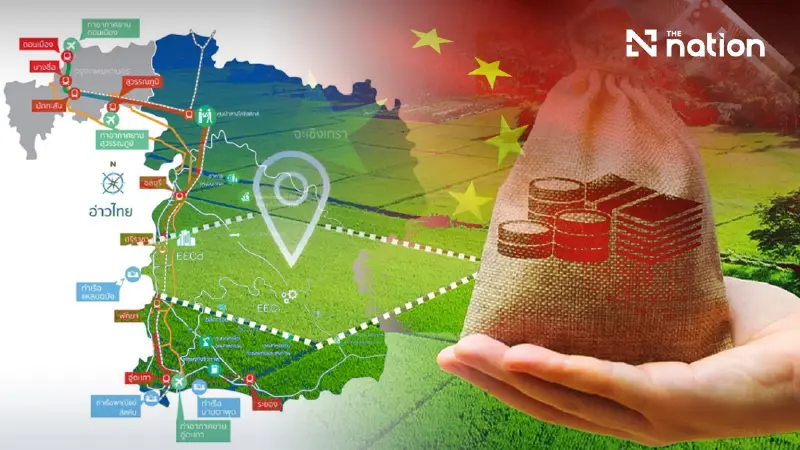
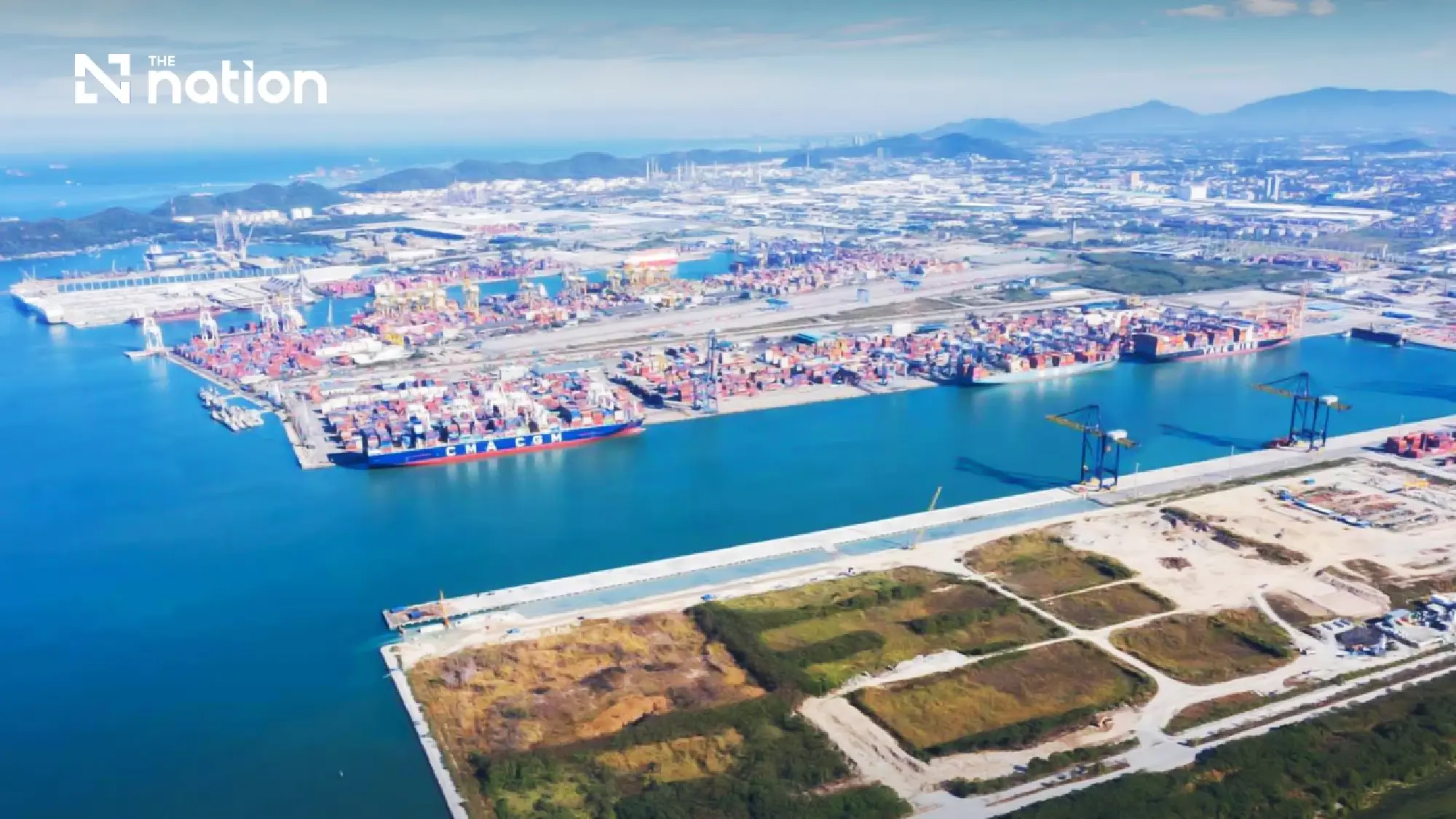
Chinese investors are driving demand for EEC industrial land, pushing up prices in Chonburi and Rayong as Thailand attracts more manufacturing FDI
Chinese investment in Thailand's industrial estates has surged, with their share growing from 6% in 2019 to over 17% by early 2026, second only to Japan.
This influx of capital is concentrated in the Eastern Economic Corridor (EEC), particularly Chonburi and Rayong, causing land prices in the area to rise by 20-30%.
The investment is fueling a rush for large land plots for factory development, both inside and outside official industrial zones, sometimes through the use of Thai nominee companies.
Concerns have been raised about "zero-dollar" investment models that use exclusively Chinese supply chains and labor, providing limited economic benefit to local Thai businesses.
Chinese investors are becoming a more powerful force in Thailand’s industrial-property market, with growing demand for factory land in the Eastern Economic Corridor pushing Chonburi and Rayong further into the spotlight.
The shift is reflected in data from the Industrial Estate Authority of Thailand (IEAT), which shows the share of Chinese investors in Thai industrial estates rising steadily over the past six years. In 2019, Chinese investors accounted for just 6% of investors in industrial estates. By the end of the first quarter of 2026, that share had climbed to 17.06%, behind only Japan at 22.75%.
The trend points to a wider relocation of Chinese manufacturing activity into Thailand, where investment in industrial estates usually involves buying or leasing land to support factory development. It also comes as Chinese companies expand their landholdings across parts of Asia as they seek overseas resources, production sites and business opportunities.
An industrial-sector source told Bangkokbiznews that major Chinese investors had been buying up large areas of land in the EEC, particularly as demand for factory sites increased. In many cases, the activity has extended beyond established industrial estates and industrial zones into nearby areas suitable for future development.
Some Chinese companies entering the market as real-estate agents or brokers have in practice been assembling large land banks and preparing them for industrial projects. Several have reportedly accumulated thousands of rai before developing the land in phases, with much of the space later sold to other Chinese investors.
Concerns over closed-loop Chinese investment
Chinese investment in Thailand had taken several forms. Some investment flows into industrial estates or industrial zones governed by conditions set by the Ministry of Industry. However, another model has caused concern because it creates limited benefit for the Thai economy.
The first concern involves so-called “zero-dollar” factories and industrial estates, where Chinese capital, Chinese labour and Chinese supply chains are used almost entirely. Construction materials, machinery, labour and even basic supplies are imported from China, leaving little or no spending with Thai businesses.
The second concern centres on nominee structures. The source said some Chinese investors used Thai accounting offices or law firms to set up front companies to buy land both inside and outside EEC industrial estates. Similar concerns have also emerged in business districts such as Yaowarat and Huai Khwang.
This pattern has contributed to sharp increases in land and rental prices, with land values in some areas rising 20-30% and commercial-building rents in certain districts increasing by three to ten times. The result, the source said, is that some Thai operators can no longer compete on cost and are being forced out of business.
Chinese capital has been especially active in areas outside industrial estates in the EEC, including Pluak Daeng district in Rayong and Bo Win subdistrict in Si Racha district, Chonburi. The source said land accumulation through nominee structures had pushed prices higher and made it harder for Thai businesses to expand.
In some locations, land and rental costs have nearly tripled, leaving local entrepreneurs unable to lease space for trade or factory expansion.
The economic slowdown had also made it difficult to blame landowners for selling. Higher offers from brokers have encouraged some owners to accept prices they regard as worthwhile, while some communities see land development as bringing local benefits.
Feedback from industrial groups under the Federation of Thai Industries also suggests foreign capital, particularly from China, has had a negative impact on several Thai industries. Of Thailand’s 46 industrial groups, 22-25 are considered at risk of crisis. The hardest-hit sectors include electrical appliances at 70.3%, construction materials at 46.9%, and steel.
A market report said land prices in Chonburi and Rayong had risen 20-30% over the past two years, driven by Chinese capital buying land both inside and outside industrial estates.
Cushman & Wakefield (Thailand) reported that Thailand had 222,388 rai of industrial-estate land in the first quarter of 2026, up by about 600 rai from the end of 2025 following the expansion of a new industrial estate in Chonburi.
The vacancy rate for industrial-estate land fell to 6.2%, down from 6.52% in the previous quarter, indicating that demand remains strong despite global economic uncertainty.
Average industrial land prices nationwide were stable at 8.31 million baht per rai. However, prices in the EEC were higher, with Chonburi averaging up to 9.5 million baht per rai, Chachoengsao at 7.75 million baht per rai and Rayong at 7.5 million baht per rai.
Chinese demand keeps rising
IEAT governor Sumet Tangprasert said Chinese investor numbers in industrial estates had increased sharply over the past three years, rising from 875 in 2023 to 1,256 in 2024 and 1,584 in 2025.
He said Chinese investment was expected to keep growing, especially in technology, data centres, digital businesses, automotive parts, electric vehicles, electronics, steel and metals.
Thailand’s industrial-estate areas remain attractive for long-term investment, particularly as companies look for safe production bases amid geopolitical tension and global uncertainty.
BOI sees China as major FDI driver
Narit Therdsteerasukdi, secretary-general of the Board of Investment (BOI), said any establishment of an industrial zone or industrial park must first be approved by the Ministry of Industry and relevant agencies.
He said Chinese investors applying for BOI privileges were among the higher-potential groups investing in Thailand, particularly in future industries.
From 2021 to September 2025, Chinese investors submitted 2,449 BOI applications with a combined investment value of 608.738 billion baht. The figures underline China’s role as one of the major foreign investors driving Thailand’s foreign direct investment.
In 2025 alone, Chinese investors filed 982 BOI applications worth 172.114 billion baht, helping push Thailand’s foreign-investment applications to a BOI record.
Over the past five years, the three sectors attracting the most Chinese investment were electrical appliances and electronics, worth 173.575 billion baht; metals and materials, worth 126.705 billion baht; and vehicles and parts, worth 74.214 billion baht.
Narit said these investments were strengthening Thailand’s industrial production base and expanding the country’s role in global supply chains, particularly in technology and next-generation automotive industries.
Investment moves into strategic industries
Narit said Chinese investment in Thailand was shifting from traditional industries towards strategic growth industries that support long-term economic development.
One major area is electric vehicles and batteries. Thailand is building a complete EV ecosystem, supported by major Chinese companies including BYD, Great Wall Motor, Changan Automobile and MG Motor. The BOI also signed an agreement with China EV100 in late 2025 to deepen cooperation in EV technology, supply-chain development and research.
Another area is semiconductors and advanced electronics, where Chinese investment is expected to expand into integrated-circuit design and upstream component production. This would strengthen Thailand’s electronics industry and link the country more closely with the global semiconductor supply chain.
Digital technology and artificial intelligence are also becoming key investment targets. From 2023 to 2025, digital and AI-related BOI applications reached a combined investment value of 1 trillion baht, covering data centres and cloud services, which are considered core infrastructure for the digital economy.
Chinese investment is also expanding into the Bio-Circular-Green Economy, including biotechnology and clean energy. This supports Thailand’s energy transition, with the country targeting a clean-energy share of 51% by 2037.
Thailand steps up investor facilitation
To support growing Chinese investment, the BOI has introduced measures to ease regulations and accelerate approval procedures. These include Thailand FastPass, which is designed to speed up consideration of high-tech projects with investment value of at least 1 billion baht.
The BOI is also supporting the recruitment of highly skilled personnel through the Long-Term Resident Visa, allowing technology companies to bring foreign experts and senior executives to work in Thailand more easily.
On the marketing side, the BOI has expanded its investment offices in China to reach investors more directly. It currently has offices in Beijing, Shanghai and Guangzhou, and is preparing to open a new office in Chengdu, a major economic centre in western China.
Narit said Chinese investment played an important role in upgrading Thailand’s industries, especially in high-technology sectors that match the country’s long-term economic development goals.
“The arrival of Chinese investors in strategic industries not only increases investment value, but also helps develop technology, upgrade supply chains and build Thailand’s future industrial production base,” he said.