
Bangkok riverside land values climb around heritage districts
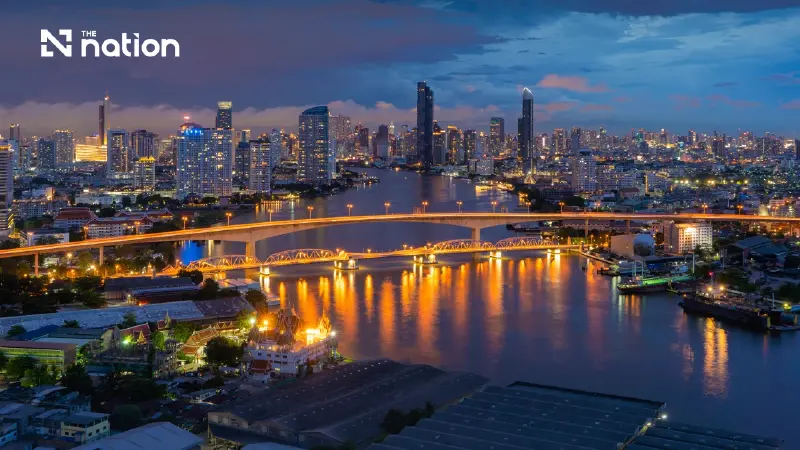


Large riverside projects, rail links and creative businesses are lifting demand around Charoen Nakhon, Charoen Krung and Khlong San.
- Land prices in Bangkok's riverside heritage areas, including Charoen Nakhon and Charoen Krung, have climbed dramatically, rising from under THB25,000 to as high as THB250,000 per square meter.
- The value increase is driven by different factors on each side of the river: Charoen Nakhon's growth is fueled by modern mega-projects like ICONSIAM and new mass transit, while Charoen Krung's is based on its cultural heritage, creative economy, and land scarcity.
- Major landmark developments, including ICONSIAM, Lhong 1919, and ASIATIQUE The Riverfront, have acted as key catalysts, turning these districts into global destinations and boosting property demand.
Among Bangkok’s prime land locations with strong potential and the most public discussion, few rival the Charoen Nakhon, Charoen Krung and Khlong San areas across the Phra Nakhon and Thon Buri sides.
The Chao Phraya River runs through the middle, drawing the two banks together.
Today, the area is filled with condominium projects, luxury hotels and premium shopping centres.
Land prices have risen from below THB25,000 per square metre to no less than THB125,000 and as high as THB250,000 per square metre, with further increases likely as investment and economic value in the area continue to grow.
Starting with Charoen Nakhon, the area is regarded as one of the high-potential locations on the Thon Buri side.
Its strengths come from large-scale riverside development along the Chao Phraya River, mass-transit connections and the continued growth of mid-range to luxury residential projects.

Factors supporting Charoen Nakhon’s continued growth
The most visible factor is the clear improvement in transport, which has connected the area more closely with the Phra Nakhon side.
This includes road and expressway networks and rail systems.
The Gold Line helps connect Charoen Nakhon to the BTS network via Krung Thon Buri Station, making travel to central business district (CBD) areas such as Sathon, Silom and Sukhumvit much more convenient.
What has made Charoen Nakhon better known is the launch of ICONSIAM, the riverside shopping centre that turned the area into a global landmark, drawing tourists, operators, retailers, hotels and premium property projects.
This has caused land values and housing demand to rise continuously.
Adjoining the site is Magnolias Waterfront Residences at ICONSIAM, which, at 317.95 metres and 70 storeys, is one of the tallest residential buildings in Bangkok and the tallest in Thailand at the time.
Investment by large investors and property developers has made Chao Phraya riverside land increasingly scarce and pushed prices higher.
Charoen Nakhon is one of the few Bangkok areas still offering riverfront land for new development, but supply is becoming limited, creating long-term price support, particularly for upper-end condominium and mixed-use projects.

The expansion of a new business centre on the Thon Buri side
The Khlong San–Charoen Nakhon area has clearly changed from a traditional residential and garden-house district into a new economic centre for trade, tourism and riverside business, increasing demand for both housing and commercial space.
In particular, the development of Lhong 1919 by Asset World Corp Public Company Limited (AWC), led by Wallapa Traisorat, an heir of tycoon Charoen, is a large project in the Charoen Nakhon–Khlong San area near ICONSIAM.
With an investment of more than THB5 billion, it aims to revitalise the historic riverside area along the Chao Phraya River into a world-class destination.
The core project is the ultra-luxury hotel The Ritz-Carlton Bangkok, The Riverside.
The development will combine 19th-century historic buildings with a 20-storey contemporary building and 192 rooms, while retaining the Mazu Shrine as a spiritual centre.
Also in the area is The Jam Factory, a relaxed community mall in old warehouses with a leafy atmosphere, coffee shops, a bookshop and a gallery.
There is also the Guan Yu Shrine (Khlong San), a more than 200-year-old shrine respected by the local community.
Travel is convenient.
Visitors can take the BTS Silom Line to Saphan Taksin Station and then a cross-river ferry, or use the Gold Line, which connects directly from BTS Krung Thon Buri Station into the heart of Charoen Nakhon and the ICONSIAM shopping centre.
Over the medium to long term, in the next 5–10 years, Charoen Nakhon remains one of Bangkok’s strong locations, owing to its mix of riverside setting, access to the CBD and continued infrastructure development.
It is suitable for both living and property investment.
Compared with Charoen Nakhon, whose selling points are the riverfront, mega-projects and luxury condominiums, the Charoen Krung–Phra Nakhon side has different strengths.
It is a location that has grown more from historical, cultural and creative-economy value than from new urban expansion.
Charoen Krung on the Phra Nakhon side connects business centres
Charoen Krung is Thailand’s first road and was once an important economic centre of Bangkok before the rise of Silom, Sathon and Sukhumvit.
It still directly connects important economic areas such as Si Phraya, Silom, Sathon, Yaowarat and Hua Lamphong.
The major project highlight is ASIATIQUE The Riverfront Destination, a large open-air riverside shopping centre on the Chao Phraya River, located between Charoen Krung Soi 72 and 76 on Charoen Krung Road, operated by AWC.
The creative economy district boosting Charoen Krung–Talat Noi–Song Wat
Over the past 10 years, the Charoen Krung–Talat Noi–Song Wat area has become a centre for galleries, cafés, boutique hotels, restaurants by new-generation chefs and design studios.
It has been promoted as Bangkok’s “creative economy district”, marking a clear difference from Charoen Nakhon because Charoen Krung’s growth is driven more by lifestyle and culture than by large projects.
Large land plots are limited
The Phra Nakhon side has many conserved buildings, a few remaining large land plots and some planning constraints, making new projects harder to develop than on the Thon Buri side from an investment perspective.
This is an advantage because good assets in this location are highly scarce, or carry strong scarcity value, and often retain value well over the long term.
Interesting businesses include boutique hotels, high-quality hostels, co-working spaces, restaurants and cafés, renovated shophouses and small-scale mixed-use developments, particularly around Talat Noi, Song Wat, Si Phraya and early Charoen Krung, which continue to gain popularity among tourists and younger people.
However, while the area is close to the central business district (CBD), traffic congestion is relatively heavy, and access to mass transit is still not as convenient as in some sections along Sukhumvit or Sathon.
Importantly, leapfrog development is difficult.
Those expecting growth similar to Rama IX, Bang Na or Charoen Nakhon may not see that pattern in Charoen Krung because the area is constrained by the old urban structure and conservation requirements.
At the same time, Charoen Krung is a relatively long road, running from Bang Rak, Si Phraya and Talat Noi to Phra Nakhon and Yaowarat, with land prices and potential varying greatly by section.
Overall, Charoen Nakhon has grown from large projects and new urban development, while Charoen Krung on the Phra Nakhon side has grown from land scarcity, cultural heritage and the creative economy.
For 10–20-year long-term investment, Charoen Krung on the Phra Nakhon side resembles regenerated old-town districts in major cities around the world: prices may not rise the fastest, but the area is likely to preserve and increase value because it cannot be newly created and has a strong identity.
