
New Wave of Industrial FDI and Tech Shift Offsets Domestic Housing Slump, Says Frasers Property Thailand


FPT's CEO says FDI in semiconductors and data infrastructure is offsetting a housing slump driven by record household debt
- Thailand's residential property market is in a slump, driven by record-high household debt that is preventing buyers from securing mortgages.
- A new wave of Foreign Direct Investment (FDI) is fueling growth in the industrial sector, shifting focus from automotive to technology like semiconductors, data centers, and electronics.
- This boom in the industrial and logistics real estate market is successfully counteracting the weakness seen in the domestic housing sector.
- Frasers Property Thailand's own results reflect this trend, with a significant drop in residential revenue but high occupancy rates (over 90%) in its factories and warehouses.
FPT's CEO says FDI in semiconductors and data infrastructure is offsetting a housing slump driven by record household debt.
Thailand's property market is splitting into two distinct stories this year: a residential sector weighed down by record household debt and an industrial and logistics sector riding a wave of foreign direct investment (FDI) unlike anything seen in a decade.
Few developers sit closer to that divide than Frasers Property Thailand (FPT), whose portfolio spans factories, warehouses, offices, malls and homes.
In an interview at One Bangkok, FPT chief executive Lim Hua Tiong described a company — and a country — pulled in two directions at once.
"Property is a very cyclical business, what we call the property clock," he said. "There's an up and there's a down. Other than residential, the industrial, the commercial office, the retail mall — everything is doing well."

A market of two speeds
FPT's own numbers illustrate the split. Third-quarter results for the financial year ending June 2026, released this month, show total revenue fell 25.6% year-on-year to 3,015 million baht, with net profit down 23% to 497 million baht.
Nearly all of the drag came from one segment: revenue from residential property sales dropped 28.6% to 1,744 million baht, as buyers continued to struggle with mortgage approvals amid tighter bank lending.
Elsewhere, the picture was steadier. Gross margin improved, from 31.7% to 33.4%. The Industrial Estate segment showed a strong contribution by an 116% jump in profit share from the ARAYA Industrial Estate.
Factories and warehouses held occupancy near 92%, while office and retail assets stayed at 85% despite a well-publicised supply overhang.

FPT still expects full-year revenue to top around 15,000 million baht, up from 14,686 million baht in FY2025.
The residential softness matches national trends. The Real Estate Information Center (REIC) reported that nationwide residential transfers rose 11.2% year-on-year in the first quarter of 2026, but transfer value rose only 3.1% — activity picking up, but at lower price points.
Thailand's household debt has been running at roughly 87% of GDP, among the highest in ASEAN, pushing banks to reject a large share of mortgage applications for lower-priced homes.
Lim was unsentimental about the cause.
"The very high household debt — buyers are not able to take a mortgage," he said. "It makes the country's buying ability affected."
FPT deliberately slowed its launch pace over the past two to three years rather than chase volume, he said, focusing instead on "product cost, quality and customer service".
He contrasted this with FPT's ultra-luxury One Bangkok residences, which he said are selling well because those buyers rarely need mortgages: "Whatever the household debt, nothing to do with them."

Where the FDI is going
The more striking part of Lim's account concerns what is filling the gap.
"Thailand is entering into a new wave of industrialisation," he said. "Older days we focused on automotive car manufacturing. This day we're talking about semiconductors, PC boards, supply chains, battery, and electronics."
That tracks with Board of Investment (BOI) data. Applications for investment promotion reached 1.473 trillion baht in the first half of 2026, up 37% year-on-year, led by the digital industry — data centres, hosting and cloud services — at 1.115 trillion baht.

FDI applications made up the bulk of that, led by Singapore-registered capital worth 1.121 trillion baht, much of it flowing from parent firms in China, Japan and the US.
Land is the physical expression of that capital. Knight Frank Thailand's mid-2026 industrial review found serviced industrial land supply reaching 191,292 rai in the first half of the year, with land take-up up 17.5% year on year to 5,503 rai despite fewer newly approved projects.
Cushman & Wakefield Thailand goes further, arguing supply is now the binding constraint: nationwide industrial land supply has grown only about 8% over the past four to five years, while demand rose roughly 18%, pushing average land prices to around 8.4 million baht per rai.
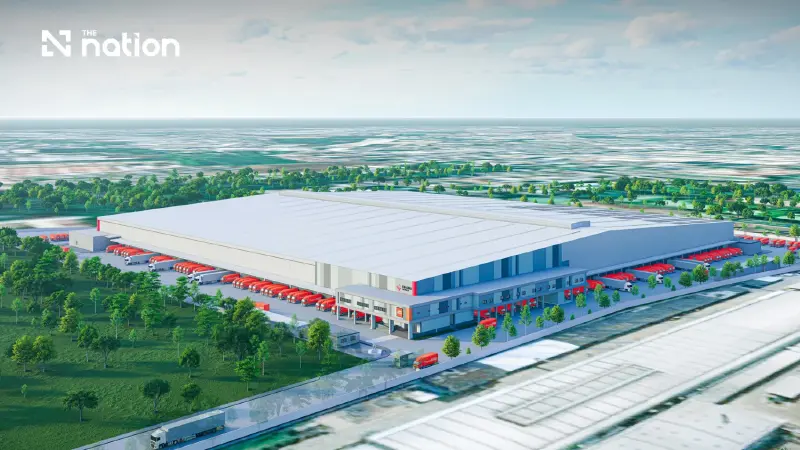
FPT is positioned to capture a large share of that growth. Lim said the company and rival WHA together control more than half of Thailand's industrial and logistics market, with FPT's own portfolio at roughly 3.5 million square metres.
He credited FPT's international offices — in Australia, Europe, Vietnam and China — with steering multinational tenants toward Thailand, an "international account manager" model he said smaller local operators cannot easily replicate.
Demand has also shifted from FPT's traditional build-to-suit model back toward ready-built factories, as investors move faster: "Our factory is 99% occupancy," Lim said. "We're running out — so we're building more."

Office market's quiet divergence
Bangkok's office sector remains the industry's most contested storyline, and Lim pushed back on the narrative of an oversupply choking premium buildings, arguing that headline vacancy figures blend ageing CBD stock, government-owned space and genuinely new Grade A towers into one misleading number.
Consultancy data offers a more nuanced picture. Knight Frank Thailand recorded Bangkok office occupancy at 77.6% in the first quarter of 2026, with roughly 436,000 square metres of new supply due to complete during the year.
CBRE Thailand put occupancy slightly higher, at 79.3%, its second consecutive quarterly rise. Both describe a market splitting sharply by quality, with non-CBD locations recording stronger absorption than CBD areas as tenants chase newer buildings at lower rents – what Knight Frank's Panya Jenkitvatanalert called "not just a decentralisation of locations, but a decentralisation of quality."
That flight-to-quality dynamic is essentially the trend Lim describes from the landlord's side. One Bangkok, now on its fourth completed office block, has reached an average occupancy of around 50% across the project — a figure Lim called encouraging this early.
He said tenants are relocating out of 20- to 30-year-old CBD buildings with outdated mechanical systems, and that no comparable new premium Grade A CBD tower is likely to break ground for another two to three years.
Cushman & Wakefield's Aukit Pronpattanapairoj offered a similar read for 2026, noting that "fewer new buildings are entering the market... reducing the oversupply stress that was seen earlier."

REITs and the road ahead
FPT's two Thai REITs — industrial-focused FTREIT and office-and-retail-focused Golden Ventures REIT (GVREIT) — round out its capital-recycling strategy.
Lim said FTREIT's assets under management have grown at roughly 7% compound annual growth for 15 straight years, while GVREIT has been a harder sell, reflecting investor scepticism about office fundamentals.
Lim also pointed to sustainability as a commercial filter rather than a cost centre, citing FPT's insistence on green certification for every new project and ARAYA's status as Thailand's first IAT-certified smart industrial estate.
Looking ahead, he said the next three to five years will reward developers competing on build quality and service rather than volume.
"Everybody should come back and look at themselves — how to create a better product and serve the customer better after they buy," he said. "It's not a one-off transaction."
Independent forecasters broadly share that two-speed framing. The World Bank has cut its 2026 Thailand GDP growth forecast to 1.6%, citing weaker trade, high household debt and softer tourism, while expecting FDI to keep building as pledged projects convert into construction.
REIC itself expects the national housing market to contract slightly for the year despite the stronger start. Against that backdrop, Thailand's pivot toward semiconductors, batteries and digital infrastructure looks less like a talking point than the property industry's central fact for 2026.
