
Beyond Greenwashing: How Global Supply Chains Forced Thailand's Real Estate Pivot
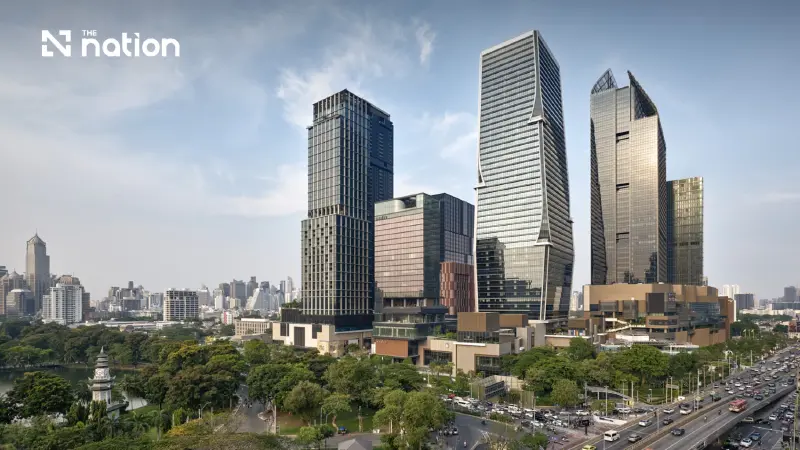


As Western FDI demands strict ESG compliance, Frasers Property Thailand's CEO explains why green building has shifted from a lobby badge to a balance-sheet necessity
- The pivot to green buildings in Thailand is driven by multinational companies relocating their supply chains, which require strict ESG compliance as a non-negotiable leasing condition.
- Green building certification has evolved from a "greenwashing" marketing tool into a financial necessity, directly impacting a property's ability to attract foreign investment and tenants.
- ESG-compliant buildings now dominate Bangkok's commercial real estate market, accounting for 80% of new office leasing activity and commanding rental premiums of up to 14%.
- In response, major developers are making green and health certifications (like LEED and WELL) a mandatory baseline for all new projects, viewing it as essential for future viability.
As Western FDI demands strict ESG compliance, Frasers Property Thailand's CEO explains why green building has shifted from a lobby badge to a balance-sheet necessity.
For years, green building certification in Thailand was treated as an optional flourish: a plaque in the lobby, a bullet point in a sales brochure. Lim Hua Tiong, chief executive of Frasers Property Thailand (FPT), argues that era is over — at least for the institutional grade of the market he competes in.
"Any building we do, it has to be a green building," Lim said in an interview at One Bangkok. "That's rule number one."
That imperative reflects a structural repricing of real estate across Southeast Asia, in which certification is migrating from a public-relations exercise to a precondition for capital allocation and tenant acquisition.
Research from JLL Thailand has found that roughly 80% of new office leasing activity in Bangkok's central business district over the past five years has gone to ESG-compliant buildings, with green-certified assets commanding rental premiums of up to 14% above the market average — and, in the same survey, up to 96% of local corporate occupiers say they are targeting fully green-certified portfolios by 2030.
For a developer backed by international capital and courting multinational tenants, the gap between "certified" and "uncertified" is becoming the difference between signing a lease and holding an empty asset.

The FDI-ESG feedback loop
Lim's commercial rationale is tied directly to the foreign direct investment reshaping Thailand's industrial sector.
Multinationals relocating manufacturing and supply-chain functions into Southeast Asia — many of them answerable to increasingly strict home-market climate-disclosure rules — are treating ESG compliance as a leasing precondition rather than a preference.
"When new FDI comes in, if they are strict on ESG compliance, our product is ready," Lim said. "So they know — they come to us."
He drew a sharper cultural distinction than most executives are willing to on the record.
"The Western world are non-compromise — regardless of the cost, they must do it," he said. "In Asia, sometimes we are still very commercially driven — if it makes money, we do it; if not, we do less."
FPT's own strategy, he said, leans towards the former, a stance he traces to the governance standards of its Singapore-listed parent company.
Testing the model: from ARAYA to vertical CBD towers
FPT is applying that baseline across both its industrial and commercial footprints.
In Samut Prakan, its 4,600-rai ARAYA industrial estate — a joint venture with Rojana Industrial Park and Asia Industrial Estate — has secured SMART I.E. certification from the Industrial Estate Authority of Thailand, an accreditation that assesses performance across facility automation, IT infrastructure, smart energy management and workforce liveability, not energy efficiency alone.

The estate has already attracted anchor tenants, including semiconductor manufacturer Infineon Technologies, and, by late 2025, had sold roughly 40% of its total saleable land — an early signal, in Lim's view, that the certification is translating into investor demand rather than sitting on the balance sheet as an unrewarded cost.
Lim acknowledged the premium involved.
"It cost us a bit more," he said, "but by doing this, we help promote Thailand to Western investors who demand these standards."
In high-density urban settings, where rooftop solar cannot realistically power a vertical tower, the sustainability focus shifts from generation to mechanical efficiency.
At the flagship One Bangkok development, FPT has invested roughly 3 billion baht in technology, including a centralised district cooling plant built in partnership with Tokyo Gas, Osaka Gas and Mitsubishi Corporation.
By piping chilled water through a two-kilometre underground loop from a single central plant, the system is estimated to cut air-conditioning energy consumption by 30–40% compared with conventional building-by-building chillers, generating annual energy savings estimated at around 17,000 megawatt-hours.
Health-focused standards have followed a similar logic. WELL certification — administered by the International WELL Building Institute and built around real-time indoor air-quality monitoring, automated touchless fixtures and MERV-rated filtration — has become a fixture across the group's commercial portfolio.
The PARQ, the mixed-use development on Rama IV Road that TCC Assets built with Frasers Property Holdings (Thailand) as development manager, became in 2020 the first project in Thailand to hold both LEED Gold and WELL Gold Core certification simultaneously, pairing intelligent lighting sensors and UV-C air disinfection with SmartScore and WiredScore benchmarks that assess a building's sensor infrastructure and connectivity rather than energy performance alone.
Lim explained that FPT had pioneered advanced air-filtration systems long before COVID-19 at Park Ventures Ecoplex, its earlier Sukhumvit project, and subsequently applied that same design logic to The PARQ. The building's real-time oxygen sensors, automated touchless fixtures, and MERV-rated air filtration were all specified well before the pandemic hit.
"We did this thing before Covid," Lim said. "So when Covid happened, these features became very popular."
He credits that early design choice with helping The PARQ fill quickly with health-conscious multinational tenants — including 3M, Chubb, and PepsiCo — even as the pandemic depressed office demand elsewhere in Bangkok.

The economics of compliance
Despite the commercial upside, broader adoption across the Thai market still faces financial friction. Reaching higher tiers under international frameworks such as LEED or Thailand's own TREES standard requires substantial upfront capital — an outlay that smaller domestic developers, already contending with thin margins and a soft housing market, cannot always absorb.
It is this cost gap, more than any lack of technical know-how or regulatory pressure, that industry data suggests is the real brake on faster adoption nationwide.
Lim's response to that tension is not to relax the standard but to remove the choice from the equation: treat certification as a fixed baseline rather than a discretionary upgrade to be negotiated away under commercial pressure.
In his view, simplifying the logic is the only way to navigate that pressure – build to standard from day one or risk obsolescence as tenant expectations continue to harden.
The regional backdrop suggests he is reading the trend correctly rather than getting ahead of it.
Thailand and Malaysia have both climbed into the global top 20 markets for LEED certification volume in recent years, and newer certification cycles are placing growing weight on live building-performance data – real-time carbon and indoor air-quality metrics – rather than a one-off design assessment at completion.
For a developer whose tenant base increasingly consists of the same multinationals driving Thailand's industrial FDI boom, Lim's wager is that the buildings meeting tomorrow's disclosure standards today will be the ones still filling up when the next downturn arrives.
This is the first article in a series exploring Thailand's sustainability transition ahead of a roundtable of business and policy leaders, convening in late September to discuss how the country can turn climate pressure into competitive advantage.
