
Russia and Thailand Panel Urges Reform and EEC Model to Unlock $100m Property Market
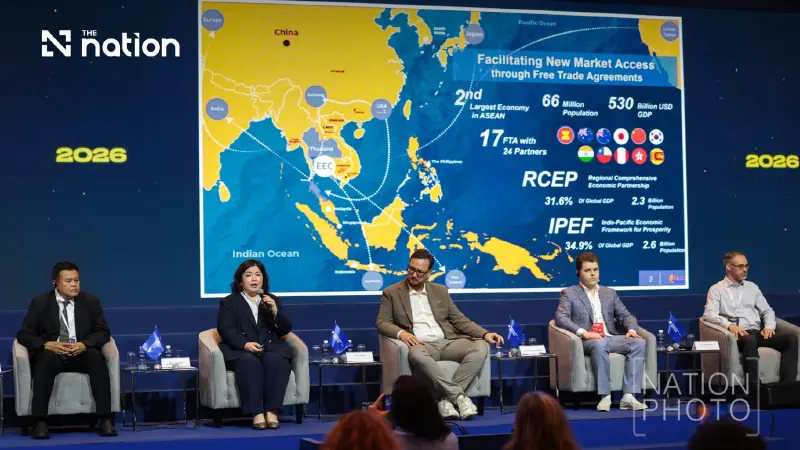


Bangkok forum hears demand for Thai real estate is surging despite rigid ownership caps, with investors directed toward the Eastern Economic Corridor and joint ventures
- A Russian-Thai investment panel highlighted that surging Russian demand, reaching $100 million, is being stifled by Thailand's restrictive property laws, including a 49% foreign ownership cap on condos and 30-year lease limits.
- The panel promoted the Eastern Economic Corridor (EEC) as a key solution, offering a special regulatory zone with extended 99-year land leases and tax incentives that bypass national restrictions.
- In the absence of immediate legal reform, panelists advocated for forming joint ventures with local Thai developers as a practical way to navigate land ownership laws and access financing.
- The forum warned investors against using illegal nominee structures to acquire property, urging them to use legal alternatives like verifiable long-term leases instead.
The Bangkok forum hears demand for Thai real estate is surging despite rigid ownership caps, with investors directed toward the Eastern Economic Corridor and joint ventures.
Property has emerged as one of the most active conduits for Russian capital in Thailand, but restrictive ownership rules and rigid leasing caps are limiting full institutional participation.
Speaking on Saturday (October 31) at the Russian-Thai Investment Forum 2026, developers, advisers, and government officials agreed that while legal reform moves slowly, joint ventures and specialised regimes like the Eastern Economic Corridor (EEC) offer immediate workarounds.
The panel, titled New Form of Development: Real Estate Development in Thailand, was moderated by Kirill Solgalov of the Russian Architects Union and Planning Group during the main business programme in Bangkok.

Surging Russian Demand Hits Regulatory Ceiling
Russian buyers completed 842 property transactions in Thailand during the first nine months of this year, with total value reaching approximately 3.6 billion baht ($100 million)—a 76 per cent increase year-on-year.
According to panel metrics, Russian nationals now represent the second-largest group of foreign real estate buyers in Thailand after Chinese nationals. Despite growing commercial appetite, structural legislative barriers remain firm.
Sitthichok Srimeechai of the Department of Land confirmed that foreign nationals remain capped at owning no more than 49 per cent of total unit space in any single condominium project, and recent attempts to raise this limit to 70 per cent failed to pass.

Standard land leases also remain restricted to a 30-year maximum under general law, with legislative proposals to extend base terms to 50 years or allow renewable terms adding up to 90 years failing to gain traction.
Furthermore, land officials confirmed that authorities are actively investigating corporate shells where foreign parties hold over 49 per cent of shares to acquire land or villas, warning against illegal nominee arrangements.
"A guaranteed extension has never existed in law and is largely a marketing claim," noted Ilya Sukharnikov, partner at B1 Group.
He urged foreign investors to operate strictly within standard leasehold terms or register superficies rights, treating foreign-quota premiums as a cost of doing business rather than counting on imminent legislative reform.

The EEC Framework: A Flexible Alternative
Panellists highlighted Thailand’s Eastern Economic Corridor—a special development zone spanning three eastern provinces—as the most commercial route for foreign property developers.
Dr Cholachit Vorawangso Virakul, assistant secretary general of the EEC Office, presented details of the corridor's bespoke regulatory framework, which allows approved investors in target sectors to secure 50-year commercial land leases, renewable for an additional 49 years, effectively bypassing the national 30-year limit.
In addition to extended land rights, corporate income tax exemptions of up to 15 years are available for qualifying projects in target industrial and technology clusters.
The state is currently developing a 24-square-kilometre flagship EEC smart city, allocating 30 per cent of green space, with infrastructure delivered through public-private partnerships.
The EEC Office confirmed that customised incentive packages, including extra concessions for developers using or producing green construction materials, are being offered to attract international partners.

Corporate Structure: Joint Ventures and Modular Tech
To navigate local financing constraints and land ownership limits, Thai industry leaders advocated direct corporate partnerships. Prateep Tangmatitham, president of Supalai Public Company, confirmed that major domestic developers are seeking joint ventures with Russian firms under standard 30 to 49 per cent foreign equity stakes.
Under these structures, local partners secure land parcels, navigate municipal planning permits, handle construction management, and help arrange domestic commercial bank financing.

Beyond capital flows, the panel examined technological integration in large-scale residential delivery. Kirill Solgalov highlighted Russia's transition to large-scale master-planned urban districts, noting over 1,100 integrated territorial projects initiated as of mid-2026, suggesting Thailand's 15-minute city initiatives follow a similar trajectory.

Meanwhile, Alexander Chekanov, deputy general director of Monarch Holding, presented modular housing technologies capable of producing 500,000 square metres of high-density housing annually.
He cited a recent Moscow project where a 23-storey, 198-apartment complex was completed in under six and a half months using off-site factory construction, offering tech-transfer partnerships to Southeast Asian developers.

Strategic Outlook
While no formal intergovernmental protocol was signed at the conclusion of the session, industry stakeholders outlined several clear priorities for the sector moving forward.
Foreign retail investors are encouraged to move away from high-risk nominee structures toward verifiable long-term leases, superficies rights, and hotel-licensed commercial setups.
Institutional real estate capital is best directed into the EEC to take full advantage of extended 99-year lease terms and targeted tax holidays.
Finally, pairing international equity with established Thai developers will help resolve land access and domestic bank financing hurdles, while deploying modular off-site construction can significantly accelerate development timelines across major urban centres.
