
New Moon race is about who can build and stay
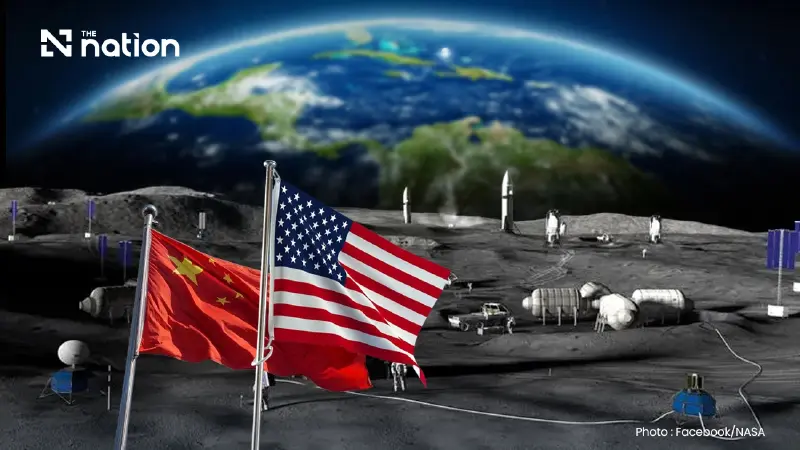


NASA is planning a phased Moon base while Chinese scientists test lunar-soil fibres that could support future off-Earth construction
The race back to the Moon is moving into a more serious phase, with the United States and China no longer focused only on landing missions but on the harder challenge of building and sustaining a long-term presence beyond Earth.
NASA is pushing ahead with a phased plan for a future Moon base, while Chinese researchers are testing fibres made from lunar soil that could one day be used to build structures on the lunar surface.
NASA turns Moon plan into long-term infrastructure push
NASA announced in March 2026 that it was reshaping its lunar strategy around a step-by-step plan to build a sustained human presence on the Moon.
The agency said it would move away from infrequent, customised missions and towards a repeatable and modular approach, building capability “landing by landing” through robotic deliveries, rovers, instruments and technology demonstrations.
The first phase, described as “Build, Test, Learn”, is designed to increase the pace of lunar activity through Commercial Lunar Payload Services deliveries and the Lunar Terrain Vehicle programme. These missions will support testing in mobility, power generation, communications, navigation, surface operations and scientific investigations.
The second phase will focus on early lunar infrastructure, including semi-habitable systems and more regular logistics to support recurring astronaut operations. NASA said this stage would include major international contributions, such as a pressurised rover from the Japan Aerospace Exploration Agency, as well as possible partner payloads, rovers and infrastructure systems.
The third phase is intended to enable longer-duration human presence. Once cargo-capable human landing systems become available, NASA plans to deliver heavier surface infrastructure, including multi-purpose habitats from the Italian Space Agency and a lunar utility vehicle from the Canadian Space Agency.
NASA said the goal is to shift from periodic expeditions towards a more permanent lunar base, while also using the Artemis programme as a stepping stone for future human missions to Mars.
The agency’s current Artemis programme places the Moon at the centre of its Moon-to-Mars strategy. NASA says Artemis II will send astronauts around the Moon on the first crewed lunar flyby in more than 50 years, while later missions are intended to expand surface exploration.
China looks to build with the Moon’s own soil
While NASA is focusing on infrastructure and mission architecture, China is working on one of the most difficult problems in lunar construction: how to reduce dependence on materials sent from Earth.

Chinese researchers have prepared fibres made from lunar soil and sent experimental samples to the Tiangong space station aboard the Tianzhou-10 cargo spacecraft, according to Xinhua. The samples are being tested on an extravehicular exposure platform to assess whether they can withstand space conditions, including high vacuum, intense radiation and extreme temperature changes.
The work is being led by researchers from the College of Materials Science and Engineering at Donghua University in Shanghai. The team heated lunar soil until it melted and then drew it into fine fibres, drawing on similarities between lunar soil and basalt.
Xinhua reported that the research team has worked on materials for extreme environments since 2016 and has developed a spinning device that can simulate lunar conditions, including high vacuum and microgravity.
The research was made possible after China’s Chang’e-5 mission returned lunar soil samples to Earth in 2020. Using just 0.5 grammes of lunar soil, the researchers were able to produce a fibre about three metres long and as thin as a human hair.
The possible applications are practical. Lunar-soil fibres could be woven into flexible construction materials, used to strengthen lunar concrete or act like reinforcement bars for structures built on the Moon.
However, the technology is still at the early verification stage. Researchers still need to test whether the fibres can survive the harsh lunar environment before they can be considered for real construction.
Moon race shifts from flags to foundations
The two approaches point to the same strategic challenge: returning humans to the Moon is only the beginning.
A lasting lunar presence would require transport, energy, mobility, communications, shelter and construction systems that can operate far from Earth. Sending all materials from Earth would be costly and difficult, which is why both space powers are looking at ways to build more efficiently on the lunar surface.
NASA’s approach is centred on phased infrastructure, commercial deliveries and international partnerships. China’s lunar-soil fibre research focuses on using local resources to support future construction.
Together, the developments show how the next stage of the Moon race is shifting from symbolic landings to practical survival. The question is no longer just who can reach the Moon, but who can build there and stay.
