
NASA Unveils Ambitious Blueprint for Permanent Humanity Outpost on the Moon
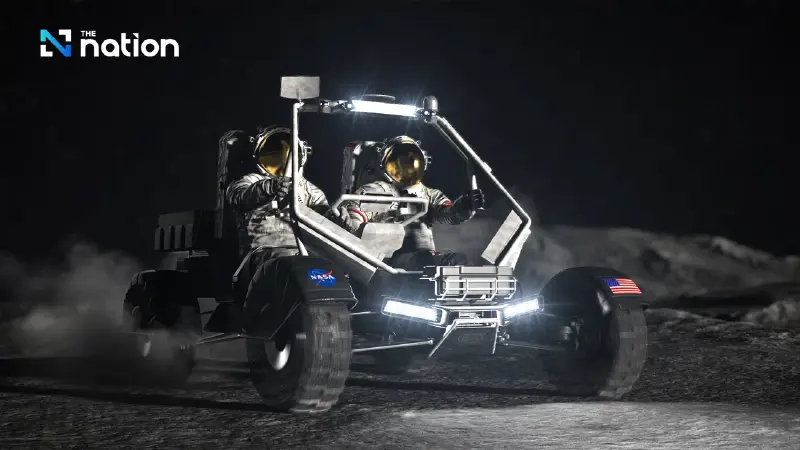


NASA to launch three uncrewed missions to the lunar South Pole by 2026, establishing vital infrastructure to locate ice and pave the way for Mars
- NASA will launch three foundational uncrewed missions to the lunar South Pole by 2026 to establish infrastructure and locate crucial water ice resources.
- The plan is supported by multi-million-pound contracts awarded to commercial companies for developing next-generation crewed rovers, heavy cargo landers, and robotic drones.
- This permanent lunar outpost is designed to be humanity's first on another celestial body, serving as a critical stepping stone for eventual human missions to Mars.
NASA to launch three uncrewed missions to the lunar South Pole by 2026, establishing vital infrastructure to locate ice and pave the way for Mars.
The National Aeronautics and Space Administration or NASA, has detailed a massive acceleration in its plans to establish a permanent human presence on the lunar surface, revealing a suite of multi-million-pound contracts for crewed rovers, heavy cargo landers, and pioneering robotic exploration missions.
Speaking at a dedicated briefing at NASA Headquarters this week, the agency’s newly appointed administrator, Jared Isaacman, confirmed that a trilogy of foundational uncrewed missions—designated Moon Base I, II, and III—will launch to test critical technologies ahead of crewed Artemis landings.
"The Moon Base will be America’s and humanity’s first outpost on another celestial world," stated Mr Isaacman, emphasising the strategic, scientific, and economic incentives of the programme.
He also acknowledged the bipartisan backing from Congress and the political trajectory set under President Trump's administration, which has prioritised securing an enduring American foothold in deep space.

Phase 1: The Initial Robotic Vanguard
The initial push involves three highly targeted uncrewed missions launching by 2026 under NASA’s Commercial Lunar Payload Services (CLPS) initiative.
These missions are explicitly designed to transport scientific equipment, test exploratory rovers, and map out the treacherous terrain of the lunar South Pole.

NASA has strategically selected the South Pole region because it receives near-constant sunlight, which is vital for solar power generation.
More importantly, the area's primary objective is the exploration and detection of lunar water ice—a crucial resource for sustaining life and manufacturing fuel.
This long-term infrastructure layout is intended to support astronauts living on the Moon while serving as a stepping stone and launchpad for eventual human journeys to Mars.

Moon Base I (Autumn 2026): Utilising Blue Origin’s Blue Moon Mark 1 Endurance lander, this mission will touch down on the Shackleton Connecting Ridge. It carries the SCALPS instrument to study how engine plumes interact with lunar soil, alongside a Laser Retroreflective Array to provide ultra-precise surface positioning for orbiting spacecraft.

Moon Base II (Late 2026): Astrobotic’s Griffin lander will transport more than 500 kilograms of cargo to the surface, anchored by Astrolab’s FLIP rover, which is tasked with assessing the mobility of heavy systems over rugged terrain.

Moon Base III (Late 2026): Flying on Intuitive Machines’ Nova-C Trinity lander, the anchor investigation, Lunar Vertex, will study the mysterious, highly magnetised "lunar swirls" across the surface. This mission features strong international cooperation, carrying key payloads from the European Space Agency (ESA) and the Korea Astronomy and Space Science Institute.

Designing the Next-Generation 'Moon Buggies'
To provide long-range mobility for future astronauts, NASA has awarded parallel design and development contracts to two separate commercial teams.
Venturing away from the primitive rovers of the Apollo era, these next-generation Lunar Terrain Vehicles (LTVs) are built to operate continuously for years under brutal surface conditions.
Astrolab has been awarded $219 million to develop the Crewed Lunar Vehicle (CLV-1), adapted from its FLEX architecture.
The vehicle features a mass of roughly 900 kilograms, a compact stowed configuration, and the capability to transport astronauts and supplies while supporting remote teleoperation at speeds up to 6mph.

Concurrently, Lunar Outpost has secured $220 million to deliver Pegasus, a lighter, mission-ready evolution of its Eagle rover. Built on Apollo-heritage technology, Pegasus is designed to operate for up to a year, supporting manual, autonomous, or teleoperated driving at speeds exceeding 9 mph.
Over the next 18 months, both companies will refine their designs, conduct rigorous crewed simulator evaluations, and build space-qualified test units.
To ferry these heavy vehicles to the lunar South Pole, NASA has awarded a separate $188 million contract to Blue Origin, with options scaling up to $280.4 million based on performance milestones.

Drones and the Next Frontier: CLPS 2.0
In a major technological leap for planetary exploration, NASA also highlighted MoonFall, a mission designed to deploy four autonomous drones to the lunar surface.
Developed by the Jet Propulsion Laboratory (JPL) and built by Firefly Aerospace, these specialized drones will execute short, coordinated hops across treacherous, hard-to-reach craters to capture high-resolution scouting imagery.
Upon completing their flights, the drones’ internal "survive-the-night" payloads will continue operating for months, establishing an uninterrupted data link from the South Pole.

Looking ahead, the space agency is already transitioning to its "CLPS 2.0" framework. This next-generation procurement structure allows NASA to purchase entirely turn-key delivery services or directly procure commercial hardware to integrate into its own proprietary missions.
With industry proposals for CLPS 2.0 due by Tuesday, 30 June 2026, the agency is preparing for an escalating cadence of launches that will ultimately serve as the logistical foundation for humanity's eventual journey to Mars.
