
China launches year-long space station mission amid moon race
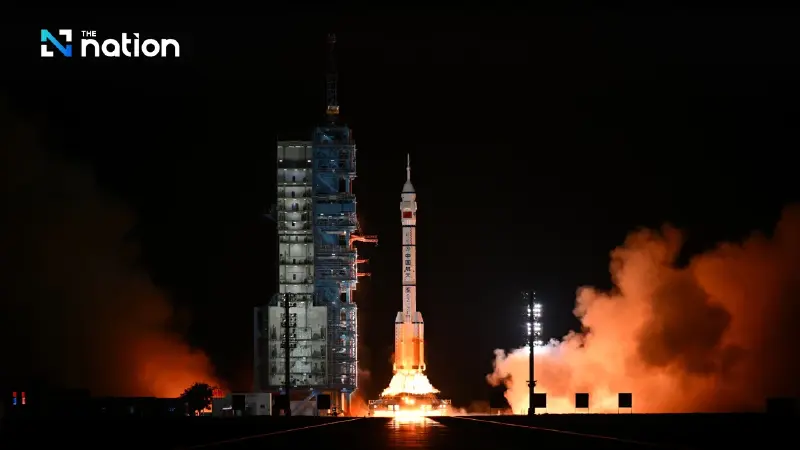


Shenzhou-23 carries three astronauts to Tiangong, including Hong Kong's Li Jiaying, as Beijing prepares for a crewed lunar landing by 2030.
- China has launched the Shenzhou-23 mission to its Tiangong space station, which will include the country's first year-long stay in orbit.
- The mission is a strategic part of China's plan to land astronauts on the moon by 2030, placing it in direct competition with the United States' goal of a 2028 lunar landing.
- A key objective is to test autonomous rendezvous and docking procedures, a critical technology required for the future lunar mission.
- Research during the extended mission will study the effects of long-term spaceflight on humans, providing crucial data for deep-space exploration and the moon landing.
China launched three astronauts to its Tiangong space station on Sunday (May 24), beginning a Shenzhou-23 mission that will include the country’s first year-long stay in orbit and support research into how humans cope with extended time in space.
The mission is also tied to Beijing’s wider plan for a crewed moon landing by 2030.
The Shenzhou-23 spacecraft lifted off at 11.08pm (1508 GMT) on a Long March-2F Y23 carrier rocket from the Jiuquan Satellite Launch Centre in northwestern China.
The crew consists of Commander Zhu Yangzhu and pilot Zhang Yuanzhi, both from the People’s Liberation Army’s astronaut division, and payload specialist Li Jiaying, a former Hong Kong police inspector. Li is the first astronaut from Hong Kong to take part in a Chinese space mission.
The China Manned Space Agency said on Saturday that one of the three astronauts would remain on Tiangong for a year, with the choice to be made later based on the mission’s progress.
The stay would be one of the longest space missions ever, though still below the 14-1/2-month record set by a Russian cosmonaut in 1995.
The launch comes as China and the United States sharpen their focus on the moon.
The US has warned about what it alleges are Beijing’s plans to colonise lunar territory and mine its resources, claims that Beijing has strongly rejected.

NASA is targeting a crewed moon landing in 2028, two years before China’s stated goal.
The US also aims to build a long-term lunar presence as a step towards eventual human exploration of Mars.
In April, four NASA astronauts made a historic journey around the moon on the Artemis II mission, travelling farther from Earth than anyone before on the first crewed lunar mission in half a century.
On Friday, Elon Musk’s SpaceX carried out a largely successful uncrewed test flight of Starship, its next-generation rocket designed for more frequent Starlink satellite launches and future NASA missions to the moon.
China, with less than four years before its 2030 target, still has to prove that new lunar hardware and software are ready for the mission.
That includes systems needed to move astronauts from the relative safety of Tiangong in low-Earth orbit to the higher-risk environment of the lunar surface.
Since 2021, China’s Shenzhou missions have regularly carried three-person crews to Tiangong for six-month rotations, with astronauts sent to the station almost a dozen times.
The Chinese space agency is also training two Pakistani astronauts, one of whom could join an expected short-duration mission to Tiangong this year.
The previous mission, Shenzhou-22, was launched ahead of schedule in November to bring three Chinese astronauts back to Earth after their Shenzhou-20 spacecraft was damaged by space debris while in orbit.
China has so far sent only robotic missions to the moon, but its Shenzhou flights underline its fast-growing space capabilities.
In June 2024, China became the first country to retrieve lunar samples from the far side of the moon using robots.
A successful crewed landing before 2030 would strengthen China’s plan to build a permanent lunar base with Russia by 2035.
Wu Weiren, chief scientist of China’s lunar programme, has said Beijing’s public timetable is deliberately conservative.
Over the past year, Beijing has been conducting safety tests on equipment developed for the 2030 mission, including the heavy-lift Long March-10 rockets, the Mengzhou spacecraft and the Lanyue lunar lander.
Shenzhou-23 will carry out China’s first autonomous rapid rendezvous and docking procedure with Tiangong’s core module.
The manoeuvre is intended to support preparations for the 2030 lunar mission, which depends on an automated lunar-orbit rendezvous between the Mengzhou capsule and the Lanyue lander.
Scientists will use the extended Shenzhou-23 mission to study the effects of radiation exposure, bone density loss and psychological stress on humans in space.
Beijing is also conducting what state media described as the world’s first human “artificial embryo” experiment in space, after sending human stem-cell samples to the Shenzhou-22 crew on Tiangong this month.
The experiment is aimed at studying long-term human residence, survival and reproduction in space.
Reuters
