
Anutin tells Team Thailand in Europe to turn diplomacy into real benefits
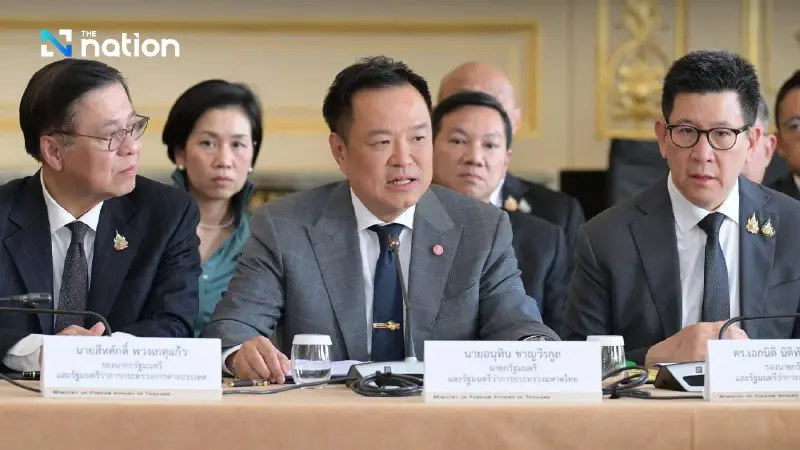


Anutin directs Thai envoys in Europe to pursue proactive diplomacy, accelerate the Thai-EU FTA and promote investment opportunities.
Prime Minister and Interior Minister Anutin Charnvirakul has instructed Team Thailand in Europe to drive forward proactive diplomacy, with a focus on ensuring that opportunities and national benefits reach the public.
He also called for all agencies to work together in a “cluster” format to advance the Thai-European Union free trade agreement (FTA).
Anutin on Sunday (May 24) chaired a meeting of Thai ambassadors and consuls-general stationed across Europe in Paris, France. The meeting was attended by deputy prime ministers, ministers, senior executives from the Ministry of Foreign Affairs, and ambassadors and consuls-general from 24 countries in Europe.
The prime minister exchanged views and listened to feedback on policy implementation during a discussion that lasted more than three hours.

After the meeting, Government Spokeswoman Rachada Dhnadirek outlined the key issues discussed.
1. Accelerating the Thai-EU FTA
The prime minister stressed that one of the government’s urgent priorities is to accelerate the Thai-EU FTA, which is an issue of major importance to both Thai and foreign businesses.
The agreement is expected to help reduce tariff and trade barriers, opening greater opportunities for high-quality Thai goods and raw materials to enter the European market.
Anutin also gave assurances that the government would adjust its working approach, integrating all agencies into a “cluster” format to push forward efforts to conclude the FTA negotiations.
On this occasion, several ambassadors said Thailand had returned to international attention and was now “on the radar” of many countries. They said Thailand was not merely a manufacturing country, but an “economic partner” capable of strengthening global supply chains.
They also noted that countries which had already signed free trade agreements with the EU had seen their exports to the bloc rise significantly.
2. Proactive diplomacy covering security, economy, society, environment and humanitarian issues
The prime minister emphasised the concept of Diplomacy 2.0, or tangible diplomacy. This refers to proactive diplomacy that maintains balance amid global conflicts.
He said Thailand’s diplomacy should focus on four pillars: security diplomacy, economic diplomacy, social and environmental diplomacy, and humanitarian diplomacy.
Anutin stressed that diplomacy must lead to concrete outcomes that people can see and benefit from.
The Deputy Prime Minister and Finance Minister said Thailand is ready to welcome trade and investment. The government is developing both infrastructure and human resources, while working with the Deputy Prime Minister and Minister of Higher Education, Science, Research and Innovation to design education programmes and build workforce skills.
He also referred to Thailand’s energy transition, including the promotion of clean energy to support future industries.

3. Raising standards towards OECD membership
The government is speeding up efforts to raise Thailand’s laws and national standards in line with those of the Organisation for Economic Co-operation and Development (OECD), in support of Thailand’s application for membership.
The prime minister wants the process completed within three years, faster than the previous five-year target.
4. Promoting Thailand’s strengths in food security and future energy
Anutin said that during exchanges of views with ASEAN leaders, all countries had identified food security as a regional priority.
Thailand, he said, has strong potential in this area.
5. Thailand to host major global events
The prime minister said Thailand will host several major global meetings and forums in the period ahead, placing the country more firmly in the global spotlight.
These events include:
- Gastech 2026, the world’s largest energy exhibition, in September.
- The World Bank-IMF Annual Meetings 2026 in October.
- The Global Wellness Summit in November.
Anutin asked Thai embassies and consulates-general to help publicise these opportunities and build on them to strengthen Thailand’s image, boost confidence and attract investment into the country.
In closing, the prime minister stressed that Thailand is ready to become a strategic hub of the region, supported by political stability, infrastructure capable of accommodating investment, and a strong private sector.
He said that when all sides — the government, private sector, Board of Investment and Thai embassies in Europe — work together as Team Thailand, the country will gain the agility needed to drive national strategy and successfully push Thailand to the forefront of the global stage.
