
Thai student receives global awards for turning plastic waste into hornbill nests
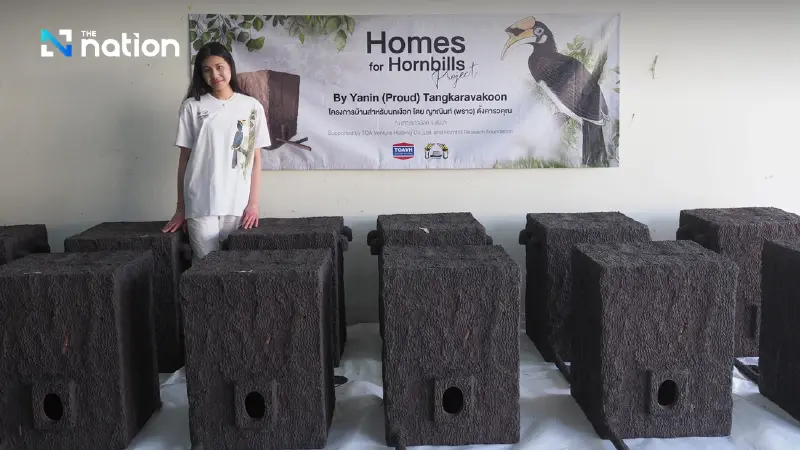


Youth-led Homes for Hornbills turns upcycled plastic into artificial nests to protect hornbills and support forest conservation.
Global awards recognise youth-led conservation work
Yanin (Proud) Tangkaravakoon, a Thai Grade 11 student at Choate Rosemary Hall in Connecticut, USA, has received international recognition through two major global awards following the success of Homes for Hornbills, which aims to protect hornbills and support forest conservation through an innovative nesting solution.
The project was selected as a 2026 Top Honors Award Recipient of The Slingshot Challenge by the National Geographic Society. The global challenge aims to identify and support the next generation of problem-solvers, advocates and stewards of the planet.
Yanin was also named the 2026 Oceania and Southeast Asia Regional Winner of The Earth Prize 2026 by The Earth Foundation in Geneva, Switzerland.
The Earth Prize is the world’s largest environmental competition and “ideas incubator” for young people. It aims to inspire and empower the next generation of environmental innovators, supporting participants with the tools they need to develop ecological solutions with real-world impact.
Together, these achievements show how Homes for Hornbills demonstrates the power of youth-led innovation, scientific collaboration and community engagement in addressing biodiversity challenges while developing practical and sustainable solutions for wildlife conservation.

Youth-led hornbill project turns plastic waste into safer nests
The youth-led Homes for Hornbills project is using artificial composite nests made from upcycled plastic waste to help protect hornbills and raise public awareness of the endangered birds’ role in supporting forest regeneration and biodiversity.
Hornbills play an essential role as seed dispersers, supporting forest regeneration and biodiversity. However, declining hornbill populations, driven by habitat loss, deforestation and poaching, continue to pose significant challenges to wildlife conservation and ecosystem sustainability.
Unlike many bird species, hornbills cannot build their own nests. They depend on naturally formed cavities in large trees for breeding. As forest loss and human activity continue to reduce these natural habitats, suitable nesting sites have become increasingly limited.
In response, the project has developed and refined durable artificial nests tailored to hornbill behaviour, while expanding conservation education in schools and promoting long-term community engagement to help reduce poaching and forest degradation.
New nest design tackles conservation challenges
Beyond preservation, the project also aims to overcome the limitations of existing artificial nest designs.
Traditional wooden nests often deteriorate within two to three years and require additional timber resources. Earthen jar nests, meanwhile, may restrict the movement and development of hornbill chicks because of limited internal space.
Fibreglass composite nests, although longer lasting, may raise long-term concerns because glass fibres can potentially irritate birds over time.
The Homes for Hornbills conservation initiative therefore focuses on creating artificial composite nests by transforming upcycled plastic bottles into resin-based materials and replacing conventional glass fibres with natural fibres.
To identify more sustainable alternatives, Yanin worked with researchers from the Thailand Hornbill Research Foundation to refine key features, including cavity size, durability, ventilation and bird safety, while testing materials capable of withstanding environmental conditions.
Extensive testing was conducted with support from TOA Venture Holding’s polymer laboratory to identify suitable natural fibres for the artificial nests.
Among the tested materials, hemp showed the best wetting ability and strong resistance to bending. Through optimisation of fibre composition and the polymer matrix, the resulting composite material achieved strong mechanical performance, durability and environmental benefits, with the potential for the nests to remain functional for up to 10 years.

Early results show promising impact
So far, the project has installed 20 artificial nests on Yao Noi Island in southern Thailand, expanding breeding opportunities for hornbills and increasing local community involvement in conservation efforts.
During the 2025 breeding season, 10 nests were occupied, resulting in 14 hornbill chicks successfully fledging. The outcome provides encouraging early evidence of the initiative’s impact.
Looking ahead, the next phase of the project aims to expand its conservation impact through the installation of 10 large artificial nests in protected forest areas.
Yanin is currently raising funds through the Taejai Foundation to support the installation of additional nests in Su-ngai Padi National Park in Narathiwat province, an important habitat for endangered hornbill species, including the Helmeted Hornbill and Rhinoceros Hornbill.

Education remains central to Homes for Hornbills
Beyond developing nesting solutions, Homes for Hornbills also focuses on education and public awareness.
The project engages local children and young people in learning about the important role hornbills play in maintaining forest ecosystems and supporting surrounding communities, while encouraging long-term participation in conservation efforts.
Yanin also directed and co-wrote the award-winning documentary Homes for Hornbills in 2025. The documentary is currently streaming on Thai PBS’s VIPA platform and aims to raise awareness of hornbill conservation and environmental protection.
