
Global food exporters turn to Thailand as gateway to Southeast Asia
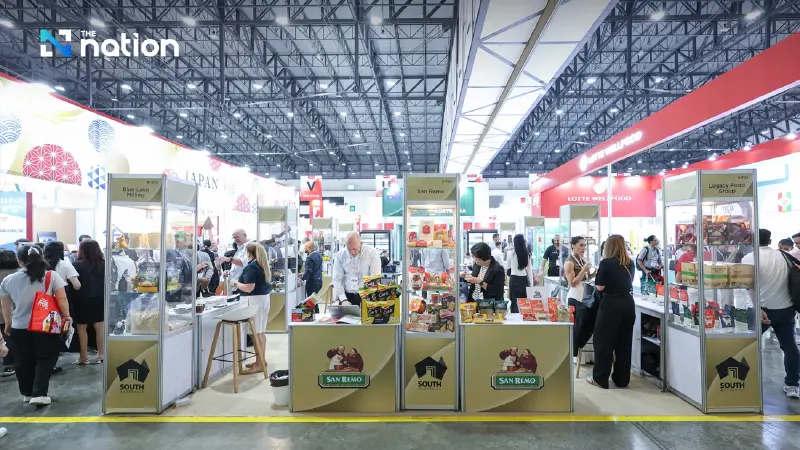


As global economic uncertainty persists, food producers from Australia, Belgium and Norway are using THAIFEX–Anuga Asia 2026 to build new partnerships, expand market access and reinforce supply-chain resilience through Thailand's strategic position in the region.
Australia, Belgium, and Norway are using THAIFEX-Anuga Asia 2026, one of Asia’s largest food trade shows as a key platform to promote its premium and quality food and beverage exports in Bangkok, strategically positioning Thailand as one of Southeast Asia’s competitive markets.
Australia is a leading provider of premium agricultural goods, including beef, lamb, dairy, wheat, and wine as well as focusing on key strategic pillars: Trust, Safety, and Sustainability
Australian Ambassador to Thailand, Dr Angela Macdonald, said the ThaiFEX-Anuga Asia is an excellent opportunity for Thais and Australians to explore new commercial avenues together.
“Australia offers a smorgasbord of quality produce and technical expertise. We have the most organic agricultural land in the world, and consumers can trust that Australian food has come from clean and green sources.”

48 food and beverage companies from New South Wales, Queensland, Western Australia, Victoria and South Australia are showcasing top Australian food and agricultural products in Thailand.
Meanwhile, key Australian agricultural exports to Thailand include mandarins, onions and Western Australian strawberries.
Austrade General Manager Southeast Asia, Ms Catherine Gallagher, said that Australian exporters were excited to explore the potential in Thailand and the broader region.
“Australian producers offer unparalleled safety standards, clean-label credentials and experience with supplying international markets. We’re hungry to match that with an appetite for long term supply chain partnerships, high-volume buyers and sustained production growth.”
Beyond Aussie beef and lamb, South Australia showcases pure, natural products

South Australian Minister for State Development Chris Picton noted that THAIFEX marked his first overseas trade mission, bringing South Australian food companies to Thailand with products including ingredients, oats, honey, jams and yoghurt.
South Australia is home to the largest concentration of agricultural research and teaching expertise in the Southern Hemisphere.
Although some South Australian exporters already have business connections in the region, the delegation’s participation in THAIFEX-Anuga Asia 2026 is aimed at expanding links in the Thai market.
“I think many people in Thailand would know South Australia’s food and wine sector first and foremost by the reputation of Penfolds. But there is so much more in terms of what comes out of South Australia and our clean, green, beautiful environment that produces really high-quality food,” Picton said.
“We are excited to have it on supermarket shelves and dinner tables here in Thailand,” he added.
Tori Dixon-Whittle, Chief Executive Officer of Food South Australia, said South Australia’s food sector was defined by trust and collaboration, with strict biosecurity and transparent tracking helping to ensure quality.
“Driven by an ambition to nurture rather than simply seek profit, the South Australian delegation is working together to offer consumers an authentic ‘taste of South Australia’ produced with genuine care," she added.

Thailand-Australia ties hold firm amid global uncertainty
Catherine Gallagher, the Austrade General Manager for Southeast Asia, explained that while the current global climate is "disruptive," the trade relationship between Australia and Thailand remains highly resilient and robust.
“Australia's premium food and beverage sector is weathering the storm because our products including wine, beef, and lamb, just fit so well within Thailand's high-quality hotels and HoReCa segment.", Catherine shared.
Meanwhile, she also pointed out about a strong bilateral trade agreement of Thailand-Australia Free Trade Agreement or TAFTA which was signed in 2005, describing that it is one of the most successful Thailand and Australia agreements.
“In that time, we have tripled two-way trade to $32 billion. And that's just in goods. And the reason we've done so well is because it's a win-win free trade agreement. And now we have zero tariffs both ways”, Catherine explained.
EU food products are seeking a larger presence in Southeast Asian markets.
Among the participating countries, Belgium is showcasing a range of processed potato products as part of an Asia-wide campaign promoting European agri-food products. Co-funded by the European Union, the initiative highlights quality, taste and sustainability while supporting Belgian exporters in international markets.
Thailand is an increasingly vital market for European processed potato products, with the country importing over 98,000 tons worth more than €122.6 million in 2025.
The campaign is complemented by an EU agri-food business mission taking place alongside the trade fair. The mission includes Belgium's agricultural export agency VLAM and several Belgian processed potato companies.
EU Commissioner for Agriculture and Food, Christophe Hansen, attended and facilitated business-to-business meetings between European producers and buyers, importers and retailers from across Southeast Asia, with the aim of strengthening trade ties between the EU and Thailand.

Norwegian seafood industry has identified Thailand as a strategic hub for Southeast Asia
Norway's seafood industry has identified Thailand as a strategic gateway to the Southeast Asian market, citing the country's established food-service infrastructure, expanding tourism sector, and growing demand for premium food products.
Despite global economic headwinds, including elevated shipping costs, geopolitical uncertainties, and a stronger Norwegian krone, Norwegian seafood exports to Thailand continued to grow in early 2026.
According to industry data, exports to Thailand reached 4.5 billion baht (1.29 billion Norwegian kroner) between January and April, up 8% from the same period last year.
Demand was particularly strong for fresh Norwegian salmon and fjord trout. Import volumes of the two species rose 17% year-on-year to 11,511 tonnes, with 97% arriving as fresh products, reflecting Thai consumers' preference for premium-quality seafood.
Meanwhile, the export value of Norwegian mackerel, commonly known in Thailand as saba, increased by 6% despite a 28% decline in volume, largely due to limited stock availability.

