
FTI Urges Energy Ministry to Support Pragmatic Transition as Refiners Diversify Sourcing
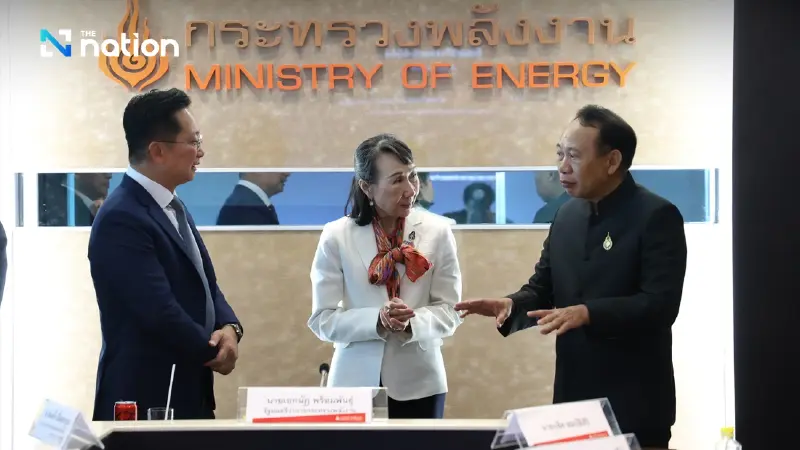


The Federation of Thai Industries holds emergency talks with the Energy Minister to secure a resilient energy grid amidst ongoing global market shocks
- The Federation of Thai Industries (FTI) is urging the Energy Ministry to adopt a "Pragmatic Energy Transition" that balances security, cost, and environmental sustainability.
- To insulate against global market shocks, Thai refiners have diversified their crude oil sources, reducing their historical dependence on suppliers from the Middle East.
- As a result of government policies and secure supplies, refiners are now facing a domestic fuel oversupply and are asking the ministry to lift export restrictions to manage full storage facilities.
- The FTI's proposals aim to modernize the national grid and protect Thailand's manufacturing competitiveness while still meeting long-term decarbonization targets.
The Federation of Thai Industries holds emergency talks with the Energy Minister to secure a resilient energy grid amidst ongoing global market shocks.
The Federation of Thai Industries (FTI) has held crucial high-level talks with the Ministry of Energy to establish a unified policy response to mounting macroeconomic challenges.
Led by FTI chairman Pimjai Leeissaranukul, the executive committee of the FTI’s Institute of Industrial Energy met with Energy Minister Akanat Promphan to present strategic proposals aimed at modernising the national grid while insulating the domestic economy from international volatility.
The immediate catalyst for the discussions stems from a complex intersection of global economic shifts, regional geopolitical tensions, and an accelerating green energy transition.
With manufacturers facing fluctuating costs, the industrial sector is pushing for an adaptable policy environment that preserves Thailand's manufacturing competitiveness without compromising its long-term decarbonisation targets.

Building Upon Structural Reforms
The talks follow a series of aggressive energy interventions by the state. The administration recently approved a sweeping overhaul of the electricity tariff structure alongside a major liberalisation of residential rooftop solar regulations.
By lifting the previous restrictive caps on power sales back to the grid, the government set a clear precedent for decentralised, cleaner power generation.
Building upon these foundations, the FTI presented its vision for the 2026–2028 term, underpinned by its strategic “5I” roadmap.
The framework focuses on:
- Intelligent Industry
- Innovation & Creative Industry
- International Alliance & Network
- Industrial Infrastructure Reform
- Inclusive & Sustainable Growth
Both parties reached a firm consensus that energy can no longer be viewed merely as an operational expense for businesses.

Instead, it must be treated as a baseline infrastructure asset that dictates foreign direct investment, digital industrial growth, and Thailand’s ultimate target of achieving net-zero greenhouse gas emissions.
Mongkol Hengrojanasophon, chairman of the FTI’s Institute of Industrial Energy, advocated for a "Pragmatic Energy Transition" pathway tailored specifically to the country's domestic economic context.
This approach seeks a calculated balance between security, cost competitiveness, and environmental sustainability.
Specifically, the industrial sector urged the government to expand direct private sector access to green power via Direct Power Purchase Agreements (Direct PPAs), invest in smart grids, and integrate battery energy storage systems (BESS).

Sourcing Shifts and Operational Headwinds
Addressing the immediate supply chain, Rungnapa Janchookiat, chairman of the FTI's Petroleum Refining Industry Club, assured the public that the nation possesses robust fuel reserves capable of meeting all domestic consumption needs.
To insulate the country from external supply shocks, Thai refiners have aggressively diversified their raw material pipelines, systematically reducing their historical reliance on Middle Eastern crude in favour of a broader network of international suppliers.
Despite these assurances, the domestic oil sector faces unique, near-term operational strains. To protect consumers from global price spikes, the government has historically utilised the state Oil Fuel Fund to heavily subsidise diesel and liquefied petroleum gas (LPG) prices.
This prolonged intervention has left the fund carrying a severe accumulated deficit of tens of billions of baht. Furthermore, mandated safety measures designed to prevent fuel shortages have pushed local refinery outputs well ahead of domestic demand.
With industrial and transport fuel stocks sitting secure at over 100 days of consumption, several major domestic oil depots are rapidly approaching their maximum storage caps.
This unexpected oversupply has forced prominent operators to reduce production capacities by up to 15 per cent to prevent tank overflows, prompting refiners to formally petition the Ministry of Energy to lift refined oil export restrictions—particularly for aviation fuel—to balance the midstream supply chain.
