
Halal Takes Centre Stage at THAIFEX – Anuga Asia 2026 in Bangkok


With 40 per cent of exhibitors offering halal-certified products, Thailand is positioning itself as a serious player in a global halal food economy worth trillions.
- Halal products were a central focus at THAIFEX – Anuga Asia 2026, with 40% of the event's 3,600 exhibitors offering halal-certified goods, making it one of the exhibition's defining pillars.
- The event highlighted Thailand's strategic ambition to become a key player in the global halal economy, featuring a dedicated Thai Halal Pavilion to connect entrepreneurs from its southern provinces with international buyers.
- Exhibits showcased the growing sophistication of the halal market, reflecting modern trends such as supply chain transparency, health-conscious products, mainstream appeal to non-Muslims, and demand for convenience.
- The trade show also underscored the regional significance of the halal sector, with a large Malaysian delegation present, highlighting both the competitive and complementary dynamics within Southeast Asia.
With 40 per cent of exhibitors offering halal-certified products, Thailand is positioning itself as a serious player in a global halal food economy worth trillions.
Bangkok is making its ambitions clear. At THAIFEX – Anuga Asia 2026, Asia's most comprehensive food and beverage trade platform, halal has emerged not as a side category but as one of the exhibition's defining pillars – a signal of how profoundly the global halal food economy has matured and how seriously Thailand intends to compete within it.
Running from 26 to 30 May at IMPACT Muang Thong Thani, the exhibition brought together participants from Thailand and 56 countries worldwide. Of its roughly 3,600 exhibitors, halal ranked among the top two categories, accounting for 40 per cent of total participants — some 1,459 companies.
"Halal is very important for the food and beverage industry," said Wendy Lim, general manager of Food & Food Technology Exhibitions at Koelnmesse, one of the event's organisers. "The majority of exhibitors and suppliers come from Southeast Asia, and most of them offer halal products; however, halal and the development of trends have become an integrated whole."
That integration is no accident. The global halal food market is on course to reach approximately US$2.95 trillion, part of a broader Islamic economy in which Muslim consumer spending across food, pharmaceuticals, fashion, travel, and media reached US$2.43 trillion in 2023 and is projected to climb to US$3.36 trillion by 2028, according to the DinarStandard State of the Global Islamic Economy report 2024/25.

Thailand's southern provinces step forward
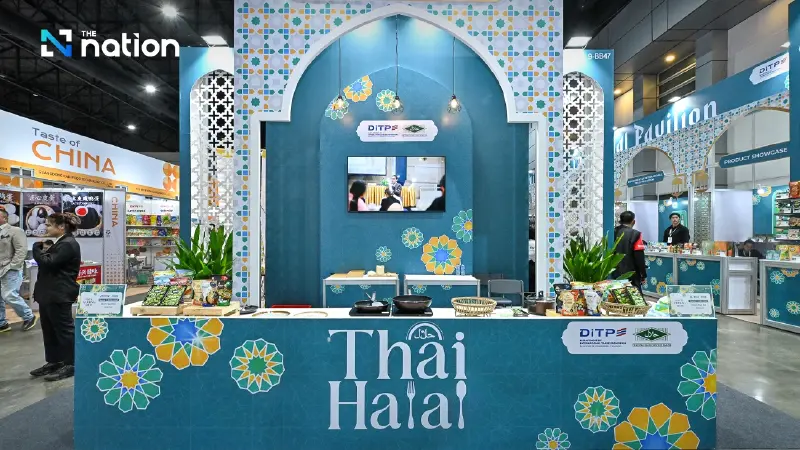
One of the more strategically significant presences on the exhibition floor was the Thai Halal Pavilion, organised by the Halal Food Division under the Office of Agricultural and Industrial Trade Promotion.
The pavilion served as a dedicated platform for 19 halal food and beverage companies drawn from Thailand's five southern border provinces — Songkhla, Satun, Pattani, Yala, and Narathiwat — with the explicit aim of connecting local entrepreneurs to international buyers and elevating them towards global market standards.
The product range on display was notably diverse, spanning processed fruit products, ready-to-eat meals, bird's nest beverages, curry pastes, Southern Thai tea powder, baked cereal snacks, and novel offerings such as sugarcane-braised mackerel and mushroom rice seasoning.

A cooking show hosted by four halal chefs drew steady crowds, demonstrating creative menus while making the commercial case for Thai halal cuisine as a vehicle for product development and value creation.
The Central Islamic Council of Thailand also operated a dedicated booth providing consultation on halal certification registration — a practical acknowledgement that for smaller producers, navigating certification remains one of the most consequential steps towards international trade.

A market redefining itself
The halal story at THAIFEX was not merely one of scale but of sophistication. Industry analysts tracking the sector have identified five trends reshaping the halal food and beverage landscape in 2026.
Conscious Halal—sometimes described as "halal-proof"—places transparency at the forefront, requiring brands to demonstrate their entire supply chain, from farm to table, rather than simply displaying a certification logo.
Health-Led Halal is responding to rising rates of lifestyle diseases across Muslim-majority markets, driving demand for low-sugar, organic, and functional products aligned with the Islamic concept of Tayyib, meaning pure, wholesome, and ethical.
Mainstream inclusivity is another force at work. Halal products are increasingly appearing on menus and retail shelves alongside vegan and gluten-free options, attracting non-Muslim consumers who associate halal certification with hygiene, ethical sourcing, and quality control.
In Thailand specifically, the halal economy is receiving further momentum from high-spending tourists from the Middle East, prompting local food brands to adapt their menus while maintaining rigorous certification standards.
Hyper-convenience rounds out the picture, as urbanisation and fast-paced lifestyles fuel demand for ready-to-eat and delivery-friendly halal meals.
The exhibition floor reflected all of these shifts. The halal pavilion in Hall 9 was among the most visited on the opening day, with visitors from multiple countries sampling products and exploring business opportunities.
The presence of a Macau pavilion prominently displaying halal logos illustrated how the certification has spread well beyond its traditional geographic heartland.

Regional competition and cooperation
Thailand is not alone in recognising the commercial significance of the halal sector. Malaysia arrived at THAIFEX – Anuga Asia 2026 with 159 companies spanning processed food, halal-certified products, frozen and ready-to-eat items, health and wellness products, and food technology – one of the largest national delegations at the event.
Dato' Wan Zaidi Wan Abdullah, Malaysia's Ambassador to Thailand, described the bilateral trade relationship as a strategic priority, noting that total trade between the two countries rose 28.5 per cent in the first quarter of 2026 to US$7.9 billion.
Malaysia used its presence at THAIFEX to promote MIHAS 2026, the world's largest halal trade exhibition, scheduled for 23 to 26 September in Kuala Lumpur, where AI-powered business-matching systems and smart trade facilitation tools are expected to generate approximately US$1.13 billion in trade value.
The competitive dynamic between Southeast Asia's halal producers is, however, as much complementary as it is rivalrous. Supply chains across the region are deeply integrated, and the growth of the global halal market — a market now far too large to be served by any single country — creates space for multiple players to expand simultaneously.

Standards, trust, and the road ahead
For all its momentum, the halal industry continues to face structural challenges. Variations in certification standards across markets add compliance complexity for exporters, while building robust halal supply chains requires sustained investment in logistics, research, and specialist expertise.
These constraints make platforms such as THAIFEX – Anuga Asia particularly valuable — not only as trade venues but also as spaces where certification bodies, producers, buyers, and policymakers can align on standards and build the cross-border relationships that underpin credible, scalable halal commerce.
For Thailand, the message from this year's exhibition is clear: the country's halal food sector, long anchored in the cultural and agricultural strengths of its southern provinces, is ready to be taken seriously on the world stage.
