
Five Chinese AI campuses combining research and opportunity
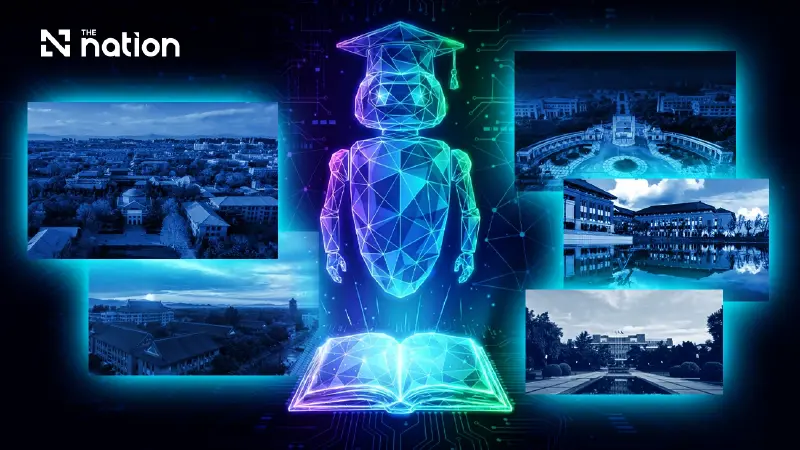


Five Chinese universities stand out in AI and computer science, with annual tuition ranging widely and scholarships available to overseas students
- Tsinghua University and Peking University, both in Beijing, are highlighted for their top global rankings and strong research bases in AI and computer science.
- Shanghai Jiao Tong University is noted for its high rankings in computer science and robotics, with a focus on combining technology with industrial applications.
- Zhejiang University leverages its location in the tech hub of Hangzhou and is ranked fourth worldwide for its artificial intelligence program.
- The University of Science and Technology of China (USTC) is distinguished by its emphasis on fundamental science and in-depth research to underpin long-term AI development.
Artificial intelligence is reshaping not only the way people work but also international competition in research, chip manufacturing, robotics, automation and generative AI.
China is moving rapidly towards the forefront of this competition. Rather than serving only as a technology user, the country is developing its own AI models, research, patents, workforce and industrial ecosystem.
For Thai students, studying AI in China offers more than potentially competitive tuition fees. It also provides access to one of the world’s largest technology ecosystems, supported by universities with growing reputations in AI and computer science.
China advances in AI research and patents
The Stanford AI Index Report 2026 identified China as the leader in the volume of AI research publications, citations and patents, while the United States remained ahead in developing notable frontier models.
US institutions produced 59 notable AI models in 2025, compared with 35 from China.
However, the performance gap between leading models from the two countries has narrowed. As of March 2026, the top US model led its Chinese counterpart by 2.7%, while models from the two countries had exchanged the leading position several times since early 2025.
Figures released by the World Intellectual Property Organization (WIPO) in July 2026 also showed rapid growth in generative-AI patent activity.
The number of published generative-AI patent families worldwide rose from about 14,000 in 2023 to more than 37,800 in 2025.
Inventors based in China published more than 43,000 generative-AI patent families during 2024 and 2025, while six of the world’s 10 largest generative-AI patent applicants were from China.
Studying AI in China therefore places students within a wider technology environment that includes companies such as Baidu, Tencent, Alibaba, ByteDance and DeepSeek, alongside extensive research and industrial infrastructure.
Five Chinese universities prominent in AI
At least five Chinese universities stand out for their work in AI, computer science, machine learning, robotics and automation.
1. Tsinghua University in Beijing

Tsinghua University is one of China’s leading institutions for technology and engineering, with strengths spanning computer science, artificial intelligence, machine learning and robotics.
The 2025 ShanghaiRanking Global Ranking of Academic Subjects placed Tsinghua second worldwide in both artificial intelligence and computer science and engineering, reflecting its strong technology research base.
2. Peking University in Beijing

Peking University is recognised for computer science, algorithms, fundamental research and disciplines connected to artificial intelligence.
Its artificial intelligence and computer science and engineering disciplines appeared in the 2025 ShanghaiRanking, while robotic science and engineering was ranked 12th worldwide.
The university’s School of Computer Science offers programmes in English for international students. Information for the 2026 academic year listed annual tuition of 50,000 yuan for its English-language master’s and doctoral programmes.
3. Shanghai Jiao Tong University in Shanghai

Shanghai Jiao Tong University (SJTU) combines technology with engineering and industrial applications in fields including computer science, robotics, control systems and manufacturing technology.
The 2025 ShanghaiRanking placed SJTU fifth worldwide in computer science and engineering and sixth in robotic science and engineering. Artificial intelligence was also among its ranked subjects.
4. Zhejiang University in Hangzhou

Zhejiang University benefits both from its academic strengths and its location in Hangzhou, one of China’s major centres for technology and the digital economy.
The university has strong programmes in AI, computer science, automation and intelligent manufacturing. Its artificial intelligence discipline was ranked fourth worldwide by ShanghaiRanking in 2025.
Its English-taught Professional Artificial Intelligence programme was listed as a three-year course for the 2026 academic year, with annual tuition of 36,800 yuan.
5. University of Science and Technology of China in Hefei

The University of Science and Technology of China (USTC) has strengths in fundamental science, computer science, advanced technology and in-depth research.
It may appeal particularly to students seeking careers in research and development or planning to pursue doctoral study.
USTC differs from institutions that focus more directly on industrial connections, placing greater emphasis on developing advanced knowledge and research that can underpin long-term progress in AI.
AI tuition varies between programmes
The commonly cited range of 30,000 to 50,000 yuan per year applies only to certain programmes and should not be regarded as a standard rate across every university.
Examples from the 2026 academic year include:
- Tsinghua University’s Master’s Programme in Advanced Computing at 39,000 yuan per year.
- Tsinghua University’s doctoral programme in Computer Science and Technology at 40,000 yuan per year.
- Zhejiang University’s Professional Artificial Intelligence programme at 36,800 yuan per year.
- Peking University’s English-taught master’s programme in computer science at 50,000 yuan per year.
- Some general international programmes at Shanghai Jiao Tong University at 24,800 yuan per year, while programmes at its Global Institute of Future Technology cost as much as 120,000 yuan annually.
Using an approximate rate of 5 baht to one yuan, tuition of 30,000 to 50,000 yuan is equivalent to about 150,000–250,000 baht per year.
International and specialised programmes can cost considerably more. Applicants should therefore check the fees for their chosen course rather than relying on a university-wide average.
Scholarships cover more than tuition
Scholarships for international students are another feature of studying in China. Options include the Chinese Government Scholarship, commonly known as the CSC scholarship, local-government funding and university scholarships.
Peking University offered international graduate students three main scholarship options for 2026:
- Chinese Government Scholarship
- Beijing Government Scholarship
- Peking University Scholarship
Benefits vary between scholarships. Some fully funded awards cover tuition, accommodation, monthly living expenses and health insurance, while others pay only tuition or part of the total cost.
Students with strong academic records and competitive applications may therefore pay significantly less than the published programme fees.
Applications require early preparation
Application periods at leading Chinese universities often begin earlier than prospective students expect.
For Peking University’s 2026 international master’s and doctoral intake, the main application period ran from October 20 to December 23, 2025. Applications for its English-taught computer science programme remained open until January 10, 2026.
Students planning to enrol in 2027 should begin monitoring official university announcements from late 2026. Deadlines differ between institutions and individual programmes.
What Thai students should prepare
Applications for AI and computer-science programmes at leading universities are not based solely on grade-point averages. Universities also assess academic foundations and research potential.
Applicants should prepare in at least four areas.
The first is academic performance, particularly in mathematics, computer science, physics, statistics and subjects connected with the chosen programme.
The second is programming ability, including experience with Python, C, C++ or other relevant languages. Projects, portfolios, GitHub work and technology competitions may also support an application.
The third is language proficiency. Chinese-taught programmes may require HSK results, while English-language courses may set different TOEFL or IELTS requirements.
For Peking University’s 2026 intake, Chinese-taught science programmes required an HSK 6 score above 200. Its English-taught computer-science programme generally required a TOEFL iBT score of at least 100 or another form of accepted language evidence.
The final area includes the personal statement, research plan and recommendation letters. These carry particular weight in master’s and doctoral applications because they demonstrate applicants’ research readiness and academic objectives.
From the classroom to global AI competition
China’s development in AI is changing the factors students may consider when choosing a university. The decision now extends beyond institutional reputation and tuition to the wider ecosystem in which students will study.
Tsinghua University and Peking University are connected with Beijing’s extensive research and technology base. Shanghai Jiao Tong University is located within Shanghai’s business and industrial centre, while Zhejiang University is based in Hangzhou, an important Chinese technology hub.
USTC, meanwhile, provides a strong foundation for advanced research in Hefei.
With China competing with the United States in AI research, patents, language models and industrial applications, studying AI in the country may provide more than a degree from a leading university. It could also give students direct exposure to a technology ecosystem likely to influence the global economy over the coming decade.
Source: Thansettakij
