
Thailand data-centre boom raises wider clean-power challenge
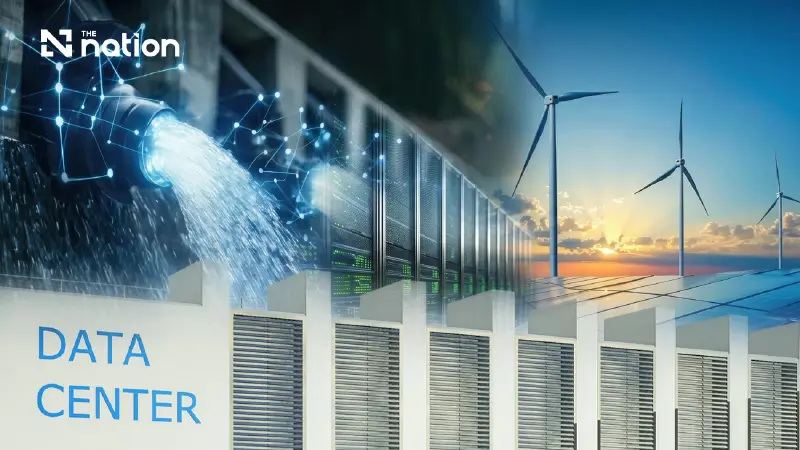


Thailand’s data-centre boom needs stronger water, energy and waste infrastructure, while clean power must remain accessible to manufacturers, SMEs and communities.
- Thailand's drive to attract data centres is creating a significant challenge, as their high demand for clean power and water competes with the needs of other industries and communities.
- Experts warn of a potential "green squeeze", where new data centres could consume the limited supply of renewable energy, hindering the ability of other businesses to decarbonise.
- Managing the environmental impact requires stronger infrastructure for water recycling and waste management, supported by clear government regulation to ensure benefits are shared across the economy.
- There is a call to ensure wider access to renewable power, preventing large tech firms from monopolising it and enabling small and medium-sized enterprises to also decarbonise.
Thailand’s drive to attract data-centre and artificial intelligence investment could bring major economic and technological opportunities, but speakers warned that growth must be matched by stronger water, energy and waste infrastructure, clear regulation and wider access to clean power.
Speaking during the roundtable discussion “Sustainable Thailand: No Choice Left—Ready to Stay in the Game?”, hosted by The Nation on Tuesday (September 15), they highlighted the challenge of preventing large digital facilities from placing greater pressure on resources also needed by households, communities, manufacturers and smaller businesses, while ensuring the technology and infrastructure built around them create broader benefits for Thailand.

Managing the environmental impact of data centres
Jerome Le Borgne, Country Representative for Veolia in Thailand, described data centres as having two sides: they consume large amounts of water and electricity but can also create technological capabilities that benefit the wider economy.
“On one side, you have an asset which is hungry for water and power, but on the other side, you have an asset that will transform power into intelligence, intelligence that can then be used for good, for sustainability purposes,” Le Borgne explained.
The central question, he argued, is whether Thailand can build the infrastructure needed to accommodate such facilities without transferring their environmental costs to surrounding communities.
“It’s all about managing the environmental impact when it comes to data centres. It’s about managing the impact on water, energy and communities. There are a lot of promises, but we need to regulate,” he noted.
Le Borgne pointed to projects involving recycled municipal wastewater as an alternative to drawing additional water directly from rivers or groundwater. Better water quality and cooling technologies could also reduce consumption, while heat generated by data centres could potentially be recovered for other uses.
Such solutions depend, however, on infrastructure already being available. Areas without adequate wastewater collection, treatment and recycling systems would have fewer options for reducing freshwater demand.
This becomes particularly important during drought, when water must be shared among households, agriculture, manufacturing, petrochemicals and data centres.
“There’s really a need to look at environmental security as a licence to operate. This licence to operate should be there for industries and for cities in order to guarantee an environment in which normality can be maintained,” Le Borgne added.
Data centres will also create another environmental challenge as servers and chips reach the end of their useful lives. Le Borgne warned that this future waste stream would contain both valuable minerals and hazardous materials, requiring compliant treatment and recovery infrastructure.

Energy efficiency becomes a key constraint
KK Chong, Head of Sustainability, Delta Electronics Thailand PCL, placed energy efficiency at the centre of the discussion, arguing that rising computing demand must be considered in the wider context of emissions and the climate crisis.
“Efficient energy consumption, regardless of whether it is because of climate change or the cost of running a business, is crucial. That alone is also the single most challenging bottleneck right now as far as carbon emissions are concerned,” Chong explained.
For data centres, he argued, concerns over water management and environmental impact ultimately come back to how efficiently electricity is consumed and how clean that electricity is.
“When we talk about the single most important thing we can do to mitigate climate change, again, I think it is the energy issue — clean energy itself. The largest source of emissions is energy use,” he added.
Chong said improved power technology could reduce energy losses, but technology alone would not resolve the environmental pressures created by rapid digital expansion. Government policy and private-sector action would have to develop together.

Avoiding a clean-power squeeze
Martin Venzky Stalling, Chair of the JFCCT Sustainable Development Committee, warned that Thailand must consider the needs of industries beyond data centres as electricity demand rises.
“We don’t have enough green energy at the moment. There might be more with the new Power Development Plan. Other industries also need to decarbonise, and so they need to be able to access green energy,” Stalling stressed.
Without sufficient additional clean-power supply, rapid expansion by large electricity users could create what he described as a “green squeeze”, making it harder for manufacturers and other businesses to cut their own emissions.
Stalling argued that a more decentralised energy sector could help, while clearer and better-connected policies would give businesses greater certainty when investing. Predictable regulation could encourage rather than discourage companies seeking to improve their environmental performance, he added.
He also urged Thailand to look beyond the physical presence of data centres and ask what the country would gain from the artificial intelligence and computing capacity they support.
“Can we use AI, can we use algorithms in agriculture, in different sectors, in energy management? Can we actually capture the upside from AI to also make our companies more efficient and sustainable?” Stalling asked.
That would require collaboration among technology companies, established businesses, start-ups and other industries so that digital investment improves productivity and sustainability across the economy rather than benefiting data-centre operators alone.
Le Borgne similarly argued that access to renewable electricity should not be concentrated among major technology investors. Direct power purchase mechanisms, he noted, could support decarbonisation across a much broader range of industries.
Small and medium-sized enterprises are particularly exposed because many depend on the electricity available through the grid and have limited control over its source.
“SMEs today do not control exactly where they buy their power. They are dependent on the grid to which they are connected. If you want them to be capable of decarbonising, the ability to procure renewable power is important,” Le Borgne explained.

Ensuring Thailand captures the benefits
Niamh Collier-Smith, United Nations Development Programme (UNDP) Resident Representative in Thailand, urged policymakers to avoid viewing data centres from an extractive perspective in which investment primarily consumes land, water and other resources.
Instead, she called for an investment framework designed to produce benefits beyond the immediate sites and communities hosting the facilities.
“With the right regulation, with the right investment in innovation, we need to ensure that both the communities immediately around data centres and Thailand more broadly benefit from the innovation that they could bring,” Collier-Smith explained.
That means evaluating data-centre investment not only by the amount of capital entering Thailand or the computing capacity created, but also by whether it supports innovation, environmental infrastructure and opportunities for the wider economy.
“Setting up the regulations, setting up that governance framework to support that would be absolutely key. And that is literally the question at the forefront of the minds of those in the space of AI and digitalisation,” she added.
Chong agreed that responsibility could not rest entirely on regulation or technology, calling for sustained cooperation between policymakers and industry.
“Legislation is important, of course, but the private sector and government have to work hand-in-hand. It doesn’t work if you have good legislation and expect things to be ideal, and neither does it if you have fantastic technology,” he noted.
For Thailand, the debate is therefore not simply about whether to welcome more data centres. The larger question is whether their growth can accelerate investment in water recycling, efficient energy systems, renewable electricity and waste recovery while ensuring households, manufacturers, SMEs and communities are not left competing for increasingly constrained resources.
If those conditions are built into planning from the outset, speakers argued, data-centre development could become more than a new source of demand for power and water. It could help Thailand build cleaner infrastructure and use artificial intelligence to strengthen productivity and sustainability across the wider economy.
