
JERA and Petronas Tell Governments: Renewables Alone Cannot Fuel the 15 GW AI Data Centre Boom
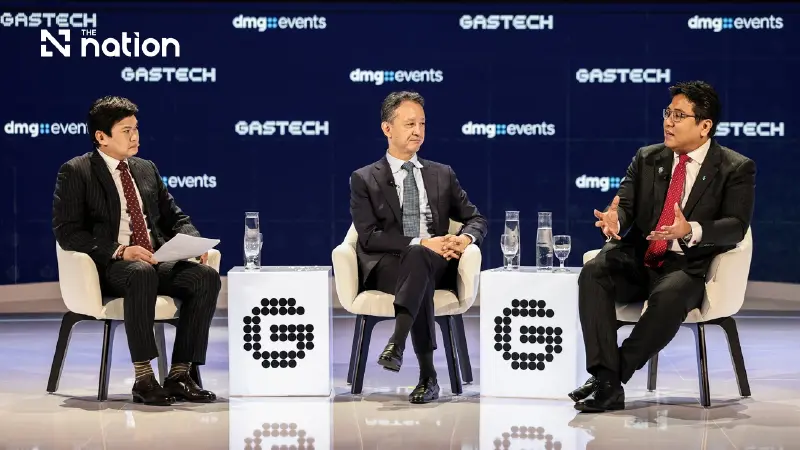


JERA's Yukio Kani and Petronas's Tengku Muhammad Taufik warn Asian policymakers that gas, not intermittent renewables, must anchor the region's AI-driven power surge
- The rise of AI is creating a massive new power demand, with Greater Tokyo alone expected to require an additional 15 gigawatts within the next decade.
- Energy leaders from JERA and Petronas argue that intermittent renewable sources alone cannot provide the reliable, 24/7 power needed to sustain this AI data center boom.
- They assert that natural gas is the only immediate and viable baseload fuel capable of keeping the grid stable amid the unprecedented power surge from AI.
- The companies are urging policymakers to adopt a pragmatic, integrated approach combining gas with carbon capture and battery storage, rather than pursuing premature fossil fuel phase-outs.
JERA's Yukio Kani and Petronas's Tengku Muhammad Taufik warn Asian policymakers that gas, not intermittent renewables, must anchor the region's AI-driven power surge.
As technology hyperscalers pour billions into Asian data centres, two of the region's biggest private energy players fired a warning shot at public grid planners on Monday (September 14): intermittent renewable energy alone cannot sustain the AI revolution.
Speaking at Gastech, JERA revealed that Greater Tokyo alone faces 15 gigawatts of new AI-related power demand within a decade, making natural gas the only immediate, round-the-clock baseload fuel capable of keeping the grid online.
Executives urged governments to fast-track integrated energy infrastructure — combining gas baseload with carbon capture and storage, battery storage and microgrids — rather than pushing for premature fossil fuel phase-outs.
The panel, Asia's Energy Century: Powering Growth in a Multi-Fuel World, was moderated by Channel News Asia business presenter Roland Lim and brought together Yukio Kani, chief executive and chairman of JERA, one of the world's largest LNG buyers, and Tengku Muhammad Taufik, president and group chief executive of Petronas, Malaysia's national oil company and a major LNG exporter.
Their message amounted to a reality check for governments and policymakers: ideological energy targets cannot override technical and economic realities, especially as artificial intelligence drives an unprecedented surge in power demand.

Debunking the "unaffordable LNG" narrative
The discussion opened on the LNG spot price spike, with benchmark prices roughly tripling over the past year, from around $10 per million British thermal units (MMBtu) to close to $30.
Kani said a single cargo now costs upwards of $100 million, against $35 million a year ago, while importing a million tonnes has risen from $500 million to $1.5 billion — a jump he called stark enough to "scare" the audience.
He warned of a difficult winter ahead, citing low European gas reserves, disruption around the Strait of Hormuz, and the scheduled end of Russian gas and LNG flows to Europe from 1 January.
But Kani pushed back hard against media coverage, describing LNG as "unaffordable". Only 30 per cent of global LNG trades on the spot market, he said, while 70 per cent is locked into long-term contracts — including JERA's own oil-linked agreements, priced at roughly $8 to $14 at Tokyo Bay.
"Many of the Japanese customers don't feel any pain during this price hike," he said, arguing the real question for buyers is finding the right balance of spot and long-term supply rather than gambling entirely on the spot market.

Taufik framed energy security around two "non-negotiable" pillars: availability and affordability.
"If it is available, but if it's not affordable, you're going to have pushback from a region that has seen three to four per cent energy demand [growth] since the beginning of this decade," he said.
The reverse scenario — affordable but unavailable — was, he said, precisely what has unfolded since a major supply disruption on 28 February, which he said had disrupted roughly a fifth of the world's LNG and a similar share of food supplies, leaving energy ecosystems "reeling".

A 65-year marriage
Both executives pointed to the JERA-Petronas relationship—spanning more than 40 years and over 13,000 delivered cargoes—as a model for the flexibility Asia's energy system now needs. The two companies recently extended their contract to 2048, taking the total relationship to 65 years.
"This is not a relationship that can only be bound by the construct of contracts, but we need long-term trust," Taufik said, describing the partnership as "practically married".
Kani said that trust was increasingly essential because renewable intermittency has made demand far more volatile. Seasonal swings between summer and winter peaks and shoulder-season troughs have sharpened in just a few years, complicating efforts to sign 20-year offtake agreements.
"We really need buyers to collaborate to make LNG contracts more flexible," he said, adding that Petronas had been "very responsible" in accommodating such requests.
No ideology, just pragmatism
Both leaders praised policymakers across Japan, Malaysia, China and South Korea for taking what Taufik called a pragmatic rather than ideology-driven approach to the energy mix, resisting pressure to force what he termed "fuel idealism".
JERA and Petronas are jointly expanding into cross-border carbon capture and storage, blue and green ammonia co-firing, biofuels, battery storage and microgrids — while insisting that natural gas remains the baseload backbone.
"Our true outcomes are long-term stability and reliability," Taufik said. "I think natural gas is just going to be a staple of baseload."

The AI power surge
Turning to data centres, Kani said Japan was Asia's biggest AI hub outside China, with 70 per cent of national data centre demand concentrated in Greater Tokyo — JERA's core franchise area — where an estimated 15 gigawatts of new demand is expected within ten years.
"Gas or LNG is only the quick solution to provide 24/7 power to AI data centres," he said, adding that JERA aims to act as an integrated provider across the entire AI energy value chain, from gas pipelines and shipping to power plants and procurement.
Taufik cautioned that the AI build-out is unfolding against a backdrop of pre-existing energy poverty: some 150 to 200 million people across Asia-Pacific still lack access to reliable power, even before accounting for new hyperscale demand.
He said Petronas was pursuing "holistic solutions" combining baseload gas, carbon abatement, battery storage and behind-the-meter microgrids, alongside pressure on the tech sector itself to design less energy-intensive data centres and cooling systems.
"It can't be a solution from someone just like Petronas or just like JERA," he said. "Policy makers [need to address] what is the game-changing technology for this sector."
A more regionalised Asia
Asked to name an assumption about Asia's energy future likely to be proven wrong within a decade, Kani rejected any "one-size-fits-all" transition model, insisting each country must design a bespoke mix of LNG, renewables, ammonia and CCS based on local conditions.
Taufik went further, predicting Asia would become "far more regionalised" and self-sufficient over the next ten years, leaning more heavily on neighbours and long-term partners rather than global supply chains.
"There's going to be natural orientation for those with the most energy demand... to work together," he said, calling for greater pragmatism around cross-border cooperation.
