
Infineon anchors Thailand’s chip ecosystem with Samut Prakan hub
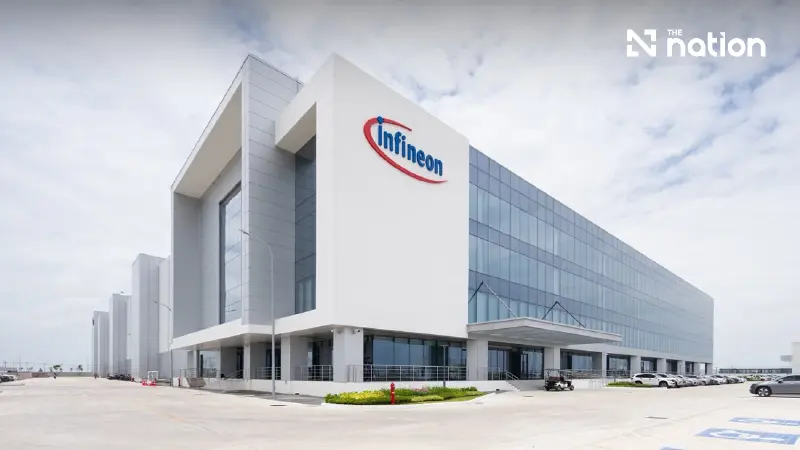


Infineon’s US$1.4 billion Samut Prakan hub combines advanced chip production, Thai talent development and long-term ecosystem growth.
- Infineon has opened a new US$1.4 billion semiconductor manufacturing hub in Samut Prakan to strengthen Thailand's chip ecosystem.
- The company is fostering local talent by collaborating with Thai universities on specialised courses and internships, with over 90% of the current staff being Thai nationals.
- The new backend facility produces chips for the automotive and industrial sectors and is designed for future expansion, with a modular structure that can grow to five times its initial size.
- This investment expands Infineon's manufacturing footprint in Southeast Asia, aiming to diversify production and improve supply-chain resilience.
Infineon Technologies AG is using its new US$1.4 billion (48 billion baht) semiconductor manufacturing hub in Samut Prakan as a long-term platform to strengthen Thailand’s semiconductor ecosystem through advanced production, local talent development and closer links with universities and industry.
The new backend facility also expands Infineon’s manufacturing footprint in Southeast Asia. Module A is the first stage of a site that can ultimately grow to five modules, while the company has secured about 200,000 square metres, or around 120 rai, of land for future expansion.

Thailand as a long-term manufacturing base
Alexander Gorski, chief operations officer of Infineon Technologies AG, highlighted Thailand’s location, industrial base and growth potential as key factors behind the company’s investment.
“What makes Bangkok such an important addition to our global manufacturing footprint is its unique combination of location and growth potential,” Gorski remarked.
Infineon also sees the site as a way to diversify production geographically, strengthen supply-chain resilience and gain greater access to fast-growing Asian markets.
“Infineon chose Thailand for its mature industrial ecosystem, strong automotive and electronics base, and established semiconductor cluster,” Gorski added.

For Wei Khoe Lim, senior vice president and managing director, the Thailand operation represents a “next-generation facility hub” that incorporates experience and lessons from Infineon’s more established manufacturing sites.
Infineon regards Thailand as an important part of its long-term manufacturing network. Lim’s editor notes describe the initial investment as “the beginning of a long-term commitment to Thailand”, with further investment, talent development and capacity expansion among the company’s priorities.

Advanced production with room to grow
The Samut Prakan plant has been built as a greenfield facility with advanced automation and a digital manufacturing backbone.
It combines cleanroom, assembly and testing capabilities with wafer testing, enabling the site to handle semiconductor backend processes and increasingly complex, high-value products for automotive, industrial and energy infrastructure applications.
Module A includes about 30,000 square metres of cleanroom space and is expected to reach full utilisation by 2027 under current production plans and demand assumptions. Further modules can be added as the market develops.
“We have built the Bangkok site with the future in mind,” Gorski noted. Starting with Module A, the facility can expand to as many as five modules, giving Infineon flexibility to increase production capacity progressively.
This phased approach also allows the plant to adapt to new technologies, changing customer requirements and larger production volumes without requiring the entire complex to be built out at once.

Building Thailand’s semiconductor workforce
Infineon is pairing its manufacturing investment with efforts to develop local semiconductor skills.
The operation currently employs about 350 people, more than 90% of whom are Thai nationals. Around 80% of the workforce consists of skilled engineers and technicians. A small group of expatriates from Malaysia, Singapore and Germany is supporting the initial phase, with their roles expected to transition gradually to local teams.
The company is collaborating with seven Thai universities to strengthen the local talent pipeline and has provided opportunities for around 150 interns to gain exposure to semiconductor technologies and industry experience.
Its wider ecosystem work includes cooperation with the Thai Semiconductor Industry Association and local universities on plans to develop at least 60 specialised semiconductor courses, train 1,100 undergraduate students and support 18 joint research and development projects in areas including process automation, big data and materials engineering.

Preparing for rising semiconductor demand
The investment comes as semiconductor demand continues to grow across data centres, electric vehicles and industrial applications, with chips becoming increasingly important across a broader range of sectors.
The Samut Prakan operation is designed to support both existing and future demand, while its modular structure gives Infineon room to add production capacity as market conditions and customer needs evolve.
The facility will manufacture semiconductor solutions for automotive, industrial and energy infrastructure applications, linking the Thailand operation with technologies supporting electrification, energy efficiency and digitalisation worldwide.

Sustainability built into the site
Sustainability measures have also been incorporated into the facility from the outset.
The Samut Prakan site operates on 100% green electricity and includes water recycling and rainwater collection systems, as well as solar modules that generate renewable energy on site. Infineon says these measures support more resource-efficient manufacturing and its efforts to reduce the carbon footprint of its wider value chain.
Together, the manufacturing investment, talent programmes and expansion plans give Infineon a platform to grow its long-term presence in Thailand while contributing to the development of the country’s semiconductor skills and industrial capabilities.
