
Go Without AI Once a Week, Tech Adviser Tells IMF Audience in Bangkok
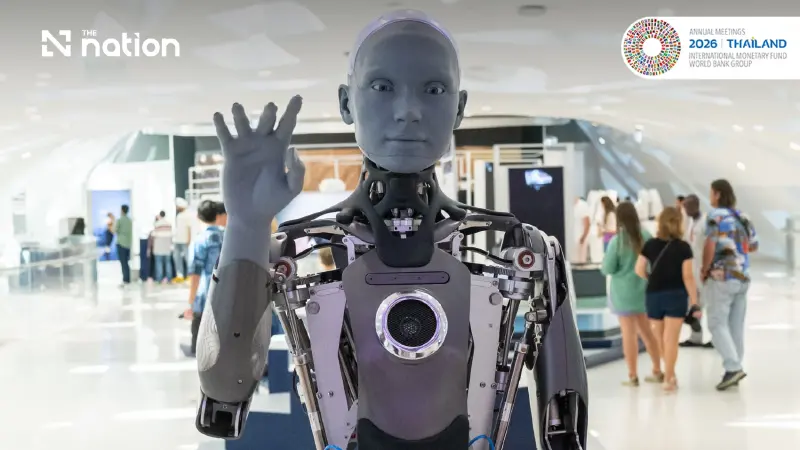


Dr Ayesha Khanna tells IMF Inspired that people need AI-free practice to keep core skills, alongside people-first business plans and national AI strategies
- Tech adviser Dr Ayesha Khanna recommends that people practice "AI fasting" by completely avoiding artificial intelligence at least one day per week.
- The primary purpose of this practice is to preserve essential human skills and ensure people can still function effectively in the event of a technology failure or cyber-attack.
- Khanna warns that over-reliance on AI is particularly risky for students, who may retain less information, and for critical professions like medicine and policing.
- She also suggests that companies should maintain a small, AI-free team to safeguard operational knowledge and capabilities against system failures.
Dr Ayesha Khanna tells IMF Inspired that people need AI-free practice to keep core skills, alongside people-first business plans and national AI strategies.
Everyone should go without artificial intelligence at least once a week to keep the basic skills needed to work if the technology fails, the AI entrepreneur Dr Ayesha Khanna told an IMF audience on the opening day of the IMF-World Bank Annual Meetings.
"There's this concept of AI fasting, which we should all be doing," said Dr Khanna, co-founder and chief executive of the AI advisory firm Addo. "You've got to not use AI once a week at all. I know it's hard. It's hard for me too."
She was speaking at "AI: Unlocking Our Human Potential", the first session of the IMF's IMF Inspired series, which showcases women entrepreneurs, activists and thought leaders. The meetings run until 18 October. Sabina Bhatia, director of the IMF's Corporate Services and Facilities Department, put the questions.
Keeping skills alive Dr Khanna said the habit matters most in professions where mistakes are costly, such as policing, immigration, counter-terrorism and medicine.
She predicted that large companies will eventually keep a small team, a "Navy Seal or commando equivalent", that is never exposed to AI. That would preserve the skills needed to operate in the event of a cyber attack or a failure of critical infrastructure.
"You have to have some analogue," she said, pointing to a surgeon who has forgotten key steps because a machine usually supplies them.
Teaching people to think
The same concern, she said, applies to young people. Research she cited suggests students who use AI to do their homework score about a quarter worse in exams, because they do not retain what they have learned.
Education systems must teach students to work with AI and to think for themselves, she said, calling the current gap "very unfair on young people".
She cited Carnegie Mellon University, which she said has received $1 billion from the financier Kenneth Griffin and is organising teaching around problems such as climate change and poverty rather than subjects, while still covering foundational theory. Chatbots, she warned, tend to agree with their users.
"It's agreeing with you, which means it's taking you down your biases and rabbit holes," she said.
Students should practise questioning AI and spotting when it is wrong, she said, and should also hold discussions with teachers and classmates without AI.
Protecting workers, not just jobs
Bhatia noted that new work from the IMF's Asia and Pacific Department showed employer demand falling in the occupations most exposed to AI, while demand for AI skills was rising.
Dr Khanna said chief executives she meets "don't want to fire people". What they do not want, she said, is someone "resistant to experimenting with AI".
She said about 85 per cent of job postings now include some AI requirement. She held up Singapore as a model, recalling Prime Minister Lawrence Wong's remark in May that "we can't protect every job, but we can protect every worker".
The city-state offers free courses and a personal "skills passport", she said, and subsidises firms that hire and retrain people over 40, covering up to 70 per cent of salary, up to a limit.
It also gives grants, which she put at $400 million, to help companies redesign their work. Courses alone are not enough, she argued, when workers over 40 have mortgages, children and elderly parents. "Till you have this trifecta," she said, companies will not be ready to absorb people.
Why a Copilot for everyone fails
For business, Dr Khanna said giving every employee an AI assistant and hoping the organisation transforms is "a disaster". Staff feel productive because they have summarised a document or drafted an email, she said, but margins and customer numbers do not move.
She advised leaders to pick three to five workflows that matter most, such as wealth management for banks or order backlogs for manufacturers, and to track six to eight metrics.
She also urged them to drop the term "use cases", which she called "very 2025".
Transformation is too often treated as an IT project, she said, leaving out human resources and communications, and vague advice to staff to "be more human" is "confusing and makes people nervous".
National strategies and "digital colonialism"
On fears of a digital divide, Dr Khanna rejected the idea that governments in emerging markets are falling behind.
"No country is in the mood to be left behind," she said.
Governments, she said, were focused on "AI sovereignty", meaning options rather than building everything from scratch.
They can choose American, Chinese or European models, or fine-tune their own as India is doing, while keeping data in local data centres and securing computing capacity.
Korea and Vietnam are setting up "AI factories" on Nvidia chips, she said, and Korea is considering making its own. The aim is to avoid "digital colonialism": if everyone uses AI built abroad, she warned, people start to write and think like its makers.
"Countries want their own culture to be reflected," she said. Attitudes differ across Asia, she added.
In wealthier, ageing societies such as Singapore and Japan, people are anxious. In Thailand, the Philippines, Vietnam and Malaysia, she said, there is "a great deal of enthusiasm and optimism" because AI is seen as a route to social mobility.
She cited an Indian tool that uses AI to flag possible tumours in lung X-rays, saying it identified about 20 people who might have cancer after screening 100,000 scans. "
We don't value the time of people who are not rich," she said.
Women and the risk of being pigeonholed
Dr Khanna said women are often more cautious adopters of AI and are frequently steered towards risk management and governance, while investment, strategy and infrastructure decisions go to others.
"There's nothing wrong with that," she said of the focus on ethics, "but this is dangerous for us."
Many women, she added, said they lacked time for free employer courses because of caring duties. She called for governments and companies to give women, and other disadvantaged groups, dedicated time during the working day to learn new skills.
How worried should we be?
Asked to rate her own concern from one to ten, Dr Khanna said it depended on her audience. If leaders believe AI means only autonomous agents and large language models,
"I'm worried at an eight." If they use the right kind of AI for each job, with security controls in place, she would be much lower. "We humans are the villains and the heroes of the story," she said.
She cited Air New Zealand, which uses generative AI for tasks such as designing uniforms and cutting food waste, but not for deciding whether an aircraft meets maintenance requirements. For those decisions, it uses traditional machine learning, which is far less risky.
Her advice was to use a simpler model where possible, set risk thresholds and run powerful systems in sandboxes. She also called for a slowdown in AI building its own successors and for limits on AI agents communicating with each other.
She closed by calling for a wider debate that includes philosophers, anthropologists and sociologists, "not just technologists, economists". People must stay in charge, she said: "We set its limits, and we can stop it with a kill switch."
Bhatia ended the session by saying AI "is not simply a technology story. It's a story about our future."
