
EGAT and IAEA chart Thailand's route to small nuclear reactors
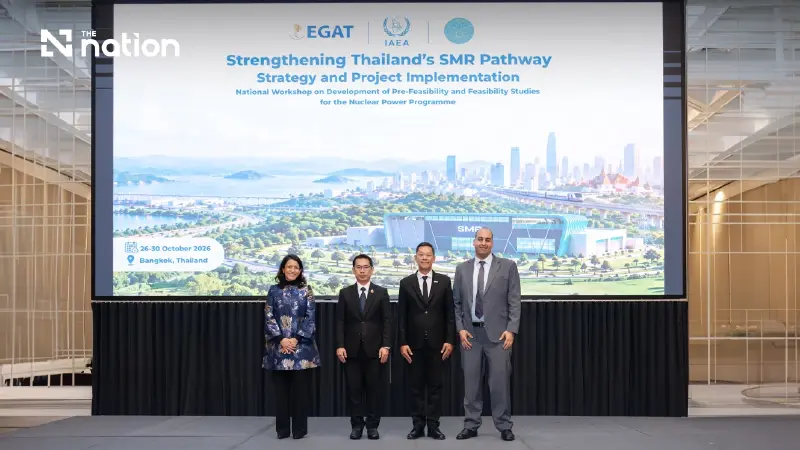


A Bangkok EGAT-IAEA workshop is building Thailand's SMR expertise as draft PDP2026 targets a 300MW nuclear plant by 2037 and 9,000MW by 2050.
- Thailand's electricity authority (EGAT) and the International Atomic Energy Agency (IAEA) are collaborating to develop a strategy for the country's potential adoption of small modular reactors (SMRs).
- A draft national power plan outlines a goal for the first 300-megawatt SMR to be operational by 2037, aiming to provide a stable, low-carbon energy source.
- Thailand is currently in an early preparatory stage, conducting feasibility studies on potential sites, reactor technologies, costs, and regulatory needs before making a final commitment to nuclear power.
As Thailand joins a growing global race to develop small modular reactors (SMRs), the “Strengthening Thailand’s SMR Pathway: Strategy and Project Implementation” workshop opened in Bangkok on Monday (October 26), bringing Thai energy agencies and international specialists together to prepare for a transition to cleaner electricity.
The workshop, organised by the Electricity Generating Authority of Thailand (EGAT) in cooperation with the International Atomic Energy Agency (IAEA) under a technical cooperation project, focuses on early-stage project studies and the expertise needed before Thailand can decide whether to proceed with nuclear power.
The draft Power Development Plan 2026 (PDP2026) envisages a first 300-megawatt (MW) SMR entering service by 2037, with total SMR capacity potentially reaching 9,000MW by 2050. Such plants could provide a steady source of low-carbon electricity to complement solar and wind power, improve energy security and support emissions reduction.
For now, however, Thailand remains in the preparatory stage, with potential sites, reactor technologies, costs and regulatory requirements still under review.

Energy ministry sees SMRs as a strategic option
Dr Sompop Pattanariyankool, deputy permanent secretary at the Ministry of Energy, who opened the workshop, linked interest in SMRs to the wider challenge of securing reliable, affordable electricity while maintaining economic competitiveness and meeting climate commitments.
He described SMRs as an option for strengthening long-term energy security and supporting economic growth, while emphasising the need for further assessments before any decision on their deployment.
“We are committed to ensuring that Thailand systematically develops the knowledge, institutions, and capacity necessary to evaluate all appropriate energy options and make informed decisions for future generations.”
Sompop explained that the Ministry of Energy would provide policy direction and help develop the workforce, regulatory capabilities, infrastructure and international partnerships required for any future nuclear power programme.
He also identified stakeholder participation and public trust as essential, particularly given the safety and environmental responsibilities associated with nuclear power.
“Any future consideration of nuclear power must be guided by the highest standards of safety, security, safeguards, environmental responsibility, and public confidence.”
The ministry’s priority, he indicated, is to ensure Thailand has a sound basis for deciding whether SMRs can deliver the anticipated energy and economic benefits.

EGAT assesses sites, technology and workforce readiness
Siriwat Chedsi, EGAT’s deputy governor for power plant development and renewable energy, outlined the practical preparations under way as the utility works towards the draft plan’s 2037 target.
EGAT is undertaking preliminary feasibility work, examining potential sites and studying reactor technologies and project costs. Siriwat explained that locations would need to meet strict technical and natural-hazard criteria, while existing transmission infrastructure and water resources could help support suitable projects.
The utility is considering technology from different suppliers, with an emphasis on proven designs, particularly light-water reactors. It is also building on more than 50 years of experience operating conventional power plants while developing the specialist capabilities required for nuclear operations.
“Building knowledge, developing skilled personnel, and strengthening our capability are fundamental steps toward understanding both the opportunities and challenges associated with future SMR deployment.”
Siriwat acknowledged that early SMR projects could have relatively high construction costs. However, he suggested that projected operating lives of up to 70 years and less volatile fuel costs could make the technology more competitive over the longer term.
Public communication is another priority while the utility assesses several possible locations. EGAT is continuing to explain the technology and its safety requirements to communities in potential project areas as the studies progress.
“We will pursue this endeavour with the highest commitment to nuclear safety, security, reliability, and environmental protection. These principles must remain our top priority at every stage of project development.”

IAEA expert highlights regional momentum and need for studies
Anna S Jaison, speaking on behalf of the IAEA at the workshop, placed Thailand’s preparations against the backdrop of renewed global interest in nuclear power.
She highlighted the international effort to triple nuclear generating capacity by 2050 and growing momentum in Southeast Asia. Vietnam is accelerating preparations for its first nuclear power plant, Malaysia has resumed preparatory work, and Singapore plans an initial IAEA infrastructure assessment in 2027, according to Jaison.
Nevertheless, she cautioned that nuclear power requires extensive planning, investment and public engagement.
“Nuclear power is a major and complex undertaking with significant strategic implications. It involves a high level of technical sophistication, substantial financial investments, and considerable potential impacts and benefits for society, the economy, and the environment.”
Jaison explained that pre-feasibility studies determine whether nuclear power is a realistic national option, while feasibility studies examine whether particular power plant projects can be implemented successfully. Both should identify the conditions required to maximise benefits, rather than simply produce a yes-or-no answer.
She welcomed Thailand’s preliminary self-assessment against the IAEA’s 19 nuclear infrastructure issues, while identifying further work on human resources, stakeholder involvement, sites, industrial participation, programme management and financing.
Experts from Sweden and Jordan will share practical examples during the workshop. Jaison argued that, with rigorous studies and preparation, Thailand could play an important role in Southeast Asia’s emerging nuclear energy landscape.

Workshop lays groundwork for future SMR decisions
The importance of the Bangkok workshop lies in helping Thailand move from SMR policy ambitions towards practical readiness. By drawing on IAEA guidance and international experience, Thai energy agencies can identify gaps in project feasibility, financing, workforce development, safety oversight and public engagement.
The knowledge gained will support informed decisions on whether and how SMRs could contribute to Thailand’s long-term energy security and clean-energy transition, while helping to keep safety and public confidence central to any future development.

