
Thailand seeks three-way plan to narrow China trade deficit
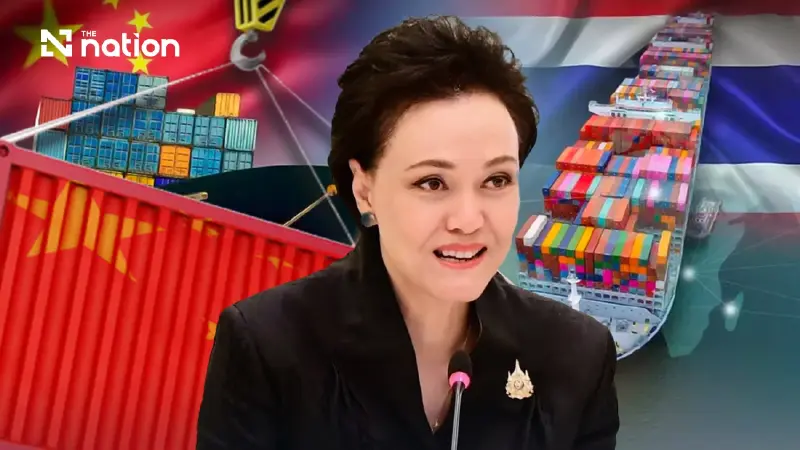


Suphajee Suthumpun wants Chinese investors to use more Thai inputs, expand SME access to Chinese e-commerce and co-invest in farm processing
- Thailand is pushing for solutions to address a massive trade deficit with China, which is projected to reach a cumulative 12.14 trillion baht over the 2016-2026 period.
- To fix the imbalance, Thailand has proposed three measures: requiring Chinese investors to use more local materials, opening Chinese e-commerce channels to Thai SMEs, and encouraging Chinese investment in Thai agricultural processing.
- China has accepted the proposals in principle but requested a transition period for companies to adjust, with both nations agreeing to form a joint working group to accelerate discussions.
- The deficit is driven by Thailand's reliance on imports of Chinese capital goods and production materials for its industries, while many Thai exports to China are lower-value agricultural products.
Thailand is pressing China for deeper use of local materials and suppliers, wider market access for Thai SMEs and investment in agricultural processing.
It seeks to reduce a trade imbalance that could reach a cumulative 12.14 trillion baht over 2016-2026.
Deputy Prime Minister and Commerce Minister Suphajee Suthumpun said Thailand had proposed a “co-creation” approach under which Chinese investment should generate more benefits inside the country rather than relying heavily on imported Chinese materials and components.
She said China was facing intense export competition and had been accused by several countries of dumping, while Thailand was dealing with low-priced imports, alleged nominee businesses and products that did not meet required standards.
Larger economies such as the United States and the European Union had stronger measures available to counter such pressures, she said.
Suphajee contrasted recent Chinese investment with the experience of Japanese carmakers, which spent decades building a domestic parts industry in Thailand.
Much of the newer electric-vehicle investment relies heavily on automation and robotics, limiting employment and local-component use despite receiving Board of Investment privileges, she said.
Three proposals to China
During bilateral talks with Chinese Vice-Premier He Lifeng on the sidelines of an APEC meeting in China in May 2026, Suphajee proposed three areas of co-operation aimed at reducing Thailand's trade deficit.
Increase local content: Chinese companies investing in Thailand should use more Thai-made raw materials and components, increasing domestic value-added, complying with rules of origin and reducing transshipment risks. Greater local content could also strengthen the ability of Thai-produced goods to enter overseas markets as products of Thailand.
Open Chinese e-commerce channels to Thai SMEs: Thailand proposed a Thai Pavilion bringing together quality, standards-compliant SME products for sale to China's consumer market of more than 1.4 billion people. The plan is intended to expand export opportunities and offset pressure from Chinese imports.
Invest in Thai agricultural processing: Chinese technology and investment could be combined with Thai agricultural raw materials to create higher-value processed products, reduce reliance on fresh produce exports and help manage phytosanitary restrictions, seasonal supply and agricultural surpluses.
China backs proposals but seeks transition period
Suphajee said China had accepted the proposals in principle, particularly agricultural processing and greater access for Thai SME products.
Chinese officials also supported increasing local content but said companies would need time to adjust and build supply chains in Thailand.
She also held talks with Chinese Commerce Minister Wang Wentao, who agreed to accelerate discussions between relevant agencies.
China's Department of Asian Affairs has been assigned to co-ordinate with Thailand on the three areas before progress is presented to the Thai-Chinese Joint Committee, which is expected to meet early next year.
Thailand does not want to wait for the Joint Committee meeting to start work, Suphajee said.
Both sides have agreed to establish a joint working group so that the meeting can review progress rather than serve as the starting point for negotiations.
Assistant Professor Dr Arm Tungnirun of Chulalongkorn University's Faculty of Law, an adviser to the deputy prime minister, has meanwhile been assigned to study China's five-year strategy to help shape Thailand's approach to the Chinese economy.
China deficit reaches US$46.22bn in first half
Nantapong Chiralerspong, director-general of the Trade Policy and Strategy Office, said Thailand recorded a US$46.22 billion trade deficit with China in the first six months of 2026, widening by US$17.63 billion from the same period a year earlier.
The widening gap was driven by imports of capital goods, intermediate products and production materials, including electrical machinery and components, mechanical machinery, chemicals, computers and parts, integrated circuits, steel and printed circuits. Thailand remains an important production base for electronics and automotive industries.
Demand for related inputs has also risen during the 2025-2026 electronics cycle and infrastructure construction linked to artificial intelligence. By contrast, many Thai exports to China are lower-value agricultural products, including fresh and chilled fruit.
Imports have grown faster than exports
International and ASEAN economics expert Ath Pisalvanich said imports had expanded faster than exports over the past decade.
In a separate trade series cited by Ath, export value increased from US$213.56 billion in 2016 to US$337.89 billion in 2025, a rise of US$124.34 billion or 58.2%. Imports increased from US$195.70 billion to US$349.74 billion, up US$154.04 billion or 78.7%.
The trade balance fluctuated between 2016 and 2020:
- 2016: surplus of US$17.86 billion
- 2017: surplus of US$10.87 billion
- 2018: deficit of US$1.18 billion
- 2019: surplus of US$5.24 billion
- 2020: surplus of US$20.66 billion
The balance then remained in deficit from 2021, starting at US$1.61 billion before widening to US$22.15 billion in 2022. The deficit narrowed to US$11.97 billion in 2023 and US$10.91 billion in 2024, before increasing to US$11.85 billion in 2025. The cumulative deficit for 2021-2025 was put at US$58.48 billion, or about 1.96 trillion baht.
Under a 2026 scenario assuming export growth of 6% and import growth of 7%, exports would rise to US$358.17 billion and imports to US$374.22 billion. That would produce a deficit of US$16.06 billion, 35.5% larger than in 2025.
If realised, 2026 would be the sixth consecutive year of deficit under that series, taking the cumulative shortfall for 2021-2026 to US$74.54 billion, or about 2.50 trillion baht.
China-specific gap could reach THB12.14tn
For China specifically, Ath estimated that Thailand would export US$41.50 billion of goods to China in 2026 while importing US$116.99 billion, producing a deficit of US$75.50 billion, or about 2.53 trillion baht, for the year.
Including the 2026 estimate, Thailand's cumulative trade deficit with China over 2016-2026 would reach US$362.37 billion, equivalent to about 12.14 trillion baht.
Ten factors behind Thailand's China trade deficit
Ath Pisalvanich identified 10 key factors behind Thailand’s continuing trade deficit with China:
- Chinese goods are cheaper than Thai products. China’s large manufacturing base lowers unit costs, while its integrated supply chain covers raw materials, components, machinery, packaging, logistics and online sales platforms. Chinese products therefore have advantages in price, variety, production speed and the launch of new products. These include electrical appliances, electronics, machinery, electric vehicles and parts, steel, chemicals, plastics, clothing, furniture and consumer goods.
- The ASEAN-China Free Trade Area (ACFTA) has reduced or eliminated import tariffs, lowering the cost of Chinese goods and making it easier for them to enter the Thai market.
- Chinese investment in Thailand increases imports of machinery and raw materials from China, particularly in electric vehicles, batteries, electrical appliances, electronics, metals, machinery, chemicals and digital industries. Some Chinese factories in Thailand import machinery, raw materials, components, technology and equipment from parent companies or suppliers in China.
- Thailand’s industrial supply chains have not developed as comprehensively as China’s. Many Thai industries remain dependent on imported machinery, technology, raw materials and components, particularly from China. As production in Thailand expands, imports of Chinese production inputs also rise.
- Enforcement of Thailand’s import standards remains insufficient, particularly for products entering through e-commerce, small parcels and online sales channels. Some goods may have problems involving quality, safety, labelling, product standards and declared prices.
- Thailand is too dependent on China for both markets and production inputs. China is an important export market and a major source of machinery, raw materials, components and higher-level finished goods, while many Thai exports to China have relatively low added value and are sensitive to changes in the Chinese economy.
- Thailand’s export structure has not kept pace with changes in China’s economy. Thai exports include agricultural products, raw materials, rubber, fruit, plastic pellets, chemicals and industrial components, while China is increasing its domestic technological and manufacturing capabilities. Thai brands, innovative products and higher-value goods have also gained limited penetration in China.
- China’s excess production capacity is being directed to overseas markets. Slower domestic economic activity and consumption have encouraged Chinese manufacturers to increase exports, while tighter tariffs, anti-dumping measures and technical requirements in the United States, European Union and other industrial economies have redirected some Chinese goods towards markets including Thailand and ASEAN.
- Thai businesses are at a disadvantage in technology, innovation and commercial platforms. Chinese companies have strengths in automation, research and development, product design, consumer data, digital marketing, payment systems and e-commerce. Thai SMEs face constraints in capital, technology, production scale, logistics costs and access to the Chinese market.
- Thailand lacks strong local-content mechanisms. Although more Chinese companies are establishing factories in Thailand, requirements to use Thai raw materials, components or domestic suppliers remain limited. If Chinese factories continue importing most production inputs from China, the value retained in Thailand may be limited to wages, land, utilities, some taxes and final assembly, while part of the revenue flows back to parent companies and suppliers in China.
Source: Bangkokbiznews
